


You have a good job. A solid group of friends. Maybe a relationship that mostly works. Nobody is actively hostile to you this week. And you are still exhausted in a way you cannot fully explain to the people who love you, in a way that does not track with anything specific enough to point to. If you have ever caught yourself thinking "nothing is really wrong, so why do I feel like this," this is for you.
There is a clinical name for what you are describing, and it is not a personal failing or a sign that you are ungrateful for a life that, on paper, looks fine. It is called minority stress, and understanding it tends to be one of the more relieving conversations a queer client can have in therapy, because it replaces "something is wrong with me" with "something real is happening to me, and it has a shape."
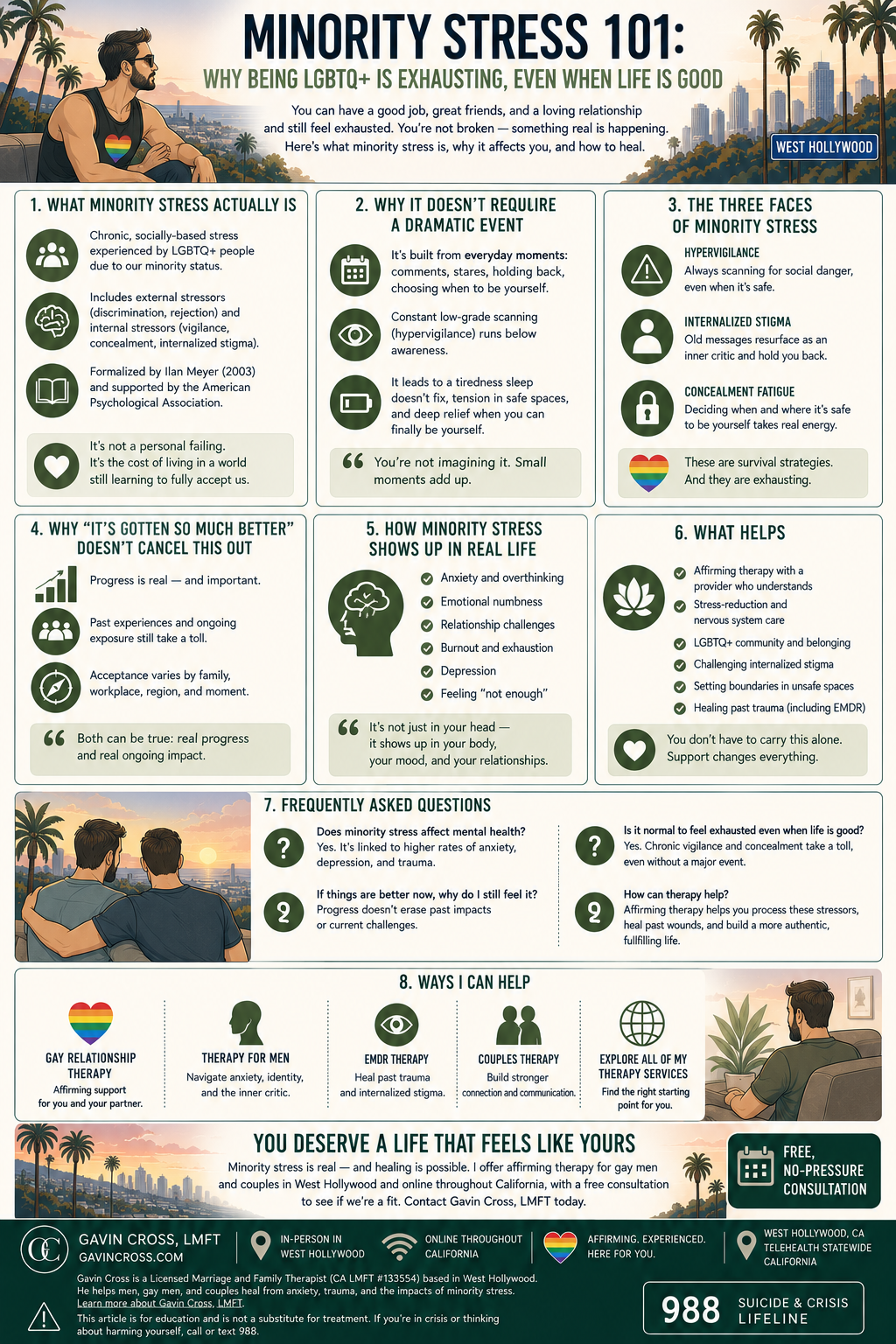
Minority stress theory was formalized by researcher Ilan Meyer in a landmark 2003 paper published in the journal Psychological Bulletin, and it remains one of the most widely cited frameworks in LGBTQ+ mental health research. The core idea: sexual and gender minorities experience chronic, socially-based stress that is additive to the ordinary stress everyone deals with, specifically because of their minority status in a society still structured around heterosexual and cisgender norms.
This stress operates on a few distinct levels. There are distal stressors, meaning external events like discrimination, rejection, or harassment. And there are proximal stressors, meaning the internal processes that develop in response to a lifetime of navigating those external threats: chronic vigilance for danger, concealment of identity in unsafe contexts, and internalized stigma absorbed from a culture that was not built with you in mind. The American Psychological Association has documented that this combination produces measurably elevated rates of anxiety, depression, and trauma among LGBTQ+ individuals compared to their heterosexual and cisgender peers, not because of anything inherent to being queer, but because of the cumulative cost of navigating a world still learning to fully hold that identity.
This is the part that trips people up. Minority stress rarely announces itself through one clear incident you can point to and say, "that is what did this." It usually works more like sediment: a comment at a family dinner you brushed off in the moment. A flicker of hesitation before deciding whether to correct a pronoun, mention a partner, or hold a hand in public. A slight recalibration of your voice, posture, or word choice walking into a new professional room. None of these individually feels like trauma. Stacked across years, they function like one.
Researchers call the constant, low-grade scanning that develops from this pattern hypervigilance, and it is exhausting precisely because it runs mostly below conscious awareness. You are not always aware you are doing it. You just notice that you are tired in a way sleep does not fix, or tense in situations that are objectively safe, or relieved in a way that feels disproportionate when you finally reach a space where you do not have to think about any of it.
Hypervigilance. A background alertness for social danger that persists even in contexts that pose no actual threat. This can look like anxiety, difficulty relaxing even in safe settings, or a kind of chronic tension that does not have an obvious trigger. If this pattern feels familiar, navigating anxiety as a gay man explores this territory in more depth.
Internalized stigma. Messages absorbed from family, religion, or culture before you had the language to question them do not simply disappear once you come out or stop hiding. They go underground and resurface as a critical internal voice, in the relationships you settle for, or in the ways you unconsciously hold yourself back from things you actually want.
Concealment fatigue. Even partial or occasional concealment, deciding moment to moment whether a given room, family gathering, or job is safe enough to be fully yourself in, takes real cognitive and emotional energy. Concealment is sometimes a genuinely necessary safety strategy, and it is also, independent of whether it is necessary, tiring in a way that compounds over time.
A common and well-meaning response queer people hear is some version of "things are so much better now than they used to be," and legally, culturally, in many respects, that is true. But minority stress research is clear that progress at a societal level does not erase the internal patterns an individual has already built up over years of navigating a less accepting environment, and it does not fully protect against ongoing exposure, since acceptance still varies enormously by family, workplace, region, and moment. A more accepting world overall does not automatically mean your particular Thanksgiving table, workplace, or hometown feels safe. Both things can be true: broad progress is real, and your nervous system's learned vigilance has not necessarily caught up with it yet.
Minority stress does not stay contained to the individual carrying it. It enters relationships too. Same-sex and queer couples often navigate mismatched levels of outness with family, differing comfort with public affection, disagreements about disclosure at work, and the shared emotional labor of moving through spaces that were not built with either partner in mind. None of this means queer relationships are more fragile. It means they carry a specific relational stress load that a culturally competent therapist should recognize rather than flattening into a generic relationship framework that assumes a heteronormative starting point. Couples therapy that understands this context tends to get to the real issue faster.
For gay and queer men specifically, minority stress often layers directly on top of the emotional suppression patterns explored in therapy for men: the pressure to perform strength, difficulty naming vulnerability, and a learned instinct to handle things alone. The intersection of gay identity and masculine socialization creates its own specific territory, one that a therapist needs genuine fluency in both areas to navigate well.
For some LGBTQ+ clients, minority stress accumulates into something that meets a clinical trauma threshold, even without a single, dramatic, easily narratable event. Family rejection stretched across years. Chronic harassment. Conversion therapy exposure. The sustained psychological cost of living closeted for an extended period. These experiences do not always fit the traditional single-incident trauma model that talk therapy alone was originally built around.
This is one of the reasons EMDR therapy is particularly well-suited to this kind of chronic, identity-based trauma. EMDR processes experience through the nervous system rather than requiring a clean verbal narrative, which matters enormously when the trauma in question is diffuse, cumulative, and does not have one clear moment to point back to. The World Health Organization and the American Psychological Association both recognize EMDR as an evidence-based trauma treatment, and it reaches material that sometimes stays just out of reach of language-based approaches alone.
Minority stress is not something willpower resolves on its own, largely because so much of it operates below conscious awareness. A few things genuinely help:
Minority stress research is not entirely bleak. Meyer's original framework, and the decades of research that followed it, also identified specific protective factors that measurably reduce its impact, which matters because it means the exhaustion described above is not simply something to endure indefinitely.
Group identification and community belonging consistently shows up as one of the strongest buffers. Feeling connected to a broader LGBTQ+ community, even loosely, appears to reduce the psychological toll of individual minority stress experiences, likely because it counters the isolating belief that you are navigating this alone. This is part of why chosen family and queer community spaces function as genuine mental health resources, not just social ones.
Identity integration matters too, meaning the degree to which your sexual or gender identity feels like a coherent, accepted part of who you are rather than a compartmentalized or conflicted piece. Identity integration tends to develop over time and with support, and it is rarely instant, particularly for people who came out later in life or who grew up in environments that were explicitly unaccepting.
A genuinely affirming social environment, including friends, family, workplace, and, importantly, a therapist, reduces the burden of constant environmental scanning. Every space where you do not have to assess your safety before being yourself is a space where your nervous system gets a real break, and those breaks accumulate into measurable relief over time.
None of these factors erase minority stress entirely, since much of it is produced by conditions outside any individual's control. But they meaningfully change how much of the weight a person has to carry alone, which is often exactly what therapy is positioned to help build.
It is a well-established framework in psychological research, formalized by Ilan Meyer in 2003 and supported by decades of subsequent research documented by bodies including the American Psychological Association. It describes a specific, additive form of chronic stress tied to minority social status, distinct from general life stress, though the two can compound each other.
Minority stress often accumulates through many small, low-intensity experiences over time rather than one clear event, and the vigilance it produces runs largely below conscious awareness. The exhaustion is real even when you cannot point to a single specific cause, and it typically reflects years of accumulated, not recent, exposure.
Yes, though not in a simple linear way. Being closeted or partially concealed carries its own specific stress load, and being fully out does not eliminate minority stress either, since ongoing exposure to microaggressions, family dynamics, and social vigilance persists across the coming-out spectrum in different forms.
Yes. Affirming therapy can address both the external stressors you are navigating and the internal patterns, hypervigilance, internalized stigma, concealment fatigue, that minority stress produces over time. For clients whose minority stress has accumulated into trauma, EMDR is often a particularly effective tool alongside traditional talk therapy.
Minority stress touches multiple areas of life, so support here is not limited to a single lane:
If you have spent years wondering why life feels heavier than it should when nothing is technically wrong, minority stress is very likely part of the answer, and it is treatable. I offer therapy for LGBTQ+ individuals in West Hollywood and online throughout California, with a free 15-minute consultation to talk through what you are carrying. Contact Gavin Cross, LMFT today.
Gavin Cross is a Licensed Marriage and Family Therapist (CA LMFT #133554) based in West Hollywood, one of the most historically significant gay communities in the country. He holds EMDRIA-approved training in EMDR and Restoration Therapy Level II certification, and specializes in affirming care for gay, queer, bisexual, transgender, and nonbinary clients. Learn more about Gavin Cross, LMFT.
There’s a big, beautiful world out there. You deserve to experience all it has to offer.
Let’s rediscover your strength.
