


Quick answer: The butterfly hug is a simple, self-administered bilateral stimulation technique from EMDR therapy: cross your arms over your chest, hands resting near your collarbones or opposite shoulders, and alternately tap left-right-left while breathing slowly and holding a calming thought in mind. It takes about three minutes, needs no equipment, and can be done sitting at a desk, in a car, or in a bathroom stall. Gavin Cross, LMFT, of Gavin Cross Therapy, teaches this and other EMDR-based self-regulation tools to clients in-person in West Hollywood, CA, and online throughout California.
1. What the Butterfly Hug Is (and Where It Comes From)
2. How to Do the Butterfly Hug: Step by Step
3. Guided Scripts for Different Situations
4. Why This Works: The Science of Bilateral Stimulation
5. What It's Good For and What It's Not
6. Pairing It with Other Tools
7. When to Bring This Into Therapy
8. Frequently Asked Questions
The butterfly hug is a form of bilateral stimulation, the same left-right, alternating input used in EMDR therapy, that you can do to yourself, with your own hands, without a therapist in the room. It was developed within EMDR humanitarian relief work in the late 1990s to help survivors of natural disasters self-soothe in the immediate aftermath of trauma, when formal sessions weren't yet possible. It has since become one of the most widely taught self-regulation tools in trauma therapy, precisely because it's simple enough to use anywhere, by anyone, without training.
You'll sometimes hear this described as "collarbone tapping," since the hands typically land near or just below the collarbones. It's the same core technique.
1. Cross your arms over your chest, so your right hand rests near your left collarbone or upper arm, and your left hand rests near your right collarbone or upper arm — hands crossed, like a self-hug.
2. Take one slow breath in and out before you start tapping, just to land in your body for a second.
3. Begin alternating taps, left hand, then right hand, at a slow, steady pace, roughly one tap per second. Keep it gentle; this isn't forceful.
4. Breathe slowly and evenly while you tap, letting your shoulders drop with each exhale.
5. Hold a calming thought, image, or phrase in mind while you continue. This is where the guided scripts below come in; the specific thought you pair with the tapping matters.
6. Continue for 1 to 3 minutes, or until you notice your breathing has slowed and the intensity of what you were feeling has measurably dropped.
7. Check in with your body before you stop. Notice how your shoulders, jaw, stomach feel, and take one more full breath before returning to whatever you were doing.
That's the entire technique. The tapping itself takes seconds to learn; what changes its effect is what you hold in mind while you do it, which is where it gets tailored to whatever you're actually dealing with.
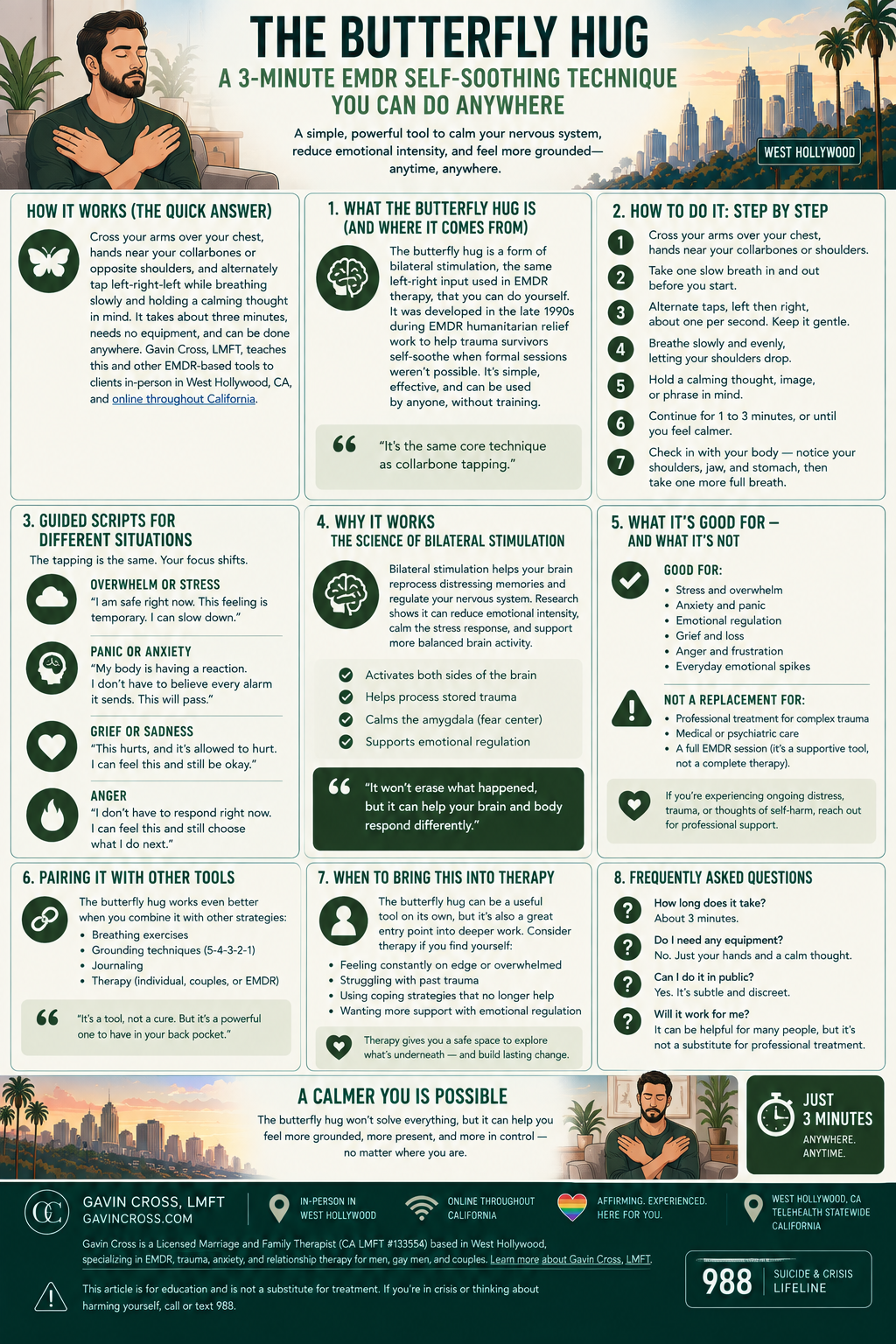
The butterfly hug isn't a one-size-fits-all script. The tapping is constant, but the internal focus should shift depending on what you're trying to regulate. Here are four common applications:
For general overwhelm or stress. As you tap, silently repeat something like: "I am safe right now. This feeling is temporary. I can slow down." Picture your shoulders and jaw softening with each tap.
For a panic or anxiety spike. Focus on your breath and body rather than the anxious thought itself: "My body is having a reaction. I don't have to believe every alarm it sends. This will pass in a few minutes." If your mind keeps pulling back to the anxious thought, that's normal, gently return focus to the tapping and your breath each time.
For grief or sadness. Rather than trying to push the feeling away, pair the tapping with acknowledgment: "This hurts, and it's allowed to hurt. I can feel this and still be okay." The goal here isn't to stop the sadness, it's to keep it from becoming unmanageable.
For anger before it becomes a problem. Use the tapping to create a pause before you act: "I don't have to respond right now. I can feel this anger and still choose what I do next." This is often most useful in the thirty seconds before a hard conversation.
Bilateral stimulation, alternating left-right sensory input is the core mechanism behind EMDR therapy, which the American Psychological Association recognizes as an effective, evidence-based treatment for PTSD. In a full clinical EMDR session, bilateral stimulation is used to help the brain reprocess specific traumatic memories. The butterfly hug borrows that same mechanism for a narrower, self-directed purpose: down-regulating an activated nervous system in the moment, rather than processing a specific memory.
EMDRIA, the EMDR International Association, notes that bilateral stimulation techniques like the butterfly hug are commonly taught as "resourcing" tools, used both inside therapy to help clients access a calmer state before deeper work, and outside therapy as a standalone self-soothing skill. It's a close cousin to other evidence-supported grounding methods, like the techniques described in the Cleveland Clinic's guide to grounding for anxiety, which similarly work by redirecting an overwhelmed nervous system's attention to a concrete, repeatable physical action.
The butterfly hug is genuinely useful for in-the-moment regulation: bringing an activated nervous system down a few notches so you can think clearly, sleep, or get through a hard hour. It's discreet enough to use at a desk, in a waiting room, or during a stressful commute, and it requires no equipment or privacy.
What it isn't is a replacement for processing the underlying source of chronic anxiety, trauma, or a recurring pattern. If you find yourself needing this tool multiple times a day, every day, that's useful information, it suggests something underneath is generating more activation than a three-minute technique can fully resolve on its own, and it's worth bringing into a full course of EMDR therapy rather than managing indefinitely with self-soothing alone.
The butterfly hug works well combined with other regulation tools rather than as a standalone fix. Some clients pair it with the four-step Restoration Therapy framework Gavin Cross, LMFT uses to work through what's driving the activation, not just soothe the activation itself. Learn more about how to regulate your emotions. It's also closely related to knee tapping, another self-administered bilateral technique covered in Strong, Successful Relationships: Unleash the Power of EMDR and Knee Tapping.
If you're using the butterfly hug as a regular coping tool for anxiety, panic, grief, or anger, it's worth having a conversation about what's underneath it. Gavin Cross, LMFT integrates EMDR into a full course of treatment for clients dealing with trauma, chronic stress, anxiety, and relationship patterns, whether in-person at his West Hollywood office or via online therapy for California residents. This is a central part of the therapy services offered, including for men, LGBTQ individuals, and couples. Learn more about Gavin Cross, LMFT, or schedule a free 15-minute consultation to talk through what ongoing support could look like.
Does the butterfly hug actually work, or is it just a placebo?
It draws on bilateral stimulation, the same mechanism used in EMDR therapy, which the APA recognizes as evidence-based for PTSD. As a standalone self-soothing tool, it's best understood as a grounding and nervous-system regulation technique rather than trauma processing on its own, which is genuinely useful for the moment, not a substitute for full treatment when that's what's needed.
How long should I do the butterfly hug for?
Most people notice a shift within one to three minutes. There's no strict rule, so continue until your breathing has slowed and the intensity has measurably dropped, then check in with your body before stopping.
Is this the same as collarbone tapping?
Yes, "collarbone tapping" is another common name for the same technique, referring to where the hands typically rest during the tapping.
Can I use this during a panic attack?
Yes, many people find it helpful during acute anxiety or panic. Focus on the physical sensation of the tapping and your breath rather than fighting the anxious thought directly.
Is the butterfly hug safe for everyone?
For most people, yes, it's a gentle self-soothing technique. If you have a trauma history involving touch or restraint, it's worth trying it first with guidance from a therapist, who can help you find a variation that feels safe.
Can I combine this with therapy I'm already in?
Absolutely. Many therapists, including Gavin Cross, LMFT, teach this as a between-session tool to complement ongoing work, particularly EMDR therapy.
Where can I learn more techniques like this?
See Strong, Successful Relationships: Unleash the Power of EMDR and Knee Tapping for a related self-regulation tool, or schedule a consultation to discuss a full course of EMDR.
Gavin Cross is a Licensed Marriage and Family Therapist (CA LMFT #133554) based in West Hollywood, providing in-person and secure telehealth therapy to clients throughout California. He holds a Restoration Therapy Level II certification and EMDRIA-approved training in EMDR, and specializes in helping men, couples, and LGBTQ+ clients heal and reconnect, whether in the office or over secure video. Learn more about Gavin Cross, LMFT.
There’s a big, beautiful world out there. You deserve to experience all it has to offer.
Let’s rediscover your strength.
