


By Gavin Cross, LMFT
You have been measuring yourself against a standard no one officially set for you. You keep moving the line. You reach a goal and the voice does not say you made it. It says you should have gotten there sooner, or that someone else did it better, or that now you need to prove you can hold it. You have been running this race since before you can remember, and the finish line has never once stayed still long enough for you to actually cross it. That voice is not the truth about you. It is a pattern that was built, and it can be changed.
This post is for men who are tired of living inside that running commentary and have started to suspect that the drive it produces is not worth the cost it extracts. You do not have to become someone who does not care about achievement or standards. You have to become someone who is no longer being managed by a voice that was never on your side in the first place.
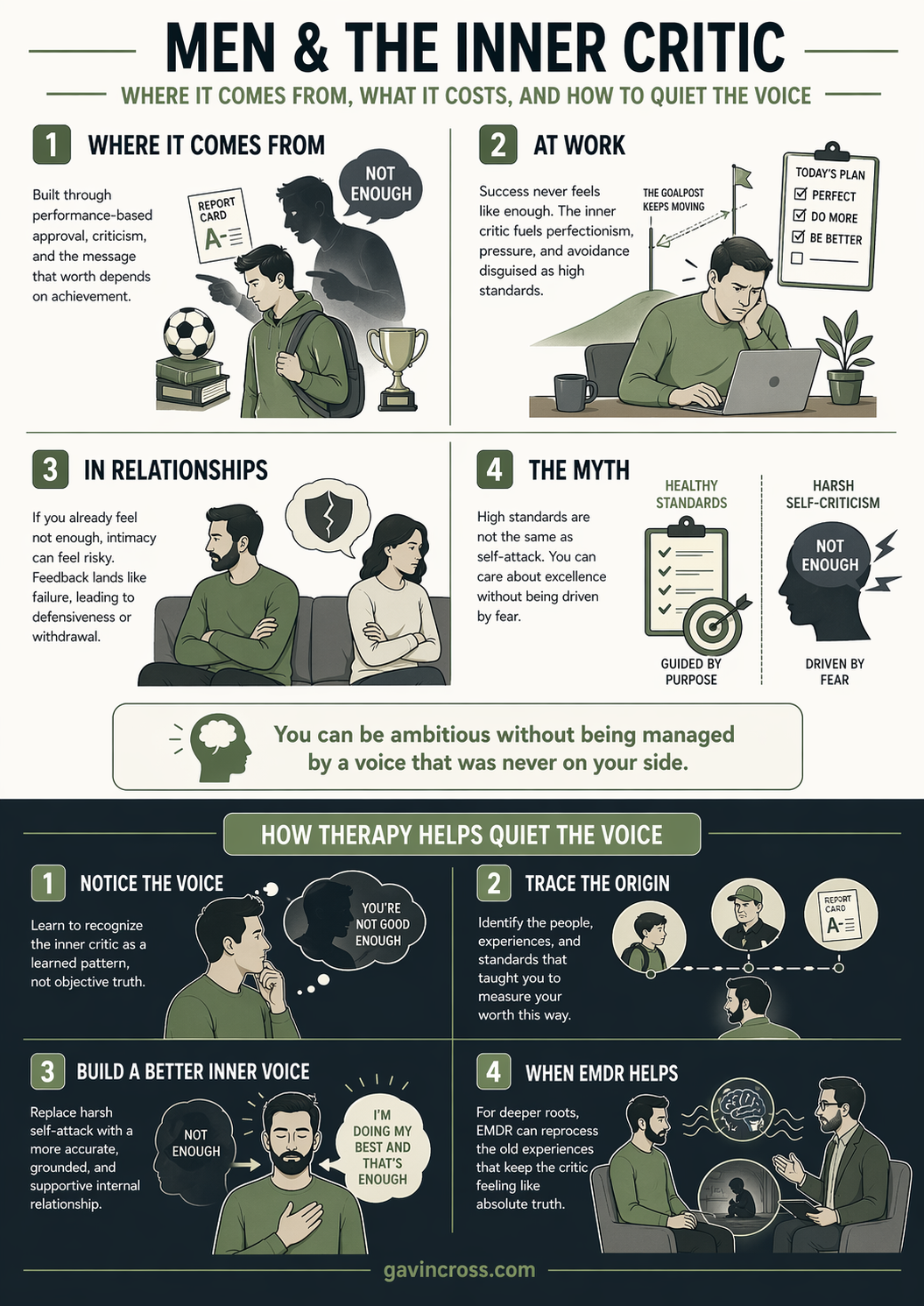
The inner critic typically does not originate in adulthood. It is built in childhood and adolescence through the feedback loops that teach a boy what he is worth and what that worth depends on. For most men, those feedback loops ran on a performance axis. Affirmation arrived in response to results: grades, athleticism, behavior, achievement. Who you were as a person, your curiosity, your sensitivity, your need for support, got far less acknowledgment than what you did and how well you did it.
Some men also grew up with a voice that was explicitly critical: a father whose approval was permanently out of reach, a coach who motivated through humiliation, a household where nothing was ever quite enough. Over time, that external voice was internalized. You no longer needed someone outside you to deliver the assessment. You became the one delivering it, reliably, every time the performance did not meet the standard.
What makes the inner critic so durable is that most men do not experience it as a pattern. They experience it as reality. The voice does not announce itself as criticism. It announces itself as accurate. Of course you should have done better. Of course that is not good enough. Of course the success does not count because of the specific way it fell short of the imaginary ideal. The voice sounds like honesty because it has always been there, and you have never had a sustained experience of what it sounds like without it.
The American Psychological Association notes that conditional self-esteem, worth tied to specific performance outcomes rather than to inherent value, is associated with higher rates of anxiety, depression, and relationship difficulty in men. The mechanism is straightforward: a self-worth that requires constant maintenance through achievement is always one failure away from collapse. You cannot rest. You cannot coast. You certainly cannot afford to let anyone close enough to see the parts that are not performing.
There is a common assumption that the inner critic is the engine of high performance in men. Push yourself hard enough and you will be successful. Settle for nothing less than excellent and you will get there. There is a narrow truth in this: the early productivity the inner critic drives can produce real results. But that frame misses the compounding costs that arrive downstream.
The man running on inner-critic fuel tends to have a particular relationship to his own success: he cannot feel it. He reaches a professional goal and experiences a brief relief, which is not the same as satisfaction, followed quickly by the reset to a new standard. The achievement is permanently re-contextualized as baseline rather than accomplishment. He is always behind, even when he is objectively ahead. The psychological term for this is the hedonic treadmill, but men with strong inner critics experience an accelerated version of it because the voice actively reframes success as merely the absence of failure rather than the presence of something worth acknowledging.
The cost also shows up in decision-making. Men with active inner critics often struggle with perfectionism, not the benign variety that produces attention to detail, but the variety that paralyzes. The risk of trying something and falling short feels worse than not trying. They stay in situations that no longer fit because the unknown carries too much potential for the verdict they are dreading. The inner critic was supposed to drive performance. In practice, it often drives avoidance.
If you recognize this in yourself, therapy for men that addresses the inner critic directly, rather than just the surface-level anxiety or depression it produces, tends to create more durable change than skill-building alone. You can learn time management and productivity frameworks, and many men do. But if the underlying voice is still running the show, the anxiety migrates to the next thing. The work is with the voice itself.
An active inner critic makes genuine intimacy difficult in a way that is hard to explain to someone who has not experienced it from the inside. If you already believe, at some level, that you are not enough, allowing a partner to fully know you feels like handing them evidence. The verdict you are dreading might come in. Better to keep a layer of distance between who you actually are and who you allow them to see.
This produces the particular loneliness of being in a relationship but not being known in it. You are there. You are present. You are performing as a partner well enough that the relationship continues. But the version of you that shows up is managed, curated, protective. Your partner is in love with a representation. You know it and they do not, and that gap creates a specific kind of isolation that no amount of companionship fills.
The inner critic also shows up in conflict. Men who run a constant internal narrative about not being enough are hypersensitive to feedback from the people they love because that feedback can too easily become confirmation of what the voice has been saying all along. Mild criticism lands as indictment. An expression of a partner's unmet need lands as "you are failing." The response is defensiveness or withdrawal, both of which make the partner feel unheard, which damages the relationship further, which gives the inner critic more material to work with.
Couples therapy can address these patterns in the relational context. Individual work on the inner critic tends to improve relationship dynamics significantly as a downstream effect, because a man who is less afraid of the verdict is more available to actually hear his partner, stay present in difficult conversations, and take feedback without it triggering a threat response.
Men are often reluctant to do anything about the inner critic because they believe it is what makes them good at what they do. Turn down the volume on that voice and you become complacent. You lose your edge. You stop caring about quality.
This belief is worth examining because it conflates two things that are actually distinct: high standards and self-attack. You can care deeply about the quality of your work without the experience of that caring being organized around threat and inadequacy. You can be ambitious without the specific flavor of drive that is powered by fear of failure rather than genuine engagement with what you are building.
The evidence on this is fairly consistent. Research on self-compassion and performance, including work by Dr. Kristin Neff at the University of Texas, finds that individuals with higher self-compassion do not show reduced motivation or lower standards. They show higher resilience after failure, more willingness to try challenging things, and more consistent engagement with goals over time. The harshest critics are often the most fragile performers, because any stumble is experienced as catastrophic rather than as information.
Men who quiet the inner critic through therapeutic work do not report becoming less driven or less committed to excellence. They report being able to access their actual capacity rather than spending a significant portion of it on managing the internal self-attack. The energy that was going into the critic loop becomes available for the work itself.
Most men imagine that addressing the inner critic means replacing self-attack with forced positivity. Affirmations in the bathroom mirror. Telling yourself you are great when you do not believe it. That is not what the work involves and it is not why it works.
The work involves three things. First, learning to notice the voice as a voice, as a learned pattern with a specific origin, rather than as transparent reality. The moment you can observe the inner critic rather than simply inhabiting it, you have already created some separation from it. You are the one hearing it. You are not the thing it is describing.
Second, tracing where it came from. Most inner critics have a specific source, a person, a context, a set of experiences, that generated the standard and the self-attack that enforces it. When you can see the critic as something that was built rather than something that has always been true, its authority over you changes. You did not choose to internalize that voice. You were not asked. And you do not have to keep running it.
Third, building a more accurate and genuinely supportive internal relationship. Not one that lies to you about your shortcomings, but one that holds both your limitations and your value without using one to erase the other. This is what Gavin's work using Restoration Therapy principles addresses directly: learning to turn down the harsh internal voice and turn up an encouraging one that is grounded in what is realistic and true rather than in fear and the threat of inadequacy.
For some men, the inner critic is not just a habit of thought that can be updated through insight and practice. It is rooted in specific formative experiences that are stored in the nervous system the same way trauma is stored. The critical parent who was never satisfied. The public failure that still activates shame. The message, delivered early and often, that your worth was conditional on performance.
When the inner critic has those deeper roots, cognitive approaches have real limits. You can understand intellectually that the voice is not accurate and still be completely hijacked by it the moment a relevant trigger activates. The understanding does not reach the level where the material is stored.
EMDR therapy addresses this by processing the specific stored experiences that are feeding the critic. When those experiences are reprocessed, the charge they carry diminishes. The voice does not disappear entirely, but it loses the physiological backing that makes it feel like absolute truth. You can hear it and disagree with it in real time rather than being pulled under by it.
The inner critic is an internalized voice that evaluates, judges, and finds the self lacking. In men, it typically runs on a performance axis: not successful enough, not strong enough, not far enough along. It often originated as an external voice from a critical parent, demanding coach, or high-pressure household that was internalized over time. Most men experience it as simply the truth about themselves rather than as a learned pattern that can be changed.
Boys are socialized to derive worth from what they do rather than who they are. Affirmation arrives in response to performance: grades, athletic results, professional success. The self-worth built on that foundation is always conditional and always provisional. It requires ongoing proof. When performance falters, the entire structure feels threatened. This is why men who are objectively successful often carry a persistent sense of inadequacy that their achievements cannot resolve.
An active inner critic makes genuine intimacy difficult because being known requires risking the verdict. If a man already believes he is not enough, allowing a partner to see him fully feels like handing them evidence. Many men keep partners at a distance to feel safety, but that produces exactly the loneliness they are trying to avoid. The inner critic also generates hypersensitivity to criticism, making it difficult to receive feedback without interpreting it as confirmation of the worst things they already think about themselves.
Yes. Therapy approaches the inner critic not as a personality trait to be overcome by willpower, but as a learned pattern with a specific origin that can be updated. The work involves identifying where the critical voice came from, what it was originally trying to do, and building a more accurate and supportive internal relationship. Men who do this work consistently report becoming more effective, not less, because they are no longer spending cognitive and emotional resources managing the internal self-attack.
You have been running the inner critic's program for a long time. It has probably produced some things worth having and cost you some things worth grieving. The question now is whether you want to keep running it, or whether you are ready to find out what you are like without it at full volume.
Gavin Cross is a Licensed Marriage and Family Therapist specializing in therapy for men, EMDR, and couples therapy in West Hollywood and online throughout California. Contact Gavin Cross, LMFT to schedule a free 15-minute consultation.
There’s a big, beautiful world out there. You deserve to experience all it has to offer.
Let’s rediscover your strength.
