


You've had some version of the same conversation a hundred times. You bring something up whether a hurt, a need, a moment you want to connect around, and your partner goes quiet, changes the subject, or simply leaves the room. You reach for more. He reaches for less. You feel abandoned. He feels suffocated. And then, somehow, you're both alone in the same relationship.
This isn't a communication failure. It isn't a sign that you chose wrong. And it isn't going to sort itself out with more effort on your end.
What you're describing is the pursuer-distancer cycle, one of the most well-documented and most damaging dynamics in couples' relationships, and it almost always has avoidant attachment at its root. Both partners have real work to do here, and the strategies for the pursuing partner are just as important, even if they're different. This article focuses on the avoidant side of the dynamic, because understanding what's actually happening there, not just behaviorally but neurologically and developmentally, is often the missing piece. That's work that couples therapy is specifically built for.
Attachment theory, developed by John Bowlby and expanded by researchers including Sue Johnson (whose work on Emotionally Focused Therapy is among the most clinically significant in couples research), describes how early caregiving experiences create internal models for all future intimate relationships. These models aren't beliefs we hold consciously, they're patterns encoded in the nervous system that operate automatically, long before thought catches up.
Avoidant attachment forms when a child's caregivers are consistently unavailable, dismissive, or punishing of emotional need. The child learns, at a physiological level, that expressing need produces pain and that self-reliance produces safety. By adulthood, that learning has become a nervous system default: closeness feels like threat, and distance feels like relief.
The adult with avoidant attachment doesn't experience this as a choice. He genuinely feels better with space. He genuinely feels something like alarm when a partner needs too much, too fast, or too intensely. The nervous system he's running on was calibrated in an environment where connection was unreliable, and it's doing exactly what it learned to do.
This is a critical piece of information for the pursuing partner to understand, because it reframes the withdrawal from rejection into something much more workable: a learned pattern, not a verdict on the relationship. It's closely connected to why men pull away in relationships generally, and why that pull isn't about love or its absence.
The pursuer-distancer cycle looks different depending on which position you occupy, and both experiences are genuinely painful.
From the pursuing partner's side: You feel chronically unseen. The harder you try to connect, the further away your partner seems. You've started to wonder whether he actually loves you, whether something is wrong with you for needing this much, or whether the relationship is simply not going to work. The moments of closeness you do have make the distance more confusing, not less. You may have started managing your own needs down, shrinking yourself to avoid triggering the withdrawal, which builds resentment over time.
From the avoidant partner's side: Closeness feels like pressure. When your partner comes toward you with emotional need, something in your chest tightens, a low-level alarm that isn't about them specifically but fires anyway. You retreat not because you don't care but because the alternative feels genuinely overwhelming. After conflict, you don't want to repair; you want the situation to simply stop existing. You may know this pattern is damaging the relationship and feel genuinely helpless to change it without understanding why it's happening.
The American Psychological Association's research on adult attachment confirms that avoidant individuals actually have comparable levels of emotional activation during relational distress as anxiously attached individuals, they simply process and express it differently. The emotion is present. The access and the expression are what's blocked. That's an important distinction for couples who have concluded that one partner simply doesn't feel as much.
The pursuer-distancer cycle is self-reinforcing in a way that makes it particularly resistant to resolution without outside support. Here's the mechanics:
The pursuing partner reaches out. The avoidant partner feels pressured and withdraws. The pursuing partner, now feeling more anxious about the disconnection, pursues more intensely. The avoidant partner, now feeling more overwhelmed, withdraws further. Both people are responding logically to their own internal experience, and both responses make the other person's position worse.
Over time, the cycle tends to calcify. The pursuing partner's default assumption becomes that any silence means rejection. The avoidant partner's default assumption becomes that any connection attempt means pressure. What started as a dynamic becomes a relationship identity "we're just not compatible" or "he doesn't care" or "she's too much" when the actual issue is an attachment mismatch that has gone unaddressed and unnamed.
Naming it is itself therapeutic. When both partners can see the cycle as the problem rather than each other as the problem, the conversation changes entirely. This is one of the core moves in structured couples therapy, moving from mutual blame to shared understanding of a system you're both caught in.
One of the most important reframes couples therapy offers is that neither position in this dynamic is the correct one. The pursuer is not too needy. The distancer is not cold. Both people developed their relational strategies in response to their early environments, and both strategies made sense in context.
The pursuing partner often grew up in environments where emotional connection was inconsistent, sometimes available, sometimes not, which made hypervigilance to relational cues an adaptive strategy. Stay alert. Watch for signs of withdrawal. Act before you lose the connection. That strategy, imported into adult relationships, becomes the pursuit that drives the cycle.
The avoidant partner grew up in environments where emotional need was unwelcome, which made self-sufficiency adaptive. Don't ask. Handle it yourself. That strategy, imported into adult relationships, becomes the withdrawal that triggers the pursuit.
Neither person is broken. Both are running outdated software in a context that requires something different. This reframe, which the National Library of Medicine's research on adult attachment supports strongly, is what makes change possible. You can't change a character flaw. You can update a learned pattern with the right support.
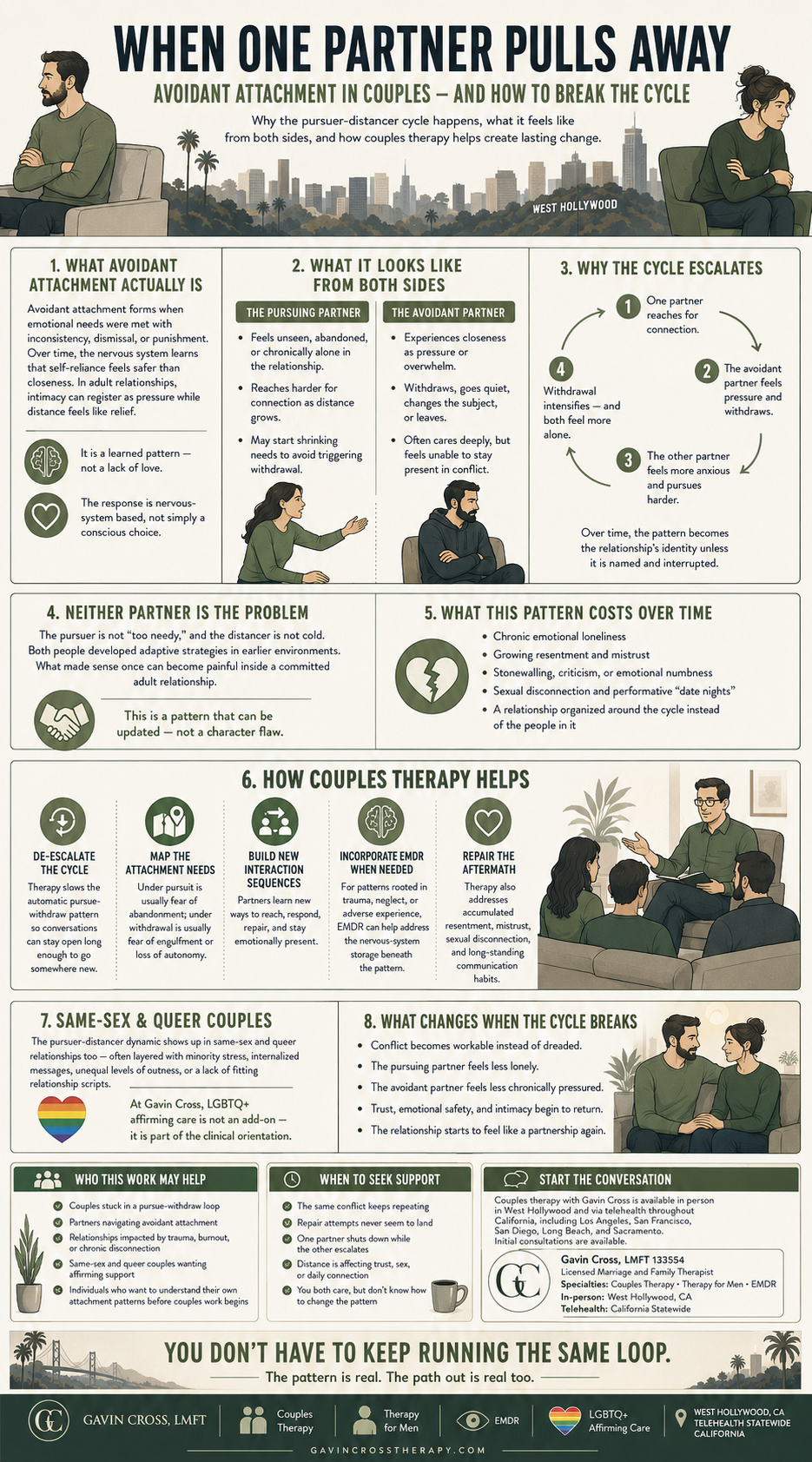
Left unaddressed, the pursuer-distancer cycle compounds. The pursuing partner experiences chronic emotional loneliness within the relationship, one of the most painful forms of isolation that exists, because it happens in the presence of someone they love. The avoidant partner experiences chronic relational pressure and, over time, increasing emotional numbness as the nervous system habituates to managing intimacy as threat.
Both partners tend to bring coping strategies that make things worse: the pursuer escalates criticism or emotional bids, the distancer escalates stonewalling or physical absence. If anger is present, the way the avoidant partner experiences the emotional masking pattern converts fear, shame, and helplessness into irritability rather than the vulnerability it actually is.
The relationship becomes organized around the cycle rather than around the two people in it. Date nights feel performative. Sex becomes fraught. Communication about anything real gets avoided because both partners know, consciously or not, that it will end badly.
This is the point at which couples typically arrive at therapy, when the workarounds have stopped working and the cost has become undeniable. The research from The Gottman Institute on relationship stability consistently identifies the withdrawal-pursuit dynamic, alongside contempt and stonewalling, as one of the primary predictors of relationship dissolution without intervention.
Effective couples therapy for the pursuer-distancer dynamic doesn't take sides. It also doesn't simply teach communication techniques, because communication technique without attachment work is like rearranging furniture in a house with a structural problem. The sessions have to go deeper.
The work typically moves through several phases:
De-escalating the cycle. Before anything else can happen, the automatic escalation pattern needs to slow down. Therapy provides a structured environment where both partners can speak to their own experience without the interaction immediately triggering the cycle. The therapist holds the container so that conversations that would normally end in pursuit and withdrawal can stay open long enough to go somewhere new.
Mapping the underlying attachment needs. Underneath the pursuit is almost always a fear of abandonment and a need for reassurance. Underneath the withdrawal is almost always a fear of engulfment and a need for autonomy. These needs aren't incompatible, but they're incompatible with the strategies each partner has been using to meet them. Therapy helps both partners see and speak to the need rather than just the behavior.
Building new interaction sequences. Once both partners understand the attachment dynamic and can communicate about their underlying fears rather than their surface positions, new patterns become possible. The pursuing partner learns to reach for connection in ways that don't trigger alarm. The avoidant partner learns to signal availability rather than disappear. These aren't scripts, they're capacities that develop through repeated, guided practice in session and outside it.
Incorporating EMDR when needed. For partners whose avoidant patterns are rooted in early trauma, neglect, or significant adverse experience, talk-based couples work sometimes reaches a ceiling. EMDR therapy, whether incorporated into couples sessions or run concurrently in individual work can reach the neurological storage of those early experiences directly. The research on what trauma does to the body explains why this matters: the pattern lives below language, and it has to be addressed there.
Addressing the relational aftermath. Couples who have lived in the pursuer-distancer cycle for years often have significant relational damage to repair: eroded trust, accumulated resentments, sexual disconnection, and communication habits built entirely around avoiding the cycle rather than building something. Later-stage couples work addresses this terrain directly, not just stopping the cycle but building the relationship that replaces it.
The pursuer-distancer dynamic appears in same-sex and queer relationships just as it does in heterosexual ones, and it arrives with additional layers. Minority stress, internalized messages about what gay or queer relationships are supposed to look like, asymmetrical levels of outness with family or community, and the absence of mainstream relationship scripts that actually fit: these factors layer on top of the attachment dynamic and can make it harder to identify what's driving the disconnection.
Couples therapy with Gavin Cross holds all of it. The LGBTQ+ affirming care built into this practice isn't a policy addendum, it's a clinical orientation. Same-sex couples working through avoidant attachment here don't have to translate their experience into heteronormative frameworks to be understood.
Couples who do this work describe similar shifts. The relationship stops feeling like a negotiation and starts feeling like a partnership. Conflict becomes something that can be resolved rather than something to dread. The pursuing partner stops feeling chronically lonely. The avoidant partner stops feeling chronically pressured. Physical and emotional intimacy tends to follow naturally once the attachment safety is established, not because the couple worked on intimacy directly, but because intimacy is what happens when people feel genuinely safe with each other.
This isn't a fast process. The pursuer-distancer cycle took years to build, and unwinding it requires sustained, consistent work. But it's one of the most reliably positive outcomes in couples therapy research, attachment-based couples work has a strong evidence base for creating durable change even in relationships that feel significantly stuck.
The version of your relationship that runs the pursuer-distancer cycle isn't the only version available. The pattern is real. The damage is real. And the path out of it is real too.
If you're the pursuing partner reading this alone, it's worth knowing that individual therapy, exploring your own attachment history and relational patterns is a meaningful step even before couples work begins. The guide to finding the right therapist can help orient that search. The comparison of what to look for in an LA therapist covers the specific factors that matter most.
Couples therapy with Gavin Cross is available in person in West Hollywood and via telehealth throughout California, including Los Angeles, San Francisco, San Diego, Long Beach, and Sacramento. Initial consultations are available for no charge. Contact Gavin Cross, LMFT to start the conversation.
Gavin Cross is a Licensed Marriage and Family Therapist (LMFT 133554) based in West Hollywood, CA. He specializes in couples therapy, therapy for men, and EMDR, with telehealth available statewide in California.
There’s a big, beautiful world out there. You deserve to experience all it has to offer.
Let’s rediscover your strength.
