


You probably know someone who is depressed and has no idea. Statistically, you might be that person.
Depression in men does not always look like sadness. It looks like a shorter fuse at work. A third drink on a Tuesday. Pulling away from the people who know you best. The signs are real, but they rarely match the image most of us carry when we hear the word “depression.”
As a therapist who specializes in therapy for men, I see this pattern constantly. Men come to me after months or years of white-knuckling it, convinced that what they are feeling is “just stress.” By the time they sit down on my couch, the stress has calcified into something heavier.
This post is for the men who suspect something is off but cannot name it. And for the people who love them.
Forget the stereotype of someone lying in bed staring at the ceiling. Men’s depression symptoms tend to show up sideways. Research from the National Institute of Mental Health confirms that men and women often experience the same conditions with very different presentations.
Here is what I see most often in my practice:
The road rage that seems disproportionate. Snapping at your partner over dishes. A constant low-grade frustration that you cannot shake. For many men, anger is the only emotion that feels “allowed.” Depression hides behind it.
Turning down plans. Going quiet in conversations. Spending more hours at work not because you love your job, but because being alone is easier than pretending you are fine. Withdrawal is one of the most common and most overlooked signs of depression in men.
Chronic headaches. Digestive problems. Back pain with no structural cause. Jaw clenching. Fatigue that sleep does not fix. Your body keeps the score when your mind refuses to. The Mayo Clinic identifies these physical manifestations as key indicators of male depression that often get misdiagnosed or ignored entirely.
Drinking more. Scrolling endlessly. Overworking. Risky behavior. These are not personality traits. They are coping mechanisms, and they are often the first visible sign that something deeper is going on. I wrote about the broader relationship between men and chronic stress previously, and depression sits at the far end of that same continuum.
This is not a mystery. Boys learn early that vulnerability is a liability. The phrase “man up” is not just a cliché. It is a behavioral instruction that gets reinforced by coaches, fathers, friends, and culture at large for decades.
By adulthood, most men have internalized three beliefs that keep them from getting help:
The cost of that silence is staggering. According to the Anxiety & Depression Association of America, over six million men in the U.S. experience depression each year, and less than half receive treatment. Men are also four times more likely to die by suicide than women.
Silence is not strength. It is a risk factor.
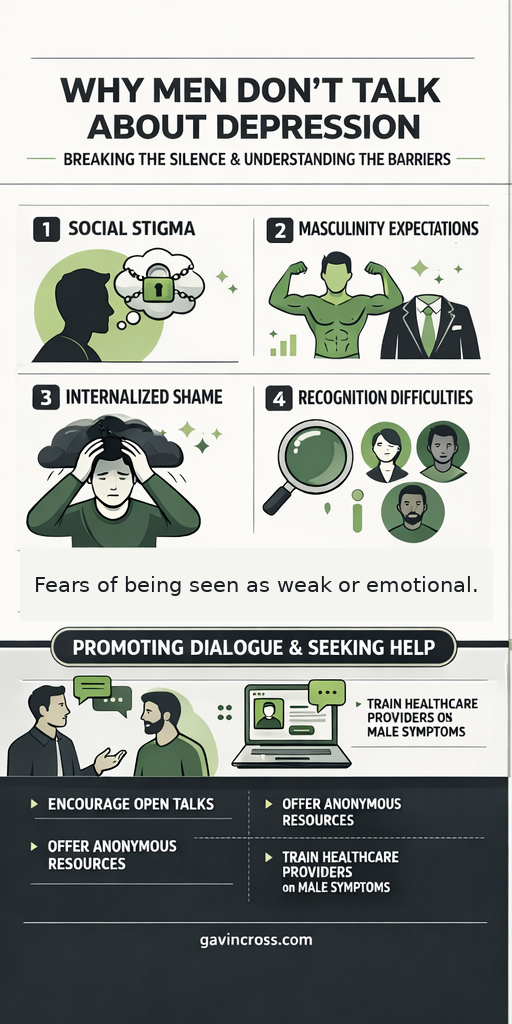
The statistics alone don't capture how layered this problem is. Social stigma, masculinity conditioning, internalized shame, and symptom misrecognition don't operate in isolation, they reinforce each other. The infographic below breaks down why men stay silent and what it takes to change that.
Depression and anxiety are frequently co-occurring. A man might come to therapy describing constant worry, restlessness, and difficulty concentrating, believing he has an anxiety problem. Underneath that anxiety, depression is driving the bus.
The reverse is equally common. A man who feels emotionally flat, disconnected, and unmotivated may not realize that the tightness in his chest and the racing thoughts at 2 a.m. are anxiety symptoms layered on top of a depressive episode.
This overlap matters because treating one without addressing the other rarely works. If you are dealing with persistent worry and emotional numbness, both deserve attention. I have written about managing social anxiety and how simple reframing techniques can start to loosen anxiety’s grip, which is often the entry point for addressing the depression beneath it.
Untreated depression does not stay at the same level. It escalates. Relationships erode because your partner cannot reach you. Work performance drops because focus requires emotional bandwidth you no longer have. Physical health deteriorates as cortisol stays elevated and healthy habits fall away.
For many men, substance use increases. Alcohol becomes a nightly reset button. Decisions get riskier. The gap between who you are and who you are pretending to be grows wider until maintaining the performance becomes its own source of exhaustion.
None of this is inevitable. But it is the trajectory when depression goes unacknowledged and untreated.
Therapy is not about lying on a couch and recounting your childhood (unless that is what you need). For most men I work with, therapy is practical. It is about identifying the emotional patterns running in the background of your life and learning how to interrupt them.
In my practice, I use a combination of talk therapy and EMDR therapy to address both the conscious and subconscious drivers of depression. EMDR is especially effective for men who carry unresolved trauma, whether from childhood, past relationships, or high-stress environments. It works by reprocessing distressing memories so they lose their emotional charge.
Here is what therapy typically addresses for men dealing with depression:
If your depression is also affecting your relationship, couples therapy can work alongside individual sessions to repair communication and rebuild intimacy. Depression does not exist in a vacuum, and neither should treatment.
There is no minimum threshold of suffering required to start therapy. You do not have to hit rock bottom. If any of the following resonate, it is worth having a conversation:
Any one of these is enough. You do not need all of them.
Depression in men often presents as irritability, anger, social withdrawal, fatigue, physical pain, and increased substance use. Visible sadness is less common, which is why male depression frequently goes undiagnosed.
Cultural expectations around masculinity discourage emotional vulnerability. Many men do not recognize their symptoms as depression, believe they should handle it independently, or fear professional and social consequences.
Therapy provides a confidential space to identify emotional patterns, develop healthier coping strategies, and address root causes. Approaches like EMDR and talk therapy are particularly effective for men dealing with depression, trauma, and chronic stress.
If anything in this post resonated with you, that recognition is meaningful. It means the awareness is already there. The next step is doing something with it.
I work with men navigating depression, anxiety, stress, relationship strain, and the particular weight of trying to hold everything together without ever saying it is heavy. My practice is built around creating a space where none of that has to be performed.
Schedule a free 15-minute consultation to see if we are a good fit. No pressure. No judgment. Just a conversation.
There’s a big, beautiful world out there. You deserve to experience all it has to offer.
Let’s rediscover your strength.
