

.jpg)
Quick answer: Before confronting a partner or boss, you can use a four-question framework drawn from Restoration Therapy, developed by Dr. Terry Hargrave, to move from a reactive, flooded state into a clear, intentional one: identify what you're actually feeling underneath your reaction, notice how you're about to unhelpfully protect yourself, check the story you're telling yourself against the facts, and decide, on purpose, how you actually want to show up. It takes about five minutes and can be done anywhere, whether you are in your car, a bathroom, or at your desk. Gavin Cross, LMFT, of Gavin Cross Therapy, teaches this framework to clients in-person in West Hollywood, CA, and online throughout California.
1. Why You Need to Regulate *Before* You Walk In
2. Where This Framework Comes From
3. The 4 Steps, Applied to a Hard Conversation
4. A Worked Example
5. Pair This with a Body-Based Tool First
6. Why You'll See These 4 Questions Again
7. When This Keeps Happening And What That Means
8. Frequently Asked Questions
Most hard conversations don't go badly because of what you say. They go badly because of the state you're in when you say it. Walk into a confrontation with your nervous system already flooded with an elevated heart rate, jaw tight, mind narrating worst-case outcomes, and you're not actually choosing your words anymore. You're reacting from whatever survival strategy your body defaults to under threat: attacking, shutting down, over-explaining, or caving before the conversation even starts.
The fix isn't "don't feel anything" or "just stay calm," which rarely works on command. It's a specific, repeatable sequence that moves you from reactive to intentional in a few minutes, before you're standing in front of the person.
This four-step sequence is drawn from Restoration Therapy, a model developed by Dr. Terry Hargrave, a marriage and family therapist and researcher whose work centers on how people move from relational pain into destructive coping cycles , and how to interrupt that cycle before it runs its usual course. Restoration Therapy's four-step process is described in detail in the SAGE Encyclopedia of Marriage, Family, and Couples Counseling and an overview from Theravive; Dr. Hargrave discusses the model directly in an interview with the Thrive Center. The same four steps apply to a wide range of triggering moments. This post applies them specifically to the run-up to a hard conversation with a partner or a boss.
1. Identify your feelings of pain.
The question: What am I actually feeling right now, underneath the urge to defend myself before I've even walked in the room?
The focus: Underneath the anger or dread, there's usually something more vulnerable whether that is hurt, fear of being dismissed, fear of losing something that matters, a sense of not being taken seriously. Name that feeling specifically, not just "stressed" or "annoyed."
2. Confess your destructive coping mechanism.
The question: Am I about to blame, shut down, control the outcome, or avoid this entirely?
The focus: Most people default to one of four patterns under pressure, such as blaming the other person, shutting down and going quiet, trying to control exactly how the conversation goes, or finding a reason to avoid it altogether. Naming which one you're reaching for takes away some of its automatic pull.
3. Check the truth of your perception.
The question: What's the actual truth here, separate from the worst-case story I'm telling myself about how this is going to go?
The focus: Under threat, the brain tends to generate the most catastrophic plausible outcome and treat it as the likely one. Separate what you actually know from what you're predicting. Has this person actually reacted this badly before, or are you bracing for the worst version out of old habit?
4. Decide on an informed response.
The question: What do I actually want to say, and how do I want to show up, regardless of how they react?
The focus: This is the shift from reactive to intentional, deciding, on purpose, what outcome you're going for and what tone gets you there, rather than letting whatever state you walked in with make that decision for you.
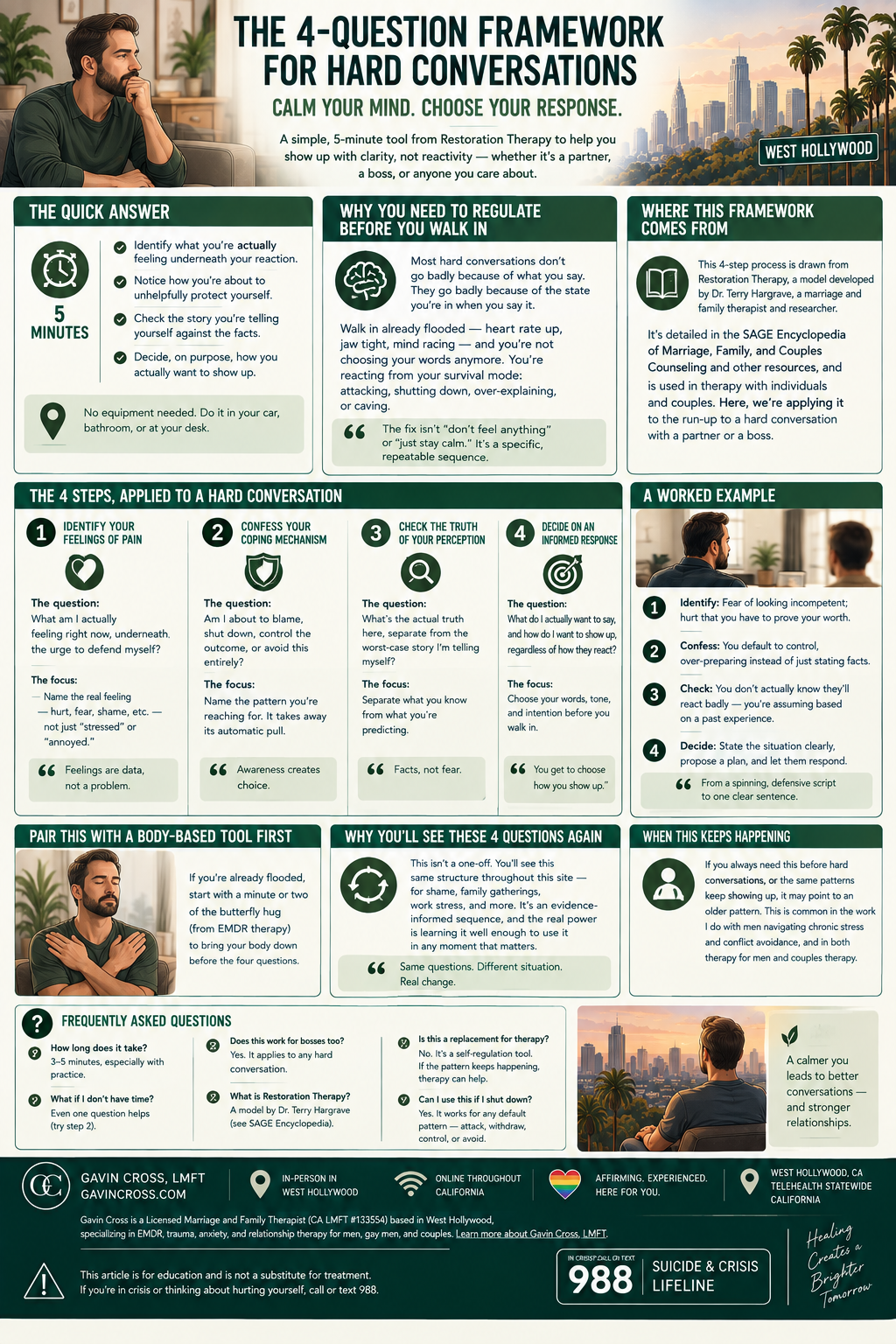
Say you need to tell your boss you're overwhelmed and about to miss a deadline. Walking in flooded, this might come out as over-apologizing, or as a defensive list of excuses. Run the four steps first:
Identify: Underneath the dread, it's actually fear, such as the fear of looking incompetent, and a little bit of hurt that you feel like you have to prove your worth every time something goes wrong.
Confess: Your default here is control, over-preparing a justification instead of just stating the facts, trying to manage their reaction before they've even had one.
Check the truth: You don't actually know they'll react badly. You're assuming that based on one bad experience with a previous manager, not this one.
Decide: You want to walk in and state the situation clearly, propose a realistic plan, and let them respond, without over-explaining or pre-apologizing for a problem you haven't caused yet.
That's the shift: from a spinning, defensive script to one clear sentence you can actually say.
If you're already flooded with a racing heart and tight chest, it can help to regulate your body before you even start on the four questions, since it's hard to think clearly from a fully activated nervous system. A minute or two of the butterfly hug, a simple self-administered tapping technique borrowed from EMDR therapy, is a fast way to bring your body down a few notches before working through the four steps above.
If you read other posts on this site, you'll notice the same four-step structure show up again when applied to shame in a room full of people, to walking into a family gathering, to freezing up under pressure at work. That's intentional, not repetitive filler: Restoration Therapy's four steps are a consistent, evidence-informed sequence, and the value isn't in inventing new steps for every situation; it's in learning one sequence well enough that you can run it in any moment that needs it. What changes from post to post is the actual content of each question, the specific fear, the specific coping pattern, the specific story, because that's genuinely different depending on what you're walking into.
If you find yourself needing this before every hard conversation, or if steps 2 and 3 keep turning up the same coping mechanism and the same distorted story no matter the situation, that's worth paying attention to. It usually means there's an older pattern driving the reaction, something learned well before this particular boss or partner was in the picture. This shows up often in the work Gavin Cross, LMFT does with men navigating chronic stress and conflict avoidance, discussed further in Unveiling the Hidden Burden: Men's Struggle with Stress, and is a common focus of both therapy for men and couples therapy at Gavin Cross Therapy.
How long does this take to actually do?
Most people can move through all four questions in three to five minutes, especially with practice. It's meant to be usable in a parking lot or a bathroom right before the conversation, not a long reflective exercise.
What if I don't have time to do this before the conversation starts?
Even one question helps identifying the coping mechanism you're about to reach for (step 2) is often the fastest single check to run when time is short.
Does this work for conversations with a boss, or just partners?
Yes, the framework is scenario-agnostic. It applies to any moment where you're about to react from an activated state rather than a chosen one, whether that's a partner, a boss, a parent, or a friend.
What is Restoration Therapy?
Restoration Therapy is a therapeutic model developed by Dr. Terry Hargrave that maps how people move from relational pain into destructive coping cycles, and provides a structured way to interrupt that cycle. See the SAGE Encyclopedia entry for a full academic overview.
Is this a replacement for therapy?
No, it's a self-regulation tool you can use at the moment. If the same pattern keeps showing up across many different situations, that's usually a sign it's worth exploring in ongoing therapy rather than managing case by case.
Can I use this if I tend to shut down rather than get angry?
Yes. Shutting down is one of the four common coping patterns the framework helps you name (step 2) the questions work the same way whether your default reaction is to attack, withdraw, control, or avoid.
Gavin Cross is a Licensed Marriage and Family Therapist (CA LMFT #133554) based in West Hollywood, providing in-person and secure telehealth therapy to clients throughout California. He holds a Restoration Therapy Level II certification and EMDRIA-approved training in EMDR, and specializes in helping men, couples, and LGBTQ+ clients heal and reconnect, whether in the office or over secure video. Learn more about Gavin Cross, LMFT.
There’s a big, beautiful world out there. You deserve to experience all it has to offer.
Let’s rediscover your strength.
