


Quick answer: If you're asking this question, the answer is very often yes, men rarely search "do I need therapy" unless something has already been quietly building for a while. Common signs include a short fuse, numbness, sleep problems, escalating drinking or overworking, and relationship strain. NIMH's research on men and mental health confirms men are less likely to seek treatment even when experiencing comparable symptoms to women, largely because those symptoms often look different. Gavin Cross, LMFT, of Gavin Cross Therapy, offers therapy for men in-person in West Hollywood, CA, and online to men throughout California. Here's how to know for sure.
1. Why Men Wait So Long to Ask For Help
2. What the Research Actually Shows
3. Common Issues Men Bring to Therapy
4. Signs You May Need Therapy
5. What Makes Therapy for Men Different
6. What Happens When These Patterns Go Unaddressed
7. What a First Session with Gavin Cross, LMFT Looks Like
8. Cost, Insurance, and Getting Started
9. Why Choose Gavin Cross, LMFT
10. Frequently Asked Questions
Most men aren't taught they're not allowed to struggle. They're taught something quieter: struggle is fine, as long as it's handled alone, without complaint, and without letting it show. By adulthood, that translates into a nervous system fluent in exactly one difficult emotion, whether that’s anger or frustration, and largely illiterate in the rest. The struggle gets rerouted into irritability instead of sadness, overworking instead of naming burnout, silence instead of asking for help. By the time a man reaches out, it's often because the coping strategies that used to work have finally stopped working, sometimes after years of quietly not working.
This is well-documented in the clinical literature. NIMH's overview of men and mental health notes that men are diagnosed with depression at lower rates than women, not because they experience it less, but in part because depression in men often presents differently: irritability, anger, and even aggression; reckless or risk-taking behavior; and physical symptoms rather than the sadness more commonly recognized as depressive. The Anxiety and Depression Association of America similarly points to persistent underdiagnosis driven by stigma and socialized reluctance to seek help, and Mayo Clinic's research on male depression notes men are significantly less likely than women to talk about their feelings or seek treatment at all.
Consider reaching out if you notice:
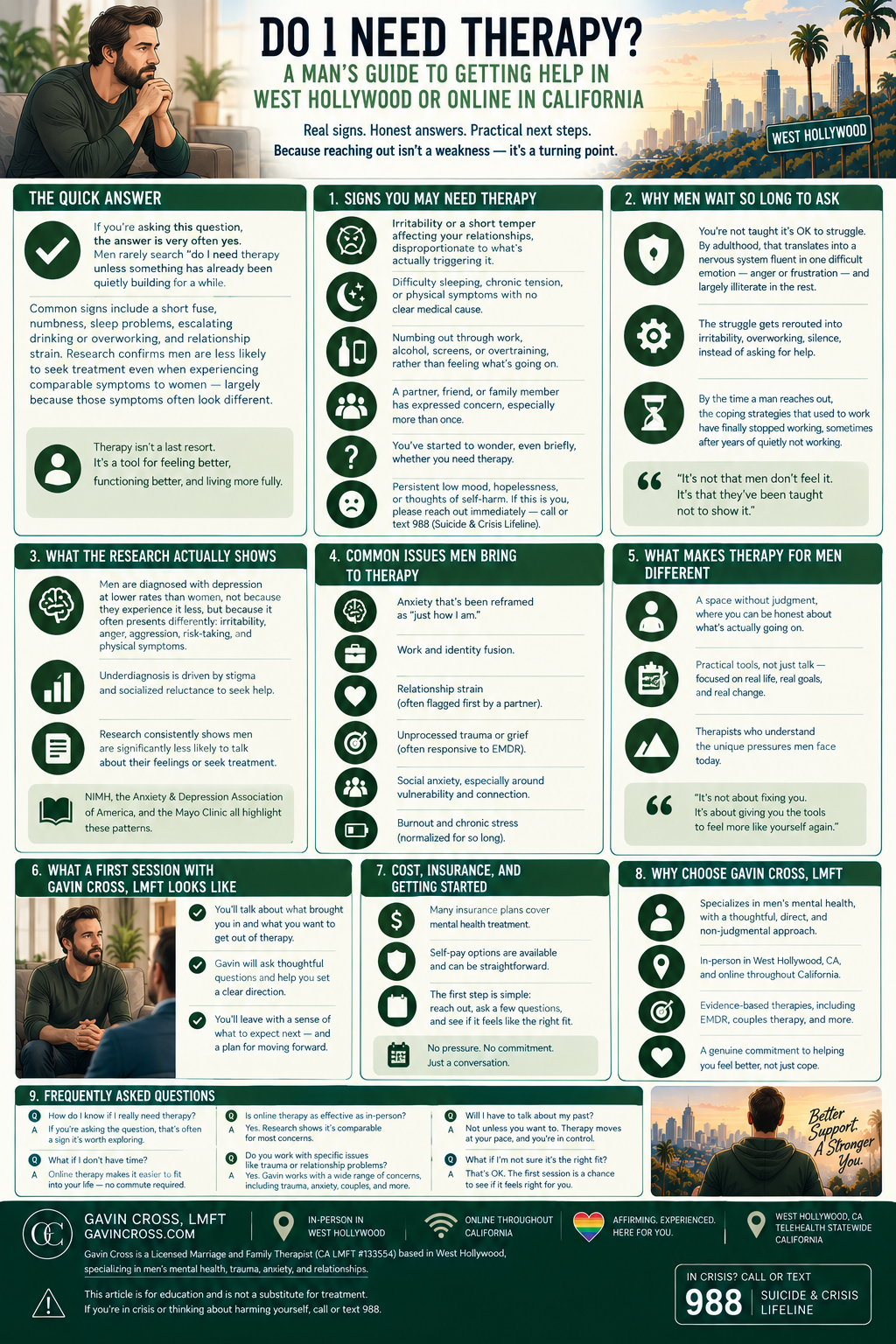
Effective therapy for men doesn't ask a client to abandon how he currently operates. It works with the existing wiring: problem-solving orientation, action-focus, discomfort sitting in raw emotion for too long. In practice, this often means starting with concrete, body-based, skills-oriented work: understanding the stress response, recognizing early warning signs, and building practical regulation tools before moving into deeper relational and emotional territory. Gavin Cross, LMFT combines this with attachment-focused work and EMDR Therapy for clients new to therapy or skeptical of purely talk-based approaches.
It's worth being direct about the trajectory here, because it's part of why waiting rarely pays off. Chronic, unaddressed stress and irritability don't tend to stay flat. They tend to escalate quietly, straining relationships one small rupture at a time until a partner or close friend eventually says something serious, or until the body itself forces the issue through elevated blood pressure, disrupted sleep, digestive problems, or a health scare that finally interrupts the pattern that willpower alone couldn't. Escalating alcohol use, in particular, is a common byproduct of untreated stress in men, what starts as "a couple drinks to unwind" can quietly become the primary coping mechanism for an unnamed and unaddressed underlying issue.
None of this is inevitable, and recognizing the pattern early, before it reaches a crisis point is generally far easier to work with than waiting until a relationship or health issue forces the conversation. This is part of why therapy for men at Gavin Cross Therapy is structured to meet men where they actually are: not waiting for a dramatic breaking point, but addressing the quieter signals, the short fuse, the numbness, the sleep issues, while they're still relatively easy to shift.
A first session typically starts with a straightforward conversation: what's bringing you in, what you've tried already, what's working and what isn't, and what you're hoping is different on the other side. There's no expectation you'll walk in with your emotions fully mapped out. Many clients start with a free 15-minute consultation to test the fit before committing to ongoing sessions, a lower-stakes entry point for anyone hesitant about starting therapy at all. Sessions are available in-person at 7720 W Sunset Blvd in West Hollywood, or via online therapy for men throughout California.
Gavin Cross Therapy operates on an out-of-network basis and can provide a superbill for potential insurance reimbursement. A free 15-minute consultation is the easiest way to start, whether you're planning to come in-person or use online therapy services for California residents.
Gavin Cross, LMFT is a Licensed Marriage and Family Therapist (License #133554) based in West Hollywood, trained in EMDR and Restoration Therapy Level II, with a practice built specifically around men's mental health, anxiety, and trauma. His clinical foundation began in crisis support work on a suicide hotline during college, long before his formal training, an experience that continues to shape a direct, non-judgmental clinical style. Learn more about Gavin Cross, LMFT, browse the full range of therapy services, or read testimonials from past and current clients.
This background matters practically, not just biographically: it means Gavin Cross, LMFT has extensive experience meeting people at their most guarded and most reluctant to ask for help, exactly the starting point for a lot of men walking into therapy for the first time. Sessions don't require you to arrive already fluent in talking about feelings, already convinced therapy will work, or already sure what's actually wrong. That clarity, when it comes, tends to arrive through the process itself, not as a prerequisite for starting it. Whether you're located in West Hollywood, elsewhere in Los Angeles, or anywhere else in California via online therapy, the same approach applies from the very first session.
Do I need therapy if I'm not in crisis?
You don't need to be in crisis to benefit from therapy. Many men start therapy specifically because they've noticed a pattern of irritability, numbness, sleep issues well before it becomes a crisis, which is generally the easier and more effective time to address it.
Why do men wait longer than women to start therapy?
Research points to socialization around emotional expression, stigma, and the fact that depression and anxiety often present differently in men, more as irritability, anger, or physical symptoms than sadness. See NIMH's overview of men and mental health for more.
What if I don't know what's wrong, I just feel off?
That's an extremely common starting point, not a barrier. Naming what's going on is often part of the early work itself.
Can men's therapy be done online?
Yes. Gavin Cross Therapy offers online therapy for men throughout California.
Does men's therapy include relationship or couples issues?
Yes. Many male clients bring in relationship strain as a primary concern, and Gavin Cross Therapy offers dedicated couples therapy alongside individual work.
How much does therapy cost, and is it covered by insurance?
Gavin Cross Therapy operates out-of-network and provides a superbill for potential reimbursement. Specifics are covered during your free consultation.
How long does therapy typically take to help?
Some men notice meaningful shifts in stress regulation and communication within the first several sessions; deeper patterns generally take longer. This is discussed during your intake.
Is it normal to feel nervous or skeptical about starting therapy?
Yes, this is one of the most common feelings men bring into a first session, and it doesn't need to be resolved before you start. A free 15-minute consultation exists specifically to lower that barrier, letting you get a feel for the process and the fit before committing to anything ongoing.
What if my partner or family is the one pushing me to go?
That's a very common starting point, and it doesn't undermine the value of the work. Many men who initially attend therapy at someone else's urging end up finding real, independent value in it once they're actually in the room. The motivation to start doesn't have to match the reasons it ends up being worthwhile.
Do you specialize in any particular issues for men?
Gavin Cross, LMFT's practice centers on anxiety, high-functioning stress, trauma (including through EMDR Therapy, and relationship patterns, with particular experience working with LGBTQ men, see the LGBTQ affirmative therapy for more.
Can therapy help even if my problems seem "normal" or not that serious compared to what other people deal with?
Comparing your struggles to someone else's is one of the most common reasons men delay getting support, and it isn't a useful measuring stick. Therapy is worth pursuing based on how something is actually affecting your life and relationships, not on how it stacks up against a harder situation someone else might be facing. If it's disrupting your sleep, your relationships, or your sense of yourself, that's reason enough to bring it into a session.
How do I actually schedule an appointment?
The simplest first step is requesting a free 15-minute consultation through Gavin Cross Therapy's contact page. That call is a chance to briefly describe what's going on, ask any questions about the process or services for men, and decide together whether ongoing sessions, whether in-person in West Hollywood or online from anywhere in California, make sense as a next step.
There’s a big, beautiful world out there. You deserve to experience all it has to offer.
Let’s rediscover your strength.
