


You are not in Los Angeles. Maybe you are in Sacramento, San Diego, the Central Valley, or three hours up the coast, and driving into West Hollywood for a weekly appointment simply is not realistic. Or maybe you are in LA but between a job, a commute, and everything else, adding a drive across town to your week feels like the reason you have not started therapy at all. Either way, you have probably wondered the same thing a lot of people wonder before their first video session: does this actually work, or is it just a lesser, more convenient version of real therapy?
It is a fair question, and it deserves a real answer rather than a marketing one. So here it is, grounded in what the research actually shows rather than what is convenient for a practice to claim: for the vast majority of people and concerns, online therapy is genuinely, measurably effective, not a diluted substitute for the real thing.
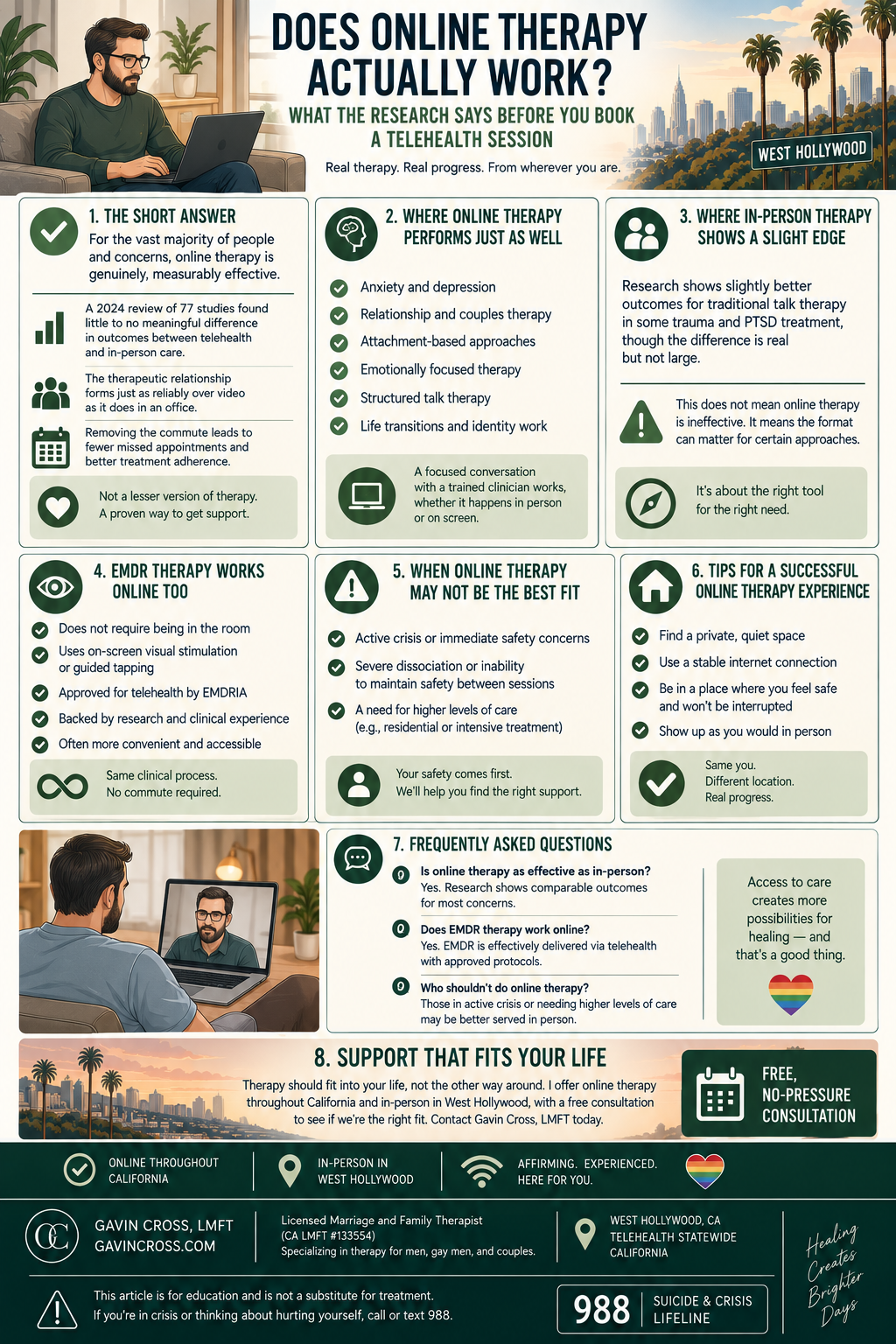
A comprehensive 2024 systematic review published in the NPJ Digital Medicine, examining 77 studies comparing telehealth to in-person care, found that differences in clinical outcomes between the two formats were generally small and, in most cases, not clinically meaningful. You can read the full review directly through the National Institutes of Health. That is a significant finding, because it means the burden of proof has effectively shifted. Telehealth therapy does not have to prove it is nearly as good as in-person care. Across most conditions studied, it already performs comparably.
That said, "comparable across most conditions" is not the same as "identical for everything," and a therapist who tells you otherwise is oversimplifying. The more useful, more honest picture has some texture to it, which is worth understanding before you decide what format is right for you.
For anxiety and depression, which are among the most common reasons people seek therapy in the first place, outcome research consistently shows telehealth performing roughly equivalent to in-person sessions. The therapeutic relationship, which decades of research identifies as one of the single strongest predictors of successful treatment regardless of modality, forms just as reliably over video as it does in an office. Attachment-based techniques, emotionally focused approaches, and structured talk therapy all translate well to a screen, because the core mechanism, a focused conversation with a trained clinician, is not fundamentally dependent on physical proximity.
Telehealth also shows some genuine advantages over in-person care in specific areas. The same 2024 review found lower rates of missed appointments and higher rates of treatment adherence among people using telehealth compared to in-person care. This makes practical sense. Removing a commute removes one of the most common reasons people skip or reschedule sessions, and consistency is one of the biggest drivers of whether therapy actually produces change. A session you attend from your living room beats a session you skip because traffic on the 405 made it feel impossible.
The nuance worth taking seriously involves trauma. Research on PTSD and complex trauma treatment shows in-person talk-based therapy producing somewhat better outcomes than telehealth, though research compiled by the VA National Center for PTSD notes the difference is real but not large. This finding applies mainly to traditional talk therapy for trauma, where the format itself, the back-and-forth dialogue, the in-room presence, seems to carry some of the therapeutic weight.
This is where EMDR therapy differs, and why the calculus flips for it specifically. EMDR involves a distinct technique, bilateral stimulation, that people often assume requires being physically in the room. It does not. EMDR is regularly and effectively delivered via telehealth using on-screen visual stimulation or self-administered tapping techniques guided in real time by the therapist, and EMDRIA, the credentialing body for EMDR clinicians, has approved telehealth delivery protocols specifically because outcome data supports it. Because EMDR relies on structured technique rather than the in-room dynamic that talk therapy depends on, online delivery can work as well, and for some clients, better, offering the same clinical process without the added friction of travel or scheduling around an office visit. If you are curious about the mechanics, what EMDR actually does, whether delivered in person or by video.
This is particularly relevant for anyone considering EMDR therapy, since EMDR involves a specific technique, bilateral stimulation, that people often assume requires being physically in the room. It does not. EMDR is regularly and effectively delivered via telehealth using on-screen visual stimulation or self-administered tapping techniques guided in real time by the therapist, and EMDRIA, the credentialing body for EMDR clinicians, has approved telehealth delivery protocols specifically because outcome data supports it. If you are curious about the mechanics, what actually happens in an EMDR session walks through the full eight-phase process, whether delivered in person or by video.
Format is not the only variable that determines whether therapy succeeds. A few factors matter more than whether you are on a screen or in a chair across from your therapist.
Privacy at home. Telehealth requires a space where you can speak freely without being overheard or interrupted. For some people, especially those living with roommates, family, or a partner they are not yet ready to loop in, this is a genuine barrier worth solving for before starting, whether that means scheduling around when the apartment is empty or using a car, a private office, or a walk with headphones as your session space.
Technology comfort, not technology sophistication. You do not need to be tech-savvy to do telehealth therapy well. You need a stable internet connection and a device with a camera. Most HIPAA-compliant platforms are simpler to use than a standard video call app, specifically because they are built for people who are not thinking about technology at all when they log in.
Your own engagement. This is true of therapy in any format, but it is worth naming directly: therapy works when you show up honestly and do the work between sessions, not because of where your body happens to be sitting. A distracted, half-present session in an office is not more effective than a fully engaged session over video.
The fit with your therapist. Research consistently identifies the therapeutic alliance, meaning how safe, understood, and aligned you feel with your therapist, as one of the strongest predictors of outcome, more predictive in many studies than the specific technique or modality used. That alliance can and does form over video. It is worth prioritizing fit over format when you are choosing who to work with.
For a lot of men, the privacy and control telehealth offers actually lowers a real barrier to starting therapy at all. If you have spent years managing the anxiety no one talks about, the idea of sitting in a waiting room before a first session can itself feel like one more obstacle. Logging into a private session from your own space removes that friction entirely, and for some men, it is the difference between finally starting therapy for men and continuing to put it off.
For LGBTQ clients, particularly those living in less affirming areas of California or navigating a household where they are not fully out, telehealth can provide access to affirming, culturally competent therapy that may not exist locally, without requiring a move, a long drive, or an explanation to anyone about where you are going. Geography should not determine whether you have access to a therapist who actually understands your experience.
For couples, telehealth solves one of the most common practical barriers to consistent couples therapy: coordinating two schedules and a shared commute on top of an already difficult conversation. Attending from home, sometimes even from separate rooms during individual portions of a session, removes a layer of logistical friction that keeps a lot of couples from ever getting started, or from staying consistent once they do.
Every telehealth session should take place on a secure, HIPAA-compliant video platform, meaning your conversation is encrypted and private in the same way protected health information is in any medical context. You can review the federal standards governing this directly through Telehealth.HHS.gov, the federal government's official telehealth policy resource.
Practically, this means you show up to a private link at your scheduled time, from wherever you have privacy, whether that is home, a parked car, or a private office during a lunch break. Sessions run the same length and follow the same clinical structure as an in-person appointment. The only real difference is the screen between you and your therapist, and for most concerns, the research says that screen does not meaningfully change the outcome.
In California specifically, licensed therapists can provide telehealth to any client physically located in the state at the time of the session, regardless of where in California they live. This is why a West Hollywood-based practice can genuinely serve someone in Eureka or Palm Springs with the same clinical standard of care as someone who lives ten minutes from the office.
For most concerns, including anxiety, depression, and relationship issues, research shows online therapy performs comparably to in-person therapy, with no clinically meaningful difference in outcomes. For certain complex trauma presentations, in-person care shows a modest edge, though online delivery, including EMDR, remains effective and is often still the right choice when it removes a real barrier to consistent treatment.
Yes. EMDR Therapy is regularly delivered via telehealth using on-screen visual stimulation or guided self-tapping techniques, and this delivery method is approved by EMDRIA, the field's credentialing body. The full eight-phase protocol translates effectively to a virtual format for the majority of clients.
Licensed therapists are required to use HIPAA-compliant video platforms specifically built for healthcare, which encrypt sessions and protect your information to the same federal standard as any other medical record. This is different from, and more secure than, a standard consumer video call app.
No. California-licensed therapists can provide telehealth to any client physically located anywhere in the state at the time of the session. You do not need to live near the therapist's physical office to receive the same standard of licensed clinical care.
If you have consistent privacy, a stable internet connection, and genuine willingness to engage, online therapy is a strong option for most people and most concerns. A free consultation is a low-stakes way to discuss your specific situation, including whether your particular concern might benefit from in-person sessions instead.
Telehealth is available across every area of this practice, not as a limited add-on but as a full clinical option:
If geography, scheduling, or simple logistics have been the thing standing between you and starting therapy, that barrier is more solvable than it might feel right now. I offer secure, HIPAA-compliant online therapy to clients anywhere in California, alongside in-person sessions in West Hollywood, with a free 15-minute consultation to talk through what you are dealing with and which format makes the most sense for you. Contact Gavin Cross, LMFT to get started.
Gavin Cross is a Licensed Marriage and Family Therapist (CA LMFT #133554) based in West Hollywood, providing in-person and secure telehealth therapy to clients throughout California. He holds a Restoration Therapy Level II certification and EMDRIA-approved training in EMDR, and specializes in helping men, couples, and LGBTQ+ clients heal and reconnect, whether in the office or over secure video. Learn more about Gavin Cross, LMFT.
There’s a big, beautiful world out there. You deserve to experience all it has to offer.
Let’s rediscover your strength.
