


By Gavin Cross, LMFT
You've decided to look for a therapist. That decision alone is not easy for most men, and you deserve a clear-eyed answer to the question you're actually asking: Is this the right place for me?
This post is going to answer that directly. It compares what Gavin Cross Therapy offers to what you'll find from many traditional therapists in Los Angeles, on the factors that actually matter for men: specialization, approach, accessibility, and fit. It's also an honest guide to what questions you should be asking any therapist before you commit.
If Gavin is not the right fit for you, this should help you figure out who is. That matters more than a soft sell. And if you're still at the stage of figuring out whether you need a therapist at all, the guide to finding the right therapist covers the fundamentals before you get to the comparison stage.
Los Angeles has no shortage of therapists. The California Board of Behavioral Sciences licenses thousands of practitioners across the region, and the density of private practice in areas like West Hollywood, Silver Lake, Beverly Hills, and Santa Monica is genuinely high by any national standard.
That's good news for access. It creates a harder problem for selection. When every therapist's profile says "warm, collaborative, and evidence-based," how do you tell the difference between someone who will actually move the needle for you versus someone who will be a decent but ultimately neutral presence in your Tuesday afternoon?
For men specifically, the stakes of fit are particularly high. Research consistently shows that men are far less likely to return to a second therapy session if the first session doesn't feel right. The door you walk through matters. So does what's on the other side of it. Men dealing with burnout, high-functioning anxiety, or attachment insecurity need a therapist who understands those specific presentations, not a generalist who treats them as variations on a generic adult caseload.
Traditional general practice therapists in LA: Many licensed therapists in Los Angeles carry a broad caseload: anxiety, depression, relationships, life transitions, grief. They're often competent across a wide range, but that breadth comes at the cost of depth. A therapist who sees an equal mix of men, women, and couples with equal frequency hasn't necessarily developed the specific attunement that men's work requires.
Gavin Cross Therapy: Men and couples are the explicit focus of this practice. Therapy for men with Gavin Cross is built around an understanding of how men are socialized, how that socialization shapes emotional suppression and behavioral patterns, and what the therapeutic environment needs to feel like to actually work for men who are skeptical, guarded, or simply unfamiliar with what good therapy looks like. That specialization matters most for the patterns that don't show up as clean presenting problems: the anger that's actually grief, the distance that's actually avoidant attachment, the exhaustion that's actually burnout compounded by depression.
Traditional therapists in LA: Most licensed therapists in California are trained in talk therapy approaches: CBT, psychodynamic work, person-centered therapy, or some integration of these. These approaches are legitimate and valuable. They're also, for some presentations, incomplete. Men dealing with trauma, performance anxiety, burnout, or relationship patterns rooted in early experiences often need more than reflective conversation to actually shift.
Gavin Cross Therapy: EMDR (Eye Movement Desensitization and Reprocessing) is a core modality here along with person-centered talk and psychodynamic therapies. EMDR is one of the most extensively researched trauma treatment approaches in existence, endorsed by the World Health Organization, the American Psychological Association, and the VA for its effectiveness with trauma and anxiety. For men who've read about what trauma does to the body and recognized themselves in it, EMDR often works where talk therapy alone has stalled, because it targets the neurological storage of distressing memories rather than relying exclusively on verbal processing.
Traditional therapists in LA: Many therapists in Los Angeles claim to be affirming. A meaningful subset have done the actual work to understand LGBTQ+ experience from the inside: the specific pressures of coming out in different family and cultural contexts, internalized homophobia and its downstream mental health effects, the particular dynamics of same-sex couples, and the needs of queer men navigating anxiety as a gay man in a city that is simultaneously a refuge and a performance.
Gavin Cross Therapy: This practice is based in West Hollywood, one of the most significant LGBTQ+ communities in the United States. That's not a marketing detail. It's a clinical one. The LGBTQ+ therapy offered here is rooted in actual expertise and proximity, not just policy. Gay and queer men who have previously felt like they were educating their therapist about their own lives tend to find the dynamic here significantly different.
Traditional therapists in LA: Many LA therapists returned to primarily in-person practice after the pandemic. For men in the immediate West Hollywood, Beverly Hills, or Silver Lake area with flexible schedules, this works. For men in San Francisco, San Diego, Sacramento, the Central Valley, or anywhere else in California, the most clinically excellent therapist in the city is simply inaccessible without a commute that most people won't sustain. In Los Angeles specifically, the traffic reality described in navigating stress as a man in LA is a genuine barrier to consistent care, rather than an excuse.
Gavin Cross Therapy: In-person sessions are available at 7720 W Sunset Blvd in West Hollywood. Telehealth sessions are available to California residents statewide. That means a man in San Jose can access the same practitioner as a man in Silver Lake, with the same quality of care. For men with demanding schedules, the telehealth option also eliminates the round-trip commute that makes consistent therapy difficult in Los Angeles, which is no small thing when you're already managing work stress and mental health simultaneously.
Traditional therapists in LA: Therapy culture in Los Angeles, like the city itself, can skew toward a particular aesthetic: very verbal, very feelings-forward, occasionally more comfortable for people who already have fluency in emotional language. That style works for many clients. For men who are new to therapy, who find emotionally heavy sessions activating rather than grounding, or who simply need a different entry point, it can create premature dropout.
Gavin Cross Therapy: The feedback from clients and colleagues consistently points to the same qualities: genuine warmth, an attuned presence, an ability to hold space for difficulty without making difficulty feel like the whole point. Men who come in guarded, particularly men who recognize the emotional masking patterns described elsewhere on this blog, often describe a session environment that doesn't feel performative or clinical. That's not an accident. Creating a therapeutic environment where men actually want to come back is itself a clinical skill.
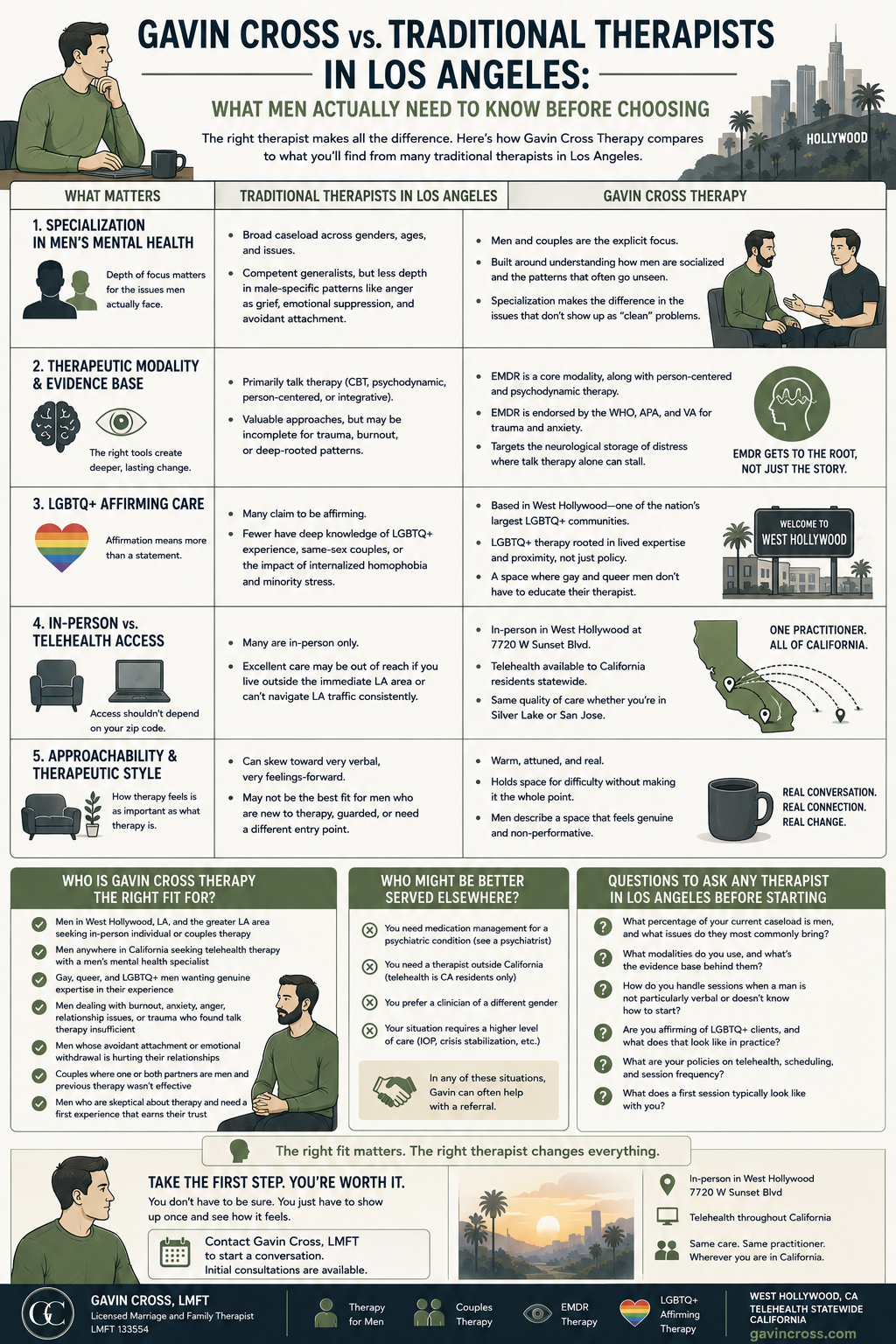
This practice works best for:
Being honest is part of how this practice operates. This may not be the right fit if:
In any of those situations, Gavin can often help with a referral.
Regardless of whether you reach out here or elsewhere, these are the questions that actually matter:
The answers to those questions will tell you more than any website description. And if you want a broader framework for evaluating fit, the guide to finding the right therapist covers how to navigate the search step by step.
The decision to find a therapist is the hard part. The decision to find the right one is the important part. Men who end up in a therapeutic relationship that doesn't fit them often walk away with a confirmed belief that therapy doesn't work for them, when what didn't work was that specific match.
If you think this might be the right place, the next step is simple. Contact Gavin Cross, LMFT to start a conversation. Initial consultations are available. You don't have to be sure. You just have to show up once and see how it feels.
Sessions with Gavin Cross are available in person in West Hollywood and virtually throughout California.
Gavin Cross is a Licensed Marriage and Family Therapist (LMFT 133554) based in West Hollywood, CA, with telehealth available statewide in California. He specializes in therapy for men, couples therapy, and EMDR.
There’s a big, beautiful world out there. You deserve to experience all it has to offer.
Let’s rediscover your strength.
