


You do not think of yourself as someone with trauma. That word belongs to someone else, someone whose story is more dramatic, more obviously broken. You just know that you are on edge more than you should be, that certain conversations put you somewhere else entirely, that your body tightens before your mind knows why. You have been operating at a low-grade intensity for so long that it has become your baseline. You call it being driven. You call it staying sharp. What you are actually doing is carrying something your nervous system never had the chance to put down.
This post is for men who are still carrying it. Not because they are weak, but because no one ever told them what was happening inside their own bodies, and no one gave them a way through it that did not require them to perform a kind of emotional fluency they were never taught.
The way most men think about trauma is as something that happened, a story from the past that you either get over or you do not. But trauma researchers and clinicians have understood for decades that this framing misses the point entirely. Trauma is not primarily a narrative. It is a physiological event that gets stored in the body when the nervous system cannot complete its natural threat response cycle.
When you encounter a threat, your brain activates your sympathetic nervous system. Cortisol and adrenaline flood your body. Your heart rate increases. Your muscles prepare to fight or run. Your prefrontal cortex, the part of your brain responsible for reasoning and language, goes partially offline. The body mobilizes everything it has to survive the moment.
When the threat passes, the system is designed to discharge. Animals shake after a near-death experience. Their nervous systems complete the cycle. But humans, particularly men trained to suppress physical and emotional expression, often do not complete that discharge. They override it. They hold it in. The energy stays stored in the body, the threat signal stays active, and the nervous system stays in a state of partial readiness for a danger that is no longer present.
This is what the National Institute of Mental Health describes as the core of PTSD: a nervous system that cannot correctly distinguish between the past and the present. The body keeps running the old threat program. And for many men, that program has been running so long they do not realize it is running at all.
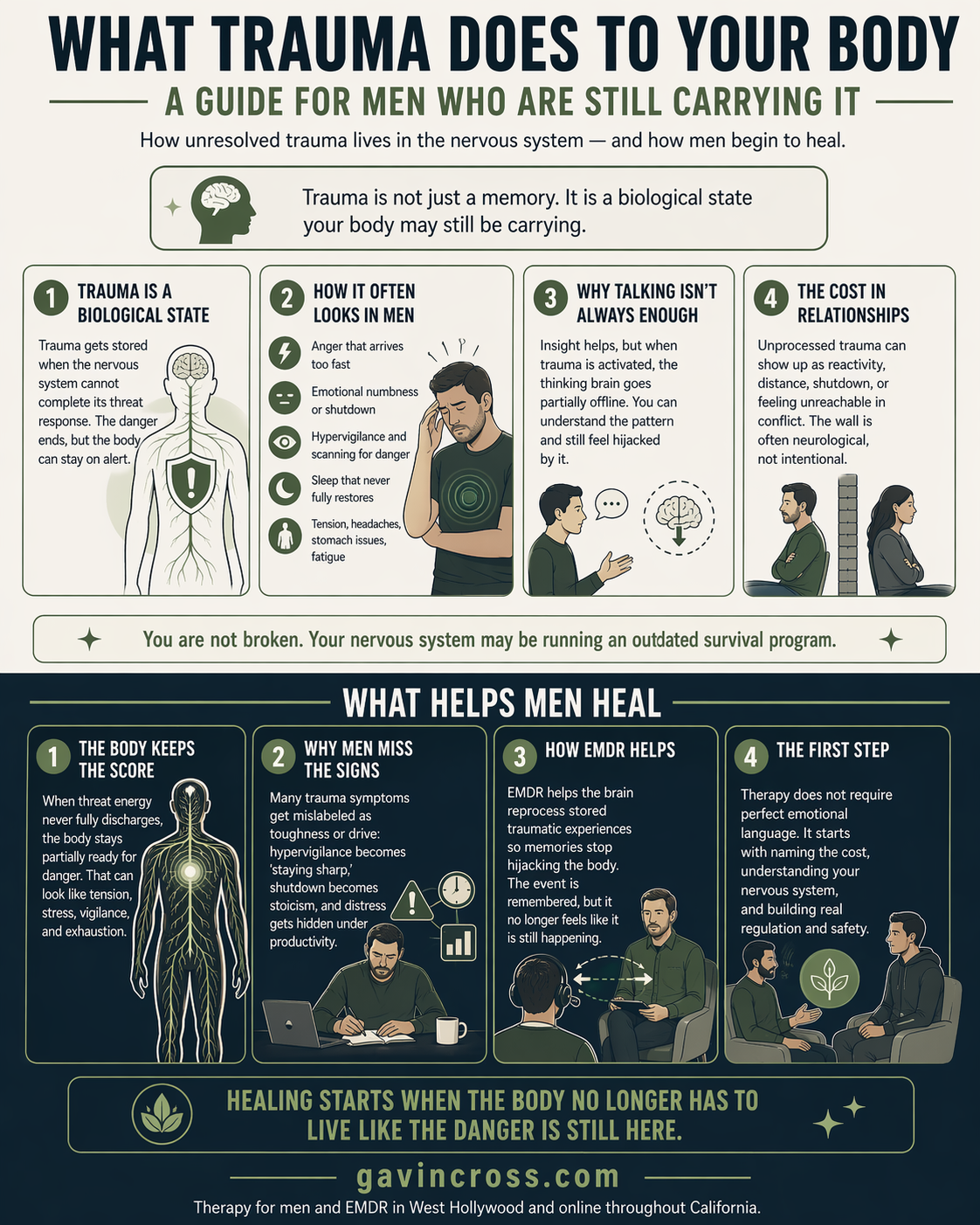
Men and women can both carry unprocessed trauma, but the way it surfaces often looks different because of how men are socialized to manage and express distress. The therapist sitting across from a man rarely hears "I think I have trauma." What they hear instead is a collection of complaints that, taken together, point directly at a dysregulated nervous system.
Here is what trauma in men commonly looks like in practice. The anger that arrives too fast and too hot for the situation, the kind you regret within minutes but cannot seem to stop. The emotional flatness in moments that should mean something to you. The hypervigilance in public, the compulsive scanning for what is wrong, the inability to relax even in safe environments. The sleep that never fully restores you because your brain stays partially alert through the night. The way certain tones of voice, certain looks, certain silences can transport you somewhere else before you know what happened.
You might also recognize the physical side. Chronic jaw tension or headaches. A tight chest that is not a cardiac problem but feels like one. Gastrointestinal issues that no diet change fully resolves. An underlying fatigue that rest does not fix. The body is not malfunctioning. It is responding to an ongoing internal signal that has not been cleared.
The American Psychological Association notes that men are less likely to seek help for trauma-related symptoms, in part because many of those symptoms are socially rewarded in male contexts. Hypervigilance becomes being alert and dependable. Emotional shutdown becomes stoicism and reliability. The capacity to override physical distress becomes toughness. The system continues to run under the surface, and the cost compounds quietly over years.
If you recognize yourself in any of this, the relevant question is not whether your experiences qualify as trauma, but whether your body is still responding as if the threat is present. If the answer is yes, that is worth addressing, regardless of what label gets put on it. Therapy for men that addresses this level of experience goes significantly deeper than advice or coping strategies. It works with the nervous system directly.
Talk therapy is genuinely useful for many things. It helps you understand your patterns, see your history with more clarity, and develop insight into why you do what you do. For men who have never had a space to think out loud about their inner lives, the experience of being heard without judgment is itself therapeutic in ways that are hard to overstate.
But there is a ceiling to what language can do for stored trauma. When a traumatic memory is activated, the prefrontal cortex, the part of the brain that generates narrative and meaning, goes partially offline. You are no longer operating from your thinking brain. You are in the body, in the threat response, in the same physiological state the original experience produced. Talking about it from inside that state often reinforces the activation rather than resolving it. You revisit the story, feel the charge, manage it as best you can, and then carry it back out with you.
This is why many men who have spent years in traditional therapy still find themselves hijacked by the same triggers, still reacting in ways they understand intellectually but cannot stop. Understanding why you do something and being able to change it are two different neurological processes. Insight does not automatically translate to regulation.
What is needed in those cases is an approach that works at the level of the nervous system itself, something that addresses the stored threat signal directly rather than processing it through language and cognition alone. That is where EMDR therapy enters the picture.
Eye Movement Desensitization and Reprocessing, known as EMDR, is a structured therapy approach developed by Francine Shapiro in the late 1980s and now among the most well-researched trauma treatments available. It is recommended by the World Health Organization, the American Psychological Association, and the Department of Veterans Affairs specifically for trauma and PTSD.
The mechanism involves bilateral stimulation, typically eye movements, tapping, or auditory tones that alternate between left and right sides of the body while you hold a distressing memory in mind. The theory, supported by a substantial body of research, is that this bilateral stimulation mimics the neurological processing that occurs during REM sleep, allowing the brain to move a fragmented, threat-tagged memory into normal long-term storage where it loses its power to activate the threat response.
In practical terms, what men who complete EMDR treatment often report is not that the memory is gone. It is that the memory no longer hijacks the body. They can think about the experience without going into the physiological state it previously triggered. The event becomes something that happened rather than something that is still happening.
For men specifically, EMDR has an additional practical advantage: it does not require you to be highly verbally expressive to make progress. You do not need to find the right words for what happened or tell the story in a particular way. The processing happens below the level of narrative, which means men who shut down when asked to talk about difficult experiences can still access and resolve those experiences in a way that traditional talk therapy alone does not always allow.
If you are working with unresolved experiences from your past and want to understand whether EMDR might be appropriate for your situation, the first step is a consultation. You can contact Gavin Cross, LMFT or call (323) 870-2557.
Unprocessed trauma does not stay contained to the individual carrying it. It shapes how you show up in every close relationship you have. The ways you protect yourself from perceived threat, the distances you maintain, the intensity of your reactions to certain dynamics, these patterns make complete sense in the context of what your nervous system learned. But the people in your life experience the effects without that context, and the gap between your internal experience and their external experience of you creates a particular kind of relational damage that is difficult to repair through effort alone.
Many of the men who come to couples therapy are carrying individual trauma that has become a relational problem. Their partners describe them as emotionally unavailable, reactive, or unreachable in conflict. They describe themselves as trying but hitting a wall they cannot get past. Both descriptions are accurate. The wall is neurological. It was built for survival and it does not come down through willpower or good intentions.
Addressing the individual trauma alongside the relationship work produces a qualitatively different outcome than relationship skills training alone. When the nervous system is regulated, the tools actually work. When it is not, every communication technique you learn gets overwhelmed the moment the threat signal fires.
The barrier most men describe when considering therapy is not actually skepticism about whether it works. It is the threshold of the first conversation. Sitting across from someone and saying out loud that something is wrong, something that has been running in the background for years, something you have managed and compensated for and built a life around, that is a harder thing than it sounds.
What gets men through that threshold, in my experience working with them, is usually one of two things. Either the cost has become undeniable, something in work, relationships, or health has deteriorated to the point where continuing as-is is no longer viable. Or they find a way to frame the work not as addressing weakness, but as developing a capability they have not had access to. The second framing is more accurate. You are not broken. Your nervous system is running an outdated program. Therapy is the process of updating it.
The work is specific. It is grounded in what is actually happening in your body and your life. It does not require you to become someone who talks endlessly about feelings. It does require you to show up and engage, but that is a standard men who have been carrying this for years are already well equipped to meet.
Trauma dysregulates the nervous system, locking the body in a state of chronic threat readiness. In men, this often presents as muscle tension, rage responses, emotional numbness, sleep disruption, hypervigilance, and a shortened fuse. These are not character flaws. They are physiological adaptations the body made to survive something it was not equipped to process alone.
Men are socialized to reframe trauma symptoms as strength or normalcy. Hypervigilance becomes staying alert. Emotional shutdown becomes being tough. Anger becomes drive. Because the symptoms are socially rewarded, men often do not identify them as trauma responses until the cost becomes undeniable in relationships, health, or work.
EMDR (Eye Movement Desensitization and Reprocessing) is a structured therapy that uses bilateral stimulation to help the brain reprocess distressing memories stored in a fragmented, threat-active state. Unlike talk therapy alone, EMDR works at the level of the nervous system, allowing men who struggle to verbalize their experiences to access and resolve trauma without needing to find the right words first.
Yes. EMDR therapy is effective for both single-incident trauma and complex or developmental trauma, including wounds from childhood. Many men carry early experiences of neglect, emotional unavailability, or high-pressure households that shaped their current relationship and behavioral patterns. EMDR addresses the stored memory at its root rather than managing surface-level symptoms.
If this resonates with you, the next step is a conversation. Gavin Cross is a Licensed Marriage and Family Therapist specializing in therapy for men and EMDR therapy in West Hollywood and online throughout California. Sessions are available in-person and virtually. Contact Gavin Cross, Licensed Marriage and Family Therapist to schedule a free 15-minute consultation.
There’s a big, beautiful world out there. You deserve to experience all it has to offer.
Let’s rediscover your strength.
