


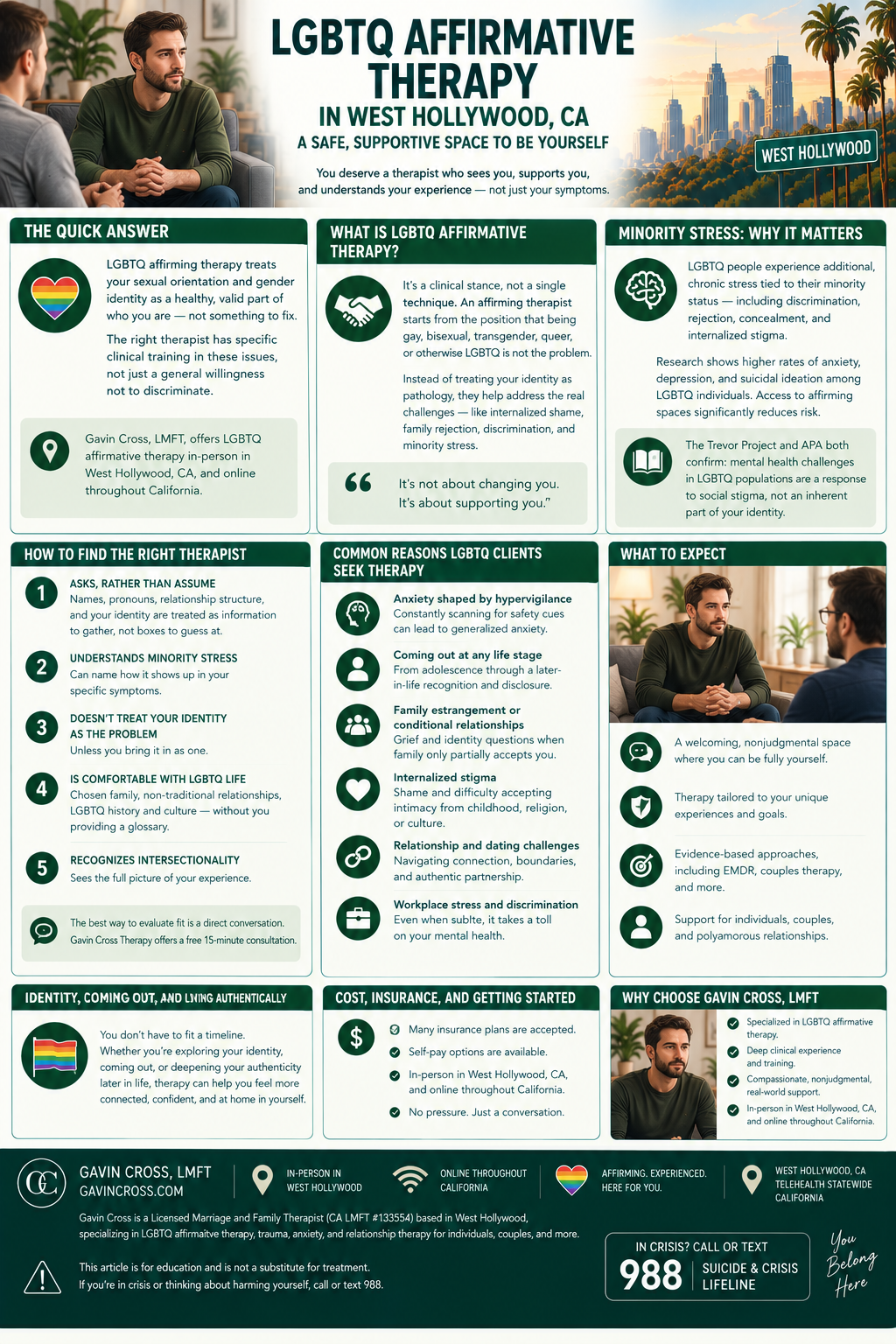
Quick answer: LGBT affirming therapy is care that treats your sexual orientation and gender identity as a healthy, valid part of who you are, not something to fix, while directly addressing the real mental health impact of minority stress, discrimination, and rejection. The right therapist has specific clinical training in these issues, not just a general willingness not to discriminate. Gavin Cross, LMFT, of Gavin Cross Therapy, offers LGBTQ affirmative therapy in-person in West Hollywood, CA, one of the country's most historically significant LGBTQ communities, and online to clients throughout California. This guide covers what to look for, what to expect, and how to get started.
1. Minority Stress: The Research Behind Why This Matters
2. How to Find the Right LGBTQ Affirming Therapist
3. Common Reasons LGBTQ Clients Seek Therapy
4. What is LGBTQ Affirmative Therapy?
5. Identity, Coming Out, and Living Authentically at Any Age
6. LGBTQ Relationships and Couples Work
7. What to Expect in Your First Session
8. Cost, Insurance, and Getting Started
9. Why West Hollywood, and Why Gavin Cross, LMFT
10. Frequently Asked Questions
The minority stress model explains that LGBTQ people experience additional, chronic stress specifically tied to their minority status, expectations of rejection, the effort of concealing identity in unsafe contexts, internalized stigma, and actual experiences of discrimination. The Trevor Project's most recent U.S. National Survey continues to document elevated rates of anxiety, depression, and suicidal ideation among LGBTQ people, and consistently finds that access to at least one LGBTQ-affirming space significantly reduces risk. The APA's resources on sexual orientation similarly emphasize that mental health difficulties in LGBTQ populations are best understood as a response to social stigma, not an inherent feature of LGBTQ identity.
"LGBTQ-friendly" has become a low bar, it often just means a therapist won't actively discriminate. Affirmative therapy is a meaningfully higher standard. Look for a therapist who:
1. Asks, rather than assume names, pronouns, relationship structure, and how you define your own identity are treated as information to gather, not boxes to guess at.
2. Understands minority stress as a clinical concept, not just an abstract sympathy point, and can name how it might be showing up in your specific symptoms.
3. Don't treat your identity as the presenting problem unless you bring it in as one.
4. Is comfortable with the specifics of LGBTQ life, chosen family, non-traditional relationship structures, LGBTQ history and culture, without you providing a glossary.
5. Recognizes intersectionality and doesn't treat LGBTQ identity as a single, uniform experience.
The best way to evaluate fit is often a direct conversation. Gavin Cross Therapy offers a free 15-minute consultation specifically so you can assess this before committing to ongoing sessions.
LGBTQ affirmative therapy isn't a single technique, it's a clinical stance woven through every technique used. An affirming therapist starts from the position that being gay, bisexual, transgender, queer, or otherwise LGBTQ is not the problem; the problems, when they exist, tend to come from internalized shame, family rejection, workplace discrimination, or the vigilance required to assess whether a space is safe. According to the APA's guidelines for psychotherapy with lesbian, gay, and bisexual clients, affirmative practice requires clinicians to understand the social and legal context LGBTQ clients navigate and to avoid treating identity itself as pathology. LGBTQ affirmative therapy is one of the central services offered at Gavin Cross Therapy.
Coming out isn't a single event, it's frequently an ongoing series of decisions about disclosure, safety, and authenticity that shifts with every new job, relationship, and family gathering. Therapy can help with the specific, concrete version of this: deciding how to come out to a specific person, processing a reaction that didn't go the way you hoped, or working through the grief of a life built around concealment before you're ready to unbuild it. For clients coming out later in life, LGBTQ affirmative therapy holds space for the fact that this can be simultaneously the right decision and genuinely difficult.
LGBTQ couples often navigate specific dynamics that generic relationship advice doesn't address: minority stress affecting both partners simultaneously, differing levels of outness, navigating family acceptance as a couple, and building relationship models without cultural scripts to fall back on. Gavin Cross Therapy offers dedicated gay relationship therapy in West Hollywood and online throughout California, alongside broader couples therapy services, drawing on attachment theory and EMDR to help partners understand the deeper patterns underneath their conflict.
Affirmative care isn't one-size-fits-all, and the specific issues that show up in session vary meaningfully across the community. Gay and bisexual men often bring in dynamics around dating culture, body image, and the particular expression of minority stress within gay social spaces. Bisexual clients frequently navigate a distinct form of erasure, having their identity questioned or minimized by both straight and gay communities alike which can compound isolation in ways that are easy for a non-specialized therapist to miss entirely. Transgender and gender-nonconforming clients often bring additional layers: navigating medical and legal systems, managing disclosure decisions with new levels of risk attached, and processing family or workplace reactions to a transition, all of which require a therapist genuinely fluent in these specifics rather than generally sympathetic to them.
Queer-identified clients of all kinds may also be navigating relationship structures, including non-monogamy, without mainstream scripts to draw on, which is its own area of clinical competence. An affirming therapist doesn't need lived experience identical to yours, but does need genuine, demonstrated familiarity with the specific terrain you're navigating, which is exactly what to listen for during an initial consultation.
A first session with Gavin Cross, LMFT starts with an ordinary, unhurried conversation about what's bringing you in, with no glossary required, no explanation of basic terms expected. Sessions are available in-person at 8702 Santa Monica Blvd in West Hollywood, within the heart of the community, or via online therapy for LGBTQ clients throughout California, which is especially valuable for clients outside major LGBTQ hubs with limited access to specialized, affirming local care.
Gavin Cross Therapy operates on an out-of-network basis and can provide a superbill for potential insurance reimbursement. The easiest way to start is a free 15-minute consultation, whether you're planning in-person sessions in West Hollywood or online therapy services for California residents.
West Hollywood holds a unique place in LGBTQ history and culture, one of the first cities in the United States incorporated with an openly gay-majority city council, and a cultural anchor for LGBTQ life in Los Angeles. That context matters clinically, not just symbolically: therapy that happens within a community that has built infrastructure, visibility, and history around LGBTQ life looks different from therapy that happens in isolation from it. Gavin Cross, LMFT (License #133554) is based directly in this community, with training in LGBTQ affirmative care, EMDR, and Restoration Therapy Level II, and a practice built around LGBTQ individuals and couples alongside men's mental health. Learn more about Gavin Cross, LMFT, browse the full range of therapy services, or read testimonials from past and current clients.
For clients who don't have this kind of specialized, affirming care available where they live, online therapy for California residents closes that gap directly, bringing West Hollywood-rooted, LGBTQ-affirmative clinical expertise to clients anywhere in the state, from rural counties to cities without a concentrated LGBTQ community of their own.
How do I find the right LGBTQ affirming therapist?
Look for specific clinical training in minority stress and LGBTQ issues (not just general acceptance), comfort with the practical specifics of LGBTQ life, and a fit you can test directly. Book a free consultation to get started.
What's the difference between "LGBTQ-friendly" and "LGBTQ-affirmative"?
"Friendly" typically means a therapist won't discriminate but may lack specific training. "Affirmative" means the therapist has clinical training in minority stress and identity development and actively incorporates it into treatment, per APA guidelines.
Do I need to be "out" to start therapy?
No. Many clients begin therapy specifically to process questions about their identity or whether and how to come out.
Is LGBTQ affirmative therapy only for identity-related issues?
No, it applies to any concern, with the understanding that identity and minority stress may intersect, even when not the primary focus.
Can LGBTQ affirmative therapy be done online?
Yes. Gavin Cross Therapy offers online LGBTQ affirmative therapy to clients throughout California.
Does this include couples and relationship work?
Yes, view the gay relationship therapy and couples therapy services pages for more information.
How much does LGBTQ affirming therapy cost, and is it covered by insurance?
Gavin Cross Therapy operates out-of-network and provides a superbill for potential reimbursement. Specifics are covered in your free consultation.
Where is Gavin Cross Therapy located?
Gavin Cross Therapy is located at 7720 W Sunset Blvd West Hollywood, CA 90069, with online therapy available throughout California.
I'm bisexual/trans/nonbinary, is this practice specifically equipped for that, or mainly focused on gay men?
While much of Gavin Cross Therapy's client base is gay and bisexual men, LGBTQ affirmative therapy is grounded in the same minority stress framework that applies across the full spectrum of LGBTQ identities. The best way to confirm fit for your specific situation is a direct conversation during your free consultation, where you can ask about experience with your specific identity or circumstances.
How is this different from a general therapist who says they're "open-minded"?
Being open-minded is a baseline, not a specialization. Affirmative therapy requires specific clinical training in concepts like minority stress and identity development, along with practical fluency in LGBTQ life, not just an absence of judgment.
Can I switch to affirmative therapy if my current therapist isn't a good fit?
Yes, and this is a common and reasonable reason to change therapists. You don't need to justify the switch extensively or worry about hurting a previous therapist's feelings, finding the right fit, especially around something as central as identity, matters more than continuity with a therapist who isn't meeting that need.
How do I actually get started?
The simplest first step is requesting a free 15-minute consultation through Gavin Cross Therapy's contact page, a low-pressure way to briefly describe what's going on, ask questions about LGBTQ affirmative therapy services, and decide together whether ongoing sessions, in-person in West Hollywood or online from anywhere in California, are the right next step.
There’s a big, beautiful world out there. You deserve to experience all it has to offer.
Let’s rediscover your strength.
