


You have probably apologized for your anger more times than you can count. You have promised to do better, tried to stay calm, talked yourself through it, and still found yourself in the same place: something flips, the temperature rises, and whatever you were actually feeling comes out wrong. What comes out is heat. What you were actually feeling was something else, something quieter and more specific, something you were never given the language or the permission to say directly.
This is not a character defect. It is the predictable outcome of a particular kind of emotional training most men received without realizing it. You were handed one tool for a very wide range of internal experiences, and you used it because it was the only one available. Understanding what is actually underneath the anger is not about excusing it. It is about finding a more direct route to what you actually need.
Watch how boys are raised in almost any cultural context and you will notice a consistent pattern. Sadness gets redirected. Fear gets dismissed. Hurt is met with "toughen up." Grief is given a deadline. But anger, or at least its surface forms, gets tolerance. It reads as strong. It reads as powerful. It does not expose you.
The result, by the time most men reach adulthood, is that an enormous range of emotional experiences has been funneled into a single output channel. A man who feels afraid expresses it as irritability. A man who feels hurt expresses it as aggression. A man who is grieving expresses it as a short fuse. The underlying emotions are genuine. The expression is the only one that felt safe enough to use.
The American Psychological Association has documented this pattern extensively, noting that men report anger as their most socially acceptable emotion while describing significant difficulty identifying and expressing other emotional states. The problem is not that men feel too much anger. It is that anger is doing the work of multiple emotions it was never designed to carry.
If you have been told your whole life that emotional expression is weakness, and then you experience something that actually hurts, the nervous system routes that experience through the one channel it knows will not expose you. The anger is real. But it is not the whole story.
In clinical work with men, the same pattern appears with remarkable consistency. Underneath most anger is one of three things.
The first is fear. Not dramatic, movie-version fear, but the quieter threat response that activates when something important feels unstable. Your relationship. Your status. Your sense of being respected or valued. When that sense of threat activates, and you have no practiced way to say "I'm scared," it comes out as anger. The anger keeps you from having to be vulnerable about what is actually at stake.
The second is grief. Men grieve losses they were never given space to mourn: fathers who were absent or critical, relationships that ended badly, versions of their lives they let go of, opportunities they missed. Unprocessed grief does not go away. It stays in the body as a low-grade heaviness that makes everything more reactive. Small frustrations hit harder than they should because they land on top of something much larger that has never been released.
The third is hurt, the specific variety that comes from feeling dismissed, disrespected, unseen, or let down by someone whose opinion of you mattered. Men will almost universally resist the word "hurt." It sounds weak. It sounds like something that should not affect them. But the physiological experience of feeling dismissed by someone you love produces a real wound, and that wound, untended, keeps firing.
The anger is the protective layer over one of these three things. When you can identify which one is actually present in a given moment, the anger loses some of its compulsive quality. You are not trying to suppress it. You are finding a more direct route to what the situation actually calls for. This kind of work is central to therapy for men who are tired of cycling through the same reactive patterns.
Anger expressed as a primary emotion does particular damage in close relationships because of the gap it creates between what you were trying to communicate and what your partner actually received. You were attempting a bid for connection, reassurance, or acknowledgment. What landed was an attack or a threat. Your partner goes into self-protection. You feel more unseen than you did before. The cycle tightens.
Over time, partners of men who express primarily through anger begin to manage around it. They stop bringing up difficult topics. They become careful about tone. They minimize their own needs to avoid triggering a response. The relationship becomes a surface tension exercise rather than a genuine connection, and the man, who can feel the distance but not trace its origin, often responds to that distance with more of the same behavior that created it.
If this describes your relationship dynamic, it is worth noting that the problem is not that you are a bad partner or an unsafe person. It is that a significant portion of your emotional communication is being routed through a channel that garbles the signal. Couples therapy can address the relational patterns, and individual work on the emotional layer beneath the anger tends to produce faster and more durable change in those patterns than relationship skills training alone.
Chronic anger is not just a relational problem. It is a physiological one. When anger fires, cortisol and adrenaline flood the body, the cardiovascular system activates, and the inflammatory response increases. When this happens repeatedly, the cumulative physical cost is substantial. Elevated blood pressure. Disrupted sleep. Compromised immune function. Heightened cardiovascular risk.
Research published through the National Institute of Mental Health notes that men's mental health issues are often expressed through behavioral and physical symptoms before they are recognized as mental health concerns. Chronic anger that is carrying unprocessed emotional weight is one of the clearest examples of this. The body is paying for what the mind has not processed.
This is also why addressing the emotional content underneath the anger tends to produce physical improvements as well. When the underlying fear, grief, or hurt is processed and expressed directly, the nervous system does not need to maintain the same level of activation. The physical symptoms that have accompanied the anger often ease along with it.
Most men have had the experience of an argument ending and then realizing, somewhere in the hours that followed, what was actually going on for them in that moment. The situation was not really about what was said. It was about feeling like your effort was not being seen. Or about a fear that the relationship was drifting in a direction you did not choose. Or about something from earlier in the week, earlier in your life, that got activated by what happened and had nowhere to go except out.
That post-argument clarity is not a mystery. It is your prefrontal cortex coming back online after the threat response settled. The emotion that was present in the moment was real. The problem was the channel it had available. The work of individual therapy for men dealing with anger is essentially the work of building a wider emotional vocabulary and a faster path to the primary emotion, so that the clarity you currently access two hours later becomes available in the moment itself.
That shift does not require you to become emotionally performative or to talk about feelings in ways that feel foreign. It requires learning to notice, with some degree of real-time accuracy, what is actually happening inside your own body when activation begins. That is a learnable skill. It is not a personality transplant.
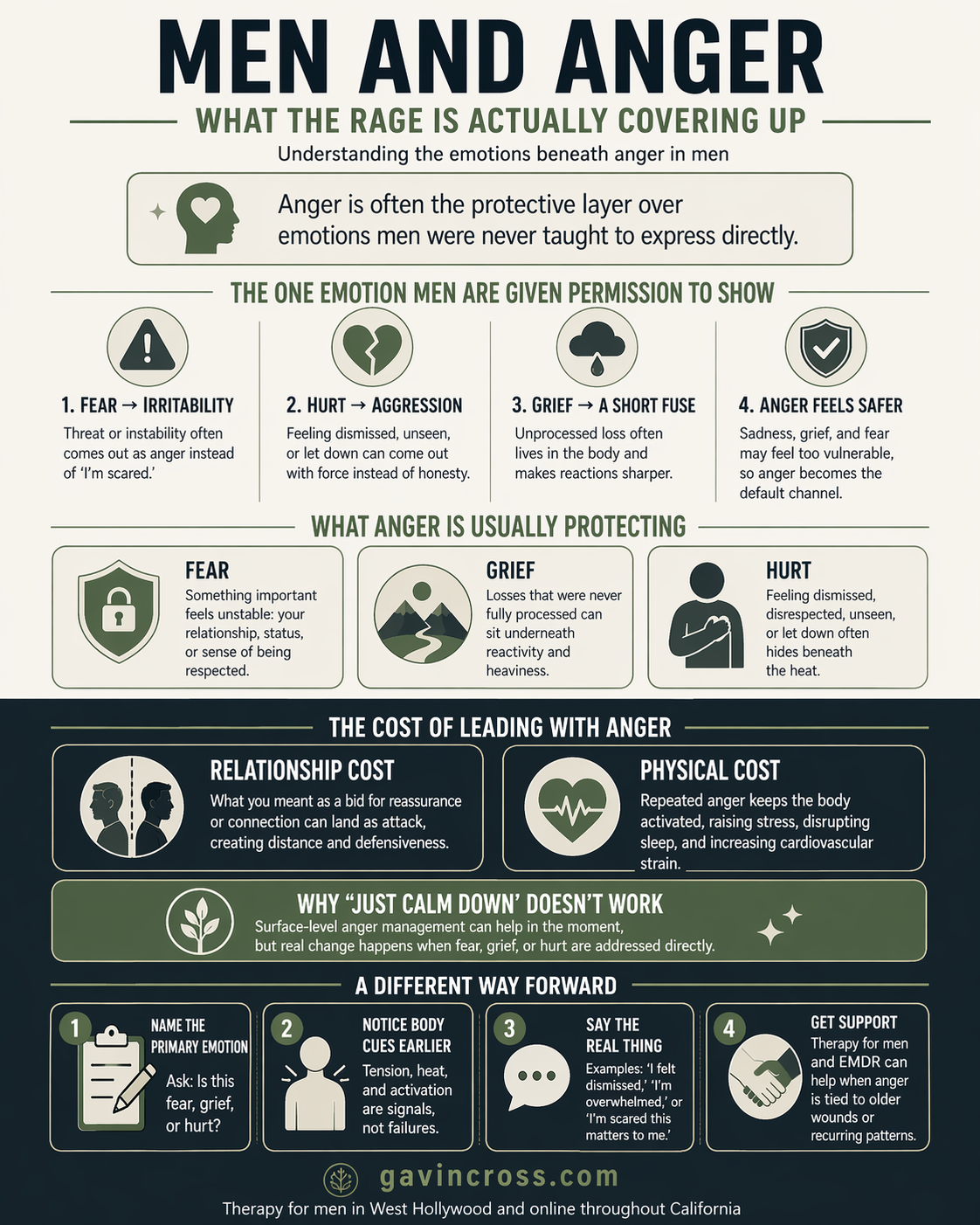
If the anger were a simple volume problem, calming down would solve it. But when the anger is carrying suppressed fear, grief, or hurt, telling yourself to calm down is asking the protective layer to stand down without giving the underlying wound anything. The wound remains. The pressure builds. The next trigger comes. The cycle repeats.
This is why techniques that focus on anger management as a performance, slow your breathing, count to ten, walk away, produce limited results for men whose anger is doing deep emotional work. The techniques are not wrong. They just operate at the surface of a problem that has roots significantly deeper. Managing the expression while the underlying experience goes unaddressed is a pressure-release valve, not a repair.
Effective work goes to what the anger is protecting. That work often involves EMDR therapy when the anger has roots in earlier experiences, particularly for men whose reactivity traces back to childhood dynamics around criticism, unpredictability, or emotional unavailability. EMDR addresses the stored memory that keeps reactivating, rather than asking you to manage the activation repeatedly for the rest of your life.
Anger is often the only emotion boys are given cultural permission to display. Fear, sadness, hurt, and grief get labeled as weakness and suppressed early. Over time, those emotions get rerouted through anger because anger feels powerful rather than vulnerable. The underlying emotion is still present. It just comes out with force instead of directness.
Underneath most male anger is one of three things: fear that something important is being threatened, grief over a loss that was never allowed to be mourned, or hurt from a wound that was never acknowledged. Anger is the protective layer. The emotion underneath it is usually much more specific and much more vulnerable than the anger itself suggests.
Anger as a primary emotional expression creates distance in relationships. Partners experience it as unsafe or unpredictable and begin to withhold, manage around it, or disconnect. The man often feels misunderstood because what he expressed as anger was actually a bid for something: connection, reassurance, acknowledgment. The bid lands as an attack. The gap widens on both sides.
Yes, and effectively. Therapy for men dealing with anger does not focus on suppressing it or performing calmness. It focuses on identifying the primary emotion underneath the anger and developing the capacity to access and express that emotion directly. When a man can say "I felt dismissed" instead of exploding, the anger loses its compulsive quality because the real need is finally being communicated.
If you are exhausted from the cycle of reacting, apologizing, and repeating, that exhaustion is useful information. It means a part of you already knows this approach is not working and that something different is worth trying. The work is specific, practical, and focused on outcomes. You do not need to become a different kind of person. You need access to a wider range of what you already feel.
Gavin Cross is a Licensed Marriage and Family Therapist specializing in therapy for men in West Hollywood and online throughout California. Contact Gavin Cross, LMFT to schedule a free consultation.
There’s a big, beautiful world out there. You deserve to experience all it has to offer.
Let’s rediscover your strength.
