


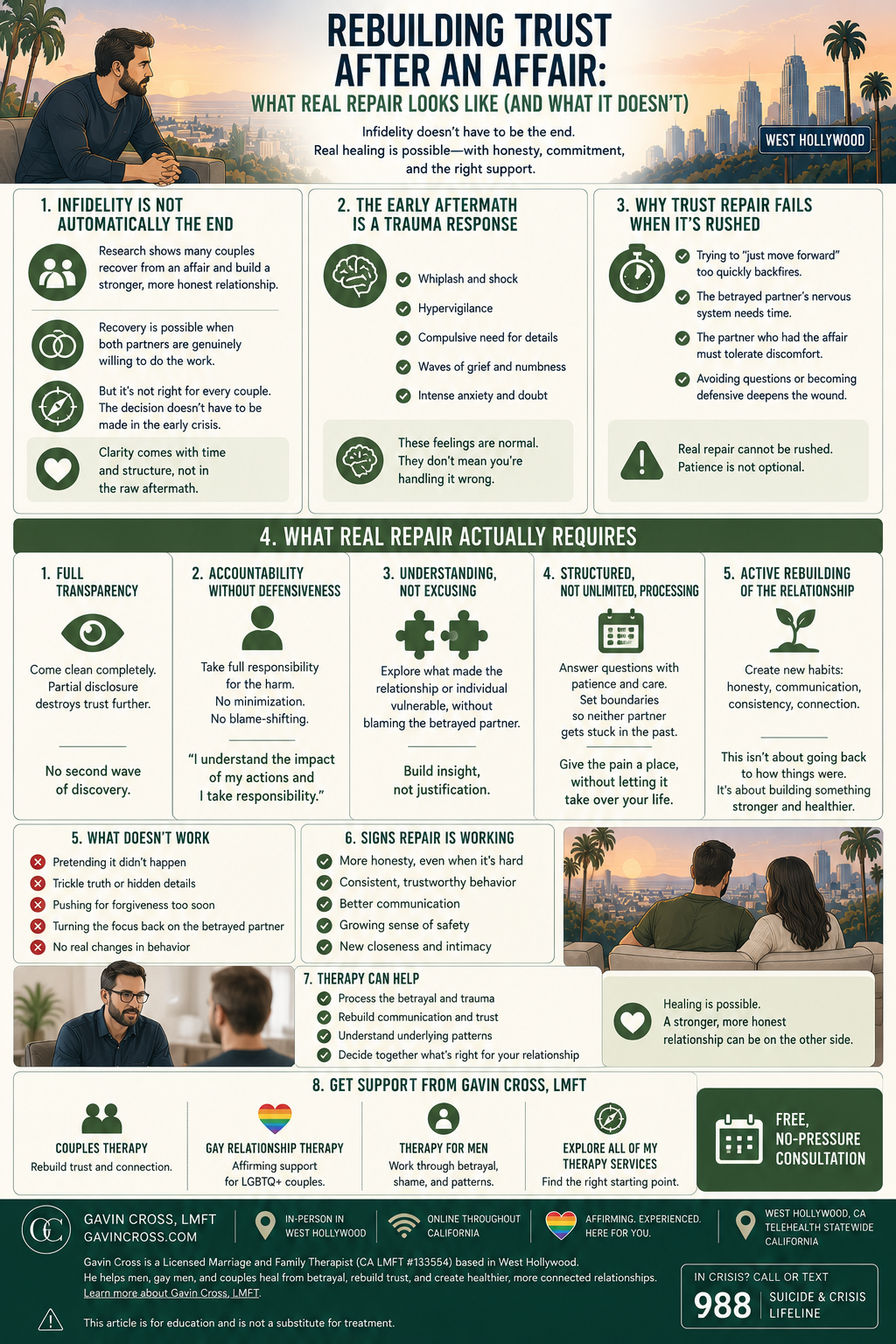
Right now you might be somewhere between two extremes: convinced the relationship is over, or desperately hoping that if you both just try hard enough, things can go back to how they were before. Neither of those is quite where healthy repair actually lands. Infidelity does not automatically end a relationship, and it does not simply heal with enough time and good intentions either. Real repair is a specific, learnable process, and understanding what it actually requires is often the difference between couples who rebuild something genuinely stronger and couples who patch things over only to have the same wound reopen a year later.
If you are reading this in the raw, disorienting aftermath of a discovery or a disclosure, the first thing worth knowing is that what you are feeling right now, the whiplash, the hypervigilance, the compulsive need to know every detail, the moments of eerie calm followed by a wave of grief, is a normal trauma response, not a sign that you are handling this wrong.
It can feel that way in the first weeks. But research consistently shows that affairs, while serious and destabilizing, are not inherently fatal to a relationship. The Gottman Institute, which has spent decades studying what separates couples who recover from those who do not, has found that recovery is possible for couples who are both genuinely willing to do the work, and that some couples report their relationship becoming more honest and more intimate on the other side of a well-handled repair process than it was before the betrayal.
That does not mean every relationship should be repaired, or that staying together is automatically the right outcome. It means the decision does not have to be made in the first raw weeks, under maximum distress, with incomplete information about whether real repair is possible. Clarity tends to come with time and structure, not in the immediate aftermath.
The most common mistake couples make is trying to move past the affair faster than the betrayed partner's nervous system is actually able to. A well-meaning but premature "let's just move forward" from the partner who had the affair, often motivated by genuine guilt and a desire to stop the pain, tends to backfire, because it skips stages of repair that cannot actually be skipped. The betrayed partner is left feeling both the original injury and now also invalidated for still hurting on a timeline someone else decided was too long.
Genuine repair requires the partner who broke trust to tolerate their partner's pain, questions, and doubt for considerably longer than feels comfortable, without becoming defensive or rushing the process toward resolution. This is often the hardest single skill required of the partner who caused the injury, and it is also the one most correlated with successful repair.
Partial honesty, admitting to some but not all of what happened, or minimizing details to protect yourself from further judgment, tends to do more damage than a harder, fuller truth delivered once. Discovering additional details later, even smaller ones, resets the trust-building clock and confirms the betrayed partner's worst fear: that they still cannot trust what they are being told. Full transparency does not mean answering every forensic question the betrayed partner asks forever. It means the initial disclosure is genuinely complete, so there is no second wave of discovery waiting to detonate months later.
This means acknowledging the specific impact of what happened, not offering a general apology that centers the apologizer's guilt over the partner's pain. There is a meaningful difference between "I'm sorry you're hurt" and "I understand why what I did has made it hard for you to trust anything I say right now, and I take full responsibility for that." The second version does the actual relational work. The first one, however well-intentioned, often lands as minimizing.
At some point, usually not in the first few weeks, it becomes useful to understand what made the relationship or the individual vulnerable to an affair happening: unmet needs that were never voiced, a pattern of emotional disconnection that predated the affair, an individual's own unresolved history that shaped a capacity for secrecy or avoidance. This is delicate work, because understanding the context can easily slide into implicitly blaming the betrayed partner for the affair, which is never accurate and never helpful. Done well, this stage builds insight without diffusing responsibility.
Betrayed partners often experience an intense, sometimes obsessive need to ask questions, check details, and revisit the story. This is a trauma response, and in the early stages it deserves patience rather than pushback. Left completely unstructured over the long term, though, endless processing can become its own trap, keeping both partners locked in the injury rather than moving through it. A therapist can help build a container for this: enough space to fully process, with an eventual shift toward integration rather than indefinite repetition.
Trust does not return through grand gestures. It returns through the accumulation of small, reliable moments: following through on a stated plan, being where you said you would be, offering transparency without being asked for it. A widely cited finding in trust repair research is that trust is rebuilt through consistency over time far more than through any single reassurance, however sincere. This is often the most frustrating part for the partner who caused the injury, because it requires patience with a slow, unglamorous process rather than a single redemptive act that resolves everything at once.
A few common instincts, however understandable, tend to slow repair rather than accelerate it.
Rushing forgiveness. Forgiveness pressured into existence before it is genuinely felt tends to resurface later, often at a moment that seems unrelated, because it was never actually resolved.
Surveillance as a substitute for trust. Location tracking, password access, and constant check-ins can feel necessary in the earliest weeks, and for a period that is reasonable. Used indefinitely as a long-term structure, they tend to prevent the relationship from ever developing organic trust again, because trust never gets tested and rebuilt through actual reliability, only monitored.
Avoiding the topic entirely. Some couples try to protect the relationship by simply not discussing the affair after an initial conversation. This usually does not resolve the injury. It buries it, and buried injuries in relationships tend to resurface, often during unrelated conflicts, in a way that is harder to trace back to the original wound.
One partner doing all the work. Repair requires genuine engagement from both partners, though in different roles. If you are the partner who was betrayed, couples therapy is not solely about your partner earning back trust. It also involves examining what you need in order to genuinely heal, which sometimes includes individual work alongside the couples work.
For some partners, betrayal reopens older wounds: a previous relationship injury, an attachment pattern rooted in childhood, or trauma that had nothing to do with this relationship but is now activated by it. If the pain of the affair feels disproportionately large, or if you find yourself reacting in ways that surprise even you, that can be a sign that this injury is connecting to something older. EMDR therapy can be useful here, since it addresses the way older experiences get stored and reactivated, which talk therapy about the current situation alone sometimes cannot fully reach. This is related to the pattern explored in avoidant attachment and how it plays out in couples, since attachment history often shapes how betrayal lands for each partner differently.
In couples therapy, trust repair generally moves through phases: first, stabilization, making sure both partners are safe enough, and the relationship is safe enough, to do the deeper work at all. Then a structured disclosure and accountability process. Then understanding the vulnerabilities that preceded the affair, without assigning blame for the affair itself. Then rebuilding, through the accumulation of consistent, trustworthy behavior over time. A trained therapist is not there to referee who was right. The role is to hold structure around a process that, left entirely to two people in acute pain, tends to spiral in one direction or the other: rushed false resolution, or permanent stalemate.
It helps to know what progress actually looks like, since the process rarely feels linear from the inside. A few markers tend to show up in couples who are genuinely healing, rather than just avoiding the topic:
The betrayed partner's questions gradually shift. Early on, questions are often forensic: who, when, how many times, what exactly was said. Over time, as trust genuinely rebuilds, questions tend to shift from interrogating the past toward checking in on the present: how are we doing, how are you feeling, what do you need from me today. That shift is a meaningful sign that the nervous system is beginning to recalibrate.
Triggers become less frequent and less intense, not immediately absent. A song, a location, an offhand comment can reactivate the injury for a long time after the affair. What changes with real repair is not that triggers disappear completely, but that they become less frequent and pass more quickly when they do occur, rather than derailing days at a time.
Both partners can discuss the affair without one shutting down or the other attacking. This does not mean the conversation is ever comfortable. It means it becomes possible to have without one partner going numb and checked out, or the other partner using the conversation as a weapon. That capacity to stay present together in a hard conversation is a strong indicator of genuine repair.
The partner who caused the injury stops needing the conversation to end quickly. One of the clearest signs of real accountability is when the partner who had the affair can sit with their partner's pain without visibly needing it to wrap up so they can feel better. Patience with the process, sustained well past the point of personal comfort, is one of the more reliable predictors of successful long-term repair.
If none of these markers are present after a significant period of consistent effort, that is worth naming directly in couples therapy rather than assuming more time alone will resolve it.
Yes, for many couples. The Gottman Institute's research on affair recovery finds that couples who engage in structured repair, with full transparency, sustained accountability, and consistent rebuilding over time, can recover, and some describe their relationship as ultimately stronger and more honest than before. Survival is not guaranteed, and it is not right for every couple, but it is genuinely possible.
There is no fixed timeline, but most therapists caution against expecting meaningful trust rebuilding in less than a year, and complex situations often take longer. Rushing the timeline tends to produce fragile, incomplete repair rather than genuine healing.
Some couples do navigate this without professional support, but the risks of doing it alone are real: premature forgiveness, incomplete disclosure, or one partner's pain getting minimized without either person intending it. A therapist trained in trust repair provides structure that is difficult to create without outside guidance, particularly in the early, most volatile stages.
That uncertainty is common and does not need to be resolved immediately. Couples therapy can also help you gain clarity on whether repair is the right path, rather than assuming reconciliation is the only acceptable outcome. Making that decision with support tends to produce more clarity, and less regret either direction, than making it alone under acute distress.
Affair recovery touches individual healing as much as it touches the relationship itself:
Whether you are trying to rebuild or trying to decide if rebuilding is even the right path, having structure and support makes an enormous difference. I offer couples therapy in West Hollywood and online throughout California, with a free 15-minute consultation for both partners to talk through where things stand. Contact Gavin Cross, LMFT to get started.
Gavin Cross is a Licensed Marriage and Family Therapist (CA LMFT #133554) based in West Hollywood. His approach to couples work draws on Restoration Therapy (Level II, under Dr. Miyoung Yoon Hammer), attachment-based therapy, and EMDRIA-approved EMDR training, and he specializes in helping couples navigate trust repair, disconnection, and conflict toward genuine reconnection. Learn more about Gavin Cross, LMFT.
There’s a big, beautiful world out there. You deserve to experience all it has to offer.
Let’s rediscover your strength.
