


By Gavin Cross, LMFT
If you find yourself snapping at people you love, simmering in traffic, or feeling a low hum of irritation you cannot quite explain, here is the short answer: anger is rarely the whole story. It is often a secondary emotion, the visible tip of something rawer underneath. And for a lot of men, it is also the one feeling that ever really got permission, so sadness, fear, shame, and exhaustion all get routed through the same narrow channel and come out sounding like anger.
That said, I want to be careful not to hand you the lazy version of this idea. Your anger is not automatically a mask for something softer, and it is not a defect to be deleted. Sometimes anger is exactly the right response to a real problem. The skill worth building is not suppression. It is learning to read your anger accurately, so you know when it is pointing at a genuine boundary and when it is protecting a feeling you have not let yourself name.
This is not a personal flaw. It is conditioning. A lot of boys grow up learning that most feelings are off limits. Sadness gets you called soft. Fear gets you called weak. Anger, though, often slips through, because anger can look like strength. Over years, that creates a strange bottleneck where a wide range of inner experiences only has one socially approved exit.
The American Psychological Association reviewed more than 40 years of research and reached a clear conclusion: teaching boys to suppress emotion and tough it out tends to harm men's health and relationships down the line. You can read the APA's own summary in its guidelines for psychological practice with boys and men. So when you ask why you are so angry, part of the honest answer is that anger may be the only feeling you were ever given a clear lane for.
The Gottman Institute uses a helpful image for this called the anger iceberg. What everyone sees, the raised voice, the clenched jaw, the sharp text back, is just the tip above the water. Below the surface sits the larger mass that is harder to see. Often that includes:
Here is the nuance that matters. Anger in this model is not the villain. It is a protector. It steps in front of the tender stuff so you do not have to feel exposed. That is why "just stop being angry" never works. You cannot remove the guard without acknowledging what it is guarding.
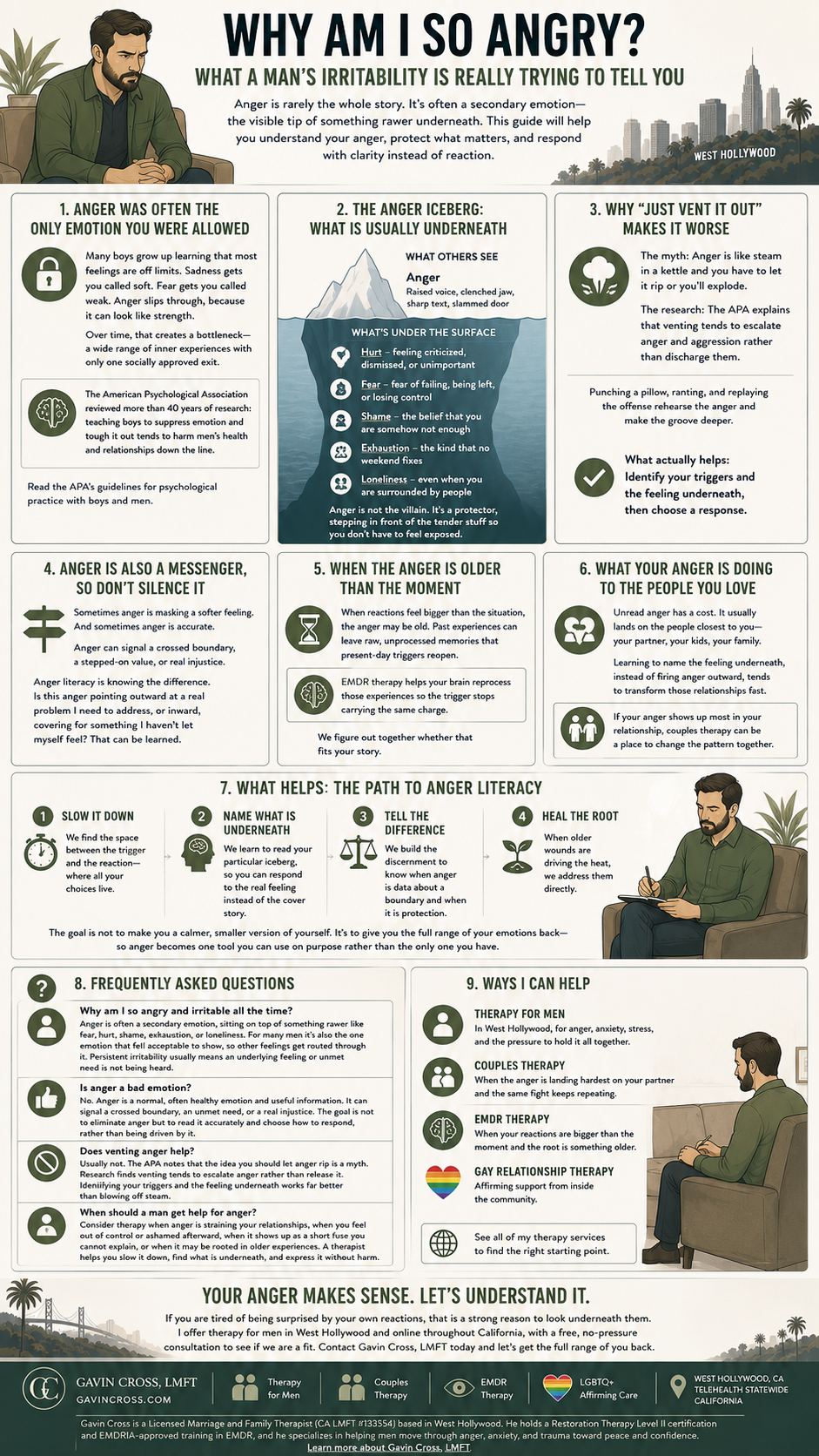
There is a popular myth that anger is like steam in a kettle and you have to let it rip or you will explode. The research says otherwise. As the APA explains in its guidance on controlling anger before it controls you, venting tends to escalate anger and aggression rather than discharge them. Punching a pillow, ranting, and replaying the offense in your head mostly rehearse the anger and make the groove deeper. What actually helps is identifying your triggers and the feeling underneath, then choosing a response.
I want to hold both truths here, because this is where a lot of advice goes flat. Sometimes anger is masking a softer feeling. And sometimes anger is accurate. It is telling you a boundary got crossed, a value got stepped on, or something genuinely unfair happened. In those moments the work is not to dig for hidden sadness. It is to honor the signal and respond with clarity instead of either swallowing it or detonating.
Anger literacy is knowing the difference. Is this anger pointing outward at a real problem I need to address, or is it pointing inward, covering for something I have not let myself feel? Most men were never taught to ask that question. It can be learned.
If your reactions feel bigger than the situation, like a small thing sets off a response that surprises even you, the anger may be old. Experiences from years ago can leave a memory stored in a raw, unprocessed state, and a present-day trigger reopens the file. When that is the case, managing your temper in the moment will only get you so far, because you are fighting a fire whose source is somewhere else.
This is where EMDR therapy can help. EMDR works with the brain to reprocess the older experiences feeding your present reactions, so the trigger stops carrying the same charge. We figure out together whether that fits your story.
Most men who come in about anger are not worried about themselves. They are worried about the face their partner makes, or the way their kid went quiet. Unread anger has a cost, and it usually lands on the people closest to you. The encouraging part is that learning to name the feeling underneath, instead of firing the anger outward, tends to transform those relationships fast. If your anger is showing up most in your relationship, couples therapy can be a place to change the pattern together rather than carrying it alone.
In therapy for men, the work with anger usually moves through a few steps:
The goal is not to make you a calmer, smaller version of yourself. It is to give you the full range of your emotions back, so anger becomes one tool you can use on purpose rather than the only one you have.
Anger is often a secondary emotion, sitting on top of something rawer like fear, hurt, shame, exhaustion, or loneliness. For many men it is also the one emotion that felt acceptable to show, so other feelings get routed through it. Persistent irritability usually means an underlying feeling or unmet need is not being heard.
No. Anger is a normal, often healthy emotion and useful information. It can signal a crossed boundary, an unmet need, or a real injustice. The goal is not to eliminate anger but to read it accurately and choose how to respond, rather than being driven by it.
Usually not. The American Psychological Association notes that the idea you should let anger rip is a myth. Research finds venting tends to escalate anger rather than release it. Identifying your triggers and the feeling underneath works far better than blowing off steam.
Consider therapy when anger is straining your relationships, when you feel out of control or ashamed afterward, when it shows up as a short fuse you cannot explain, or when it may be rooted in older experiences. A therapist helps you slow it down, find what is underneath, and express it without harm.
Anger rarely travels alone, so I work with it from a few angles:
If you are tired of being surprised by your own reactions, that is a strong reason to look underneath them. I offer therapy for men in West Hollywood and online throughout California, with a free, no-pressure consultation to see if we are a fit. Contact Gavin, Cross, LMFT today and let's get the full range of you back.
Gavin Cross is a Licensed Marriage and Family Therapist (CA LMFT #133554) based in West Hollywood. He holds a Restoration Therapy Level II certification and EMDRIA-approved training in EMDR, and he specializes in helping men and move through anger, anxiety, and trauma toward peace and confidence. Learn more about Gavin Cross, LMFT
There’s a big, beautiful world out there. You deserve to experience all it has to offer.
Let’s rediscover your strength.
