


By Gavin Cross, LMFT
You want a real connection. Most men do, even the ones who have spent years convincing themselves otherwise. You want a relationship where you feel known, where the pressure lets up, where you are not performing for someone else's comfort. And yet when the opportunity for that kind of closeness actually appears, something in you retreats. You get busy. You go quiet. You create distance through small moves that do not look like withdrawal but function exactly that way. Your partner calls it pulling away. You call it needing space. You are both right, and neither description captures what is actually happening underneath.
This post is about that gap, between what men want from their relationships and what their nervous systems allow them to reach for. Understanding it is not about assigning fault. It is about locating the actual problem so that something about it can change.
The logic of intimacy avoidance only makes sense when you understand what closeness has historically meant for the men who avoid it. Being known by someone means they can see what is actually there. That visibility carries risk. If what they see disappoints them, makes them reject you, or is used against you, the exposure made things worse than the distance would have. Better to keep it managed. Better to stay slightly out of reach.
This is not a conscious calculation. It happens at the level of the nervous system, shaped by accumulated experiences that taught you, probably long before you had the language for it, that emotional openness was dangerous. A father who responded to vulnerability with criticism. A household where emotional expression was dismissed or punished. A relationship that ended in a way that confirmed that letting someone all the way in was a mistake. The conclusions the nervous system drew from those experiences are now running as background operating code in every close relationship you have, even when the current person in front of you has given you no reason to maintain those defenses.
The American Psychological Association has noted that men are significantly less likely than women to describe themselves as having close confidants outside of romantic relationships, and significantly more likely to rely on a single partner for all emotional connection. That combination, high dependency on one relationship and low tolerance for the vulnerability that relationship requires, creates a particular pressure that many men manage by controlling the distance within that relationship.
The result is a man who is simultaneously more isolated than he realizes and more defended than he wants to be. Therapy for men that takes this seriously does not tell you to simply open up more. It looks at what opening up has historically cost you and works to update those associations at the level where they are actually stored.
Attachment theory, developed by John Bowlby and expanded by researchers including Mary Ainsworth and Sue Johnson, describes the relational strategies humans develop in response to the consistency and availability of their early caregivers. Men who learned early that emotional needs were unsafe, dismissed, or met with conditional responses often develop what is called an avoidant attachment orientation. This is not a diagnosis or a defect. It is an adaptive strategy that made sense in the environment where it developed.
In adult relationships, avoidant attachment looks like this: when the relationship feels close, comfortable, and low-pressure, engagement is relatively easy. When something elevates the emotional stakes, an argument, a request for more connection, a moment of vulnerability from a partner, the nervous system treats that increased closeness as a threat and activates withdrawal. The man pulls back, creates some distance, lets things cool. Once the intensity passes, he can re-engage. His partner experiences this as abandonment at the moments it matters most. He experiences his partner’s response to his withdrawal as confirmation that intensity in relationships leads to problems, which reinforces the original pattern.
This cycle is not about not caring. Men with avoidant attachment patterns often care intensely. What they are doing is managing an anxiety response that gets activated by the very thing they want. Couples therapy using an attachment-informed model can identify this pattern and create a different experience within the relationship itself, one where closeness becomes associated with safety rather than threat. That experiential shift is what actually changes the pattern, not insight alone.
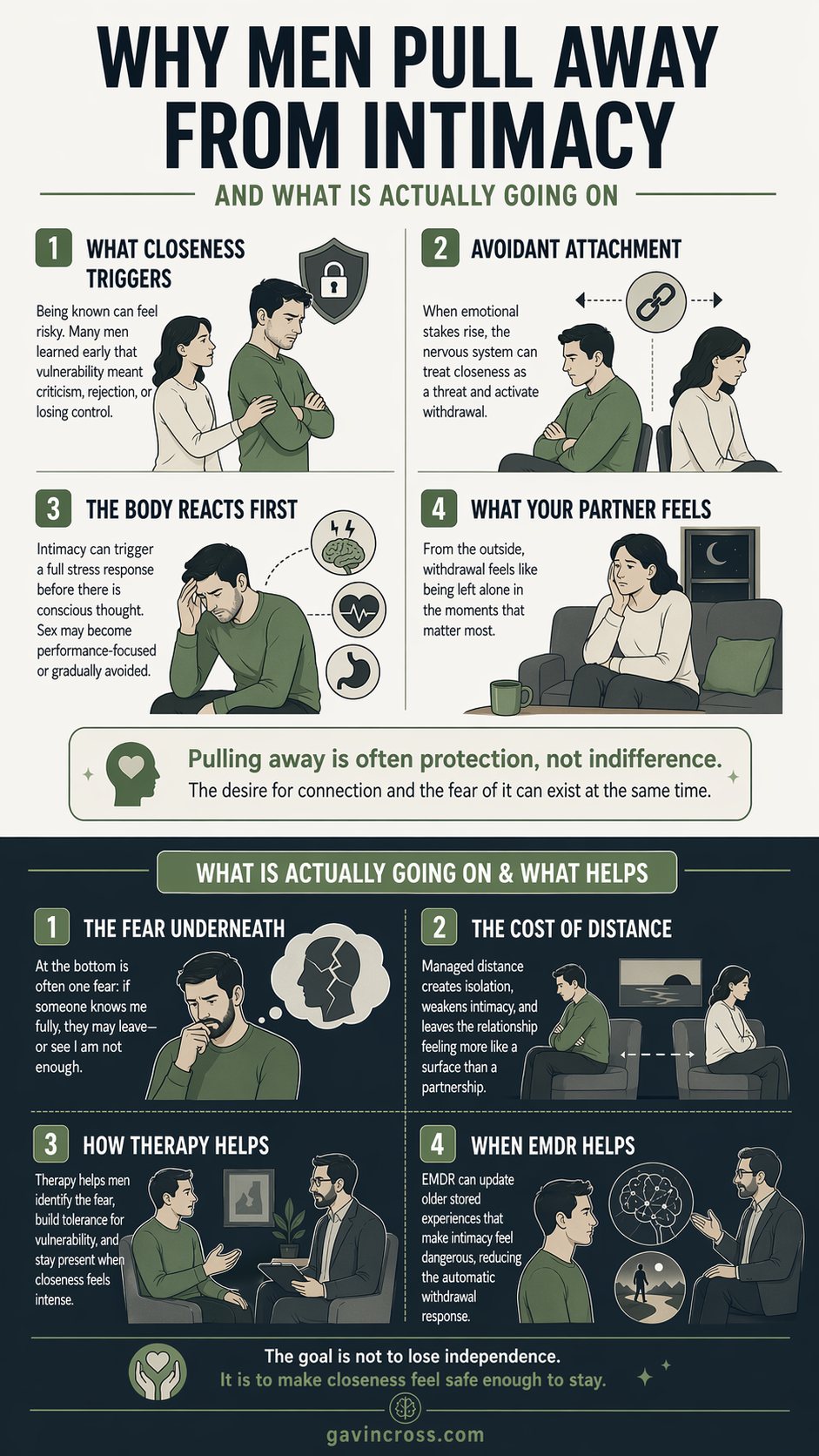
For men who carry earlier wounds around connection and trust, intimacy does not just feel uncomfortable. It can produce a full physiological response before any conscious decision-making has occurred. Your partner reaches for you during a difficult moment. Something goes cold. You are not sure why. You say you are tired. You turn away. It happened faster than thought.
This is the body responding to a conditioned cue, not your actual partner. The same dynamic occurs in sexual intimacy, where emotional closeness and physical vulnerability overlap in ways that can make the bed a particularly activated space for men with unresolved relational wounds. Sex becomes either overly performance-focused, a way of doing something rather than being present with someone, or gradually avoided, as the vulnerability it requires becomes too much to sustain.
Neither pattern is what you want. And neither is solved by trying harder or communicating better before the underlying activation has been addressed. EMDR therapy is one effective avenue for men whose withdrawal from intimacy is rooted in earlier experiences that the nervous system has not been able to update through talk and understanding alone. When the stored associations around closeness are processed and updated, the automatic withdrawal response loses its grip.
It is worth naming this plainly because men who pull away from intimacy are often genuinely confused by how their partners respond. From inside the withdrawal, you are just taking space. You are not doing anything aggressive. You are not saying you do not love them. You are just managing your own experience the best way you know how.
From the outside, what your partner experiences is being left alone inside a moment where they needed you to be present. Repeatedly. The cumulative effect of that experience is not just loneliness. It is a loss of trust in the relationship as a place of real safety. Your partner begins to expect the withdrawal. They stop bringing things to you. They stop asking. The relationship develops a particular kind of managed surface where genuine exchange no longer happens, not because the love is gone, but because the risk no longer seems worth it.
If you recognize this dynamic, it is a good indicator that the work needs to happen at the individual level before the relationship can shift meaningfully. You cannot simply will yourself into an availability that your nervous system has not yet built. But you can build it. That is what the work is for.
At the bottom of most intimacy avoidance in men is a fear that is both very simple and very hard to admit: the fear that if someone knows you fully, they will leave, or worse, that they will stay but you will see in their eyes that what they found was not enough. The performance of confidence and competence that most men maintain is, in part, a protection against that verdict. Keep the distance right and the verdict never comes in.
The cost of that protection is enormous. You never get to find out what it would actually feel like to be known and accepted as you are, not as the version of yourself you have managed and curated and held together for other people's benefit. The relationship remains an audience rather than a partnership. The loneliness that produces is not the same as being alone. It is lonelier, because you are surrounded by proof that connection is available and you are the thing keeping it at arm's length.
Naming this fear in a therapeutic context, with a clinician who has heard it before and will not react to it with judgment, is usually where something begins to shift. Not because the fear disappears, but because it loses the additional weight of secrecy. A fear you can name is a fear you can work with. A fear you spend all your energy not acknowledging runs the whole show from behind the curtain.
Men who engage seriously with this material in therapy consistently describe a similar outcome: they do not stop being private or independent. Their personality does not change. What changes is that emotional closeness stops feeling like a threat they need to manage. They can be present in an intimate moment without the nervous system sounding an alarm. They can hear a partner's vulnerability without needing to exit the conversation. They can stay.
That staying changes everything about the relationship. It changes the sexual connection, which deepens when it no longer has to carry the weight of being the only form of closeness available. It changes the conflict patterns, which de-escalate when withdrawal is no longer the automatic response to emotional intensity. It changes how they experience themselves, which is harder to describe but men who have been through it tend to describe as feeling more real, more grounded, more like themselves.
The work is available. The question is whether the cost of the current pattern has become high enough to make it worth starting. For most men, the answer eventually becomes yes. The earlier that answer arrives, the less is lost in the meantime.
Men often pull away from intimacy not because they do not want connection, but because closeness activates a threat response shaped by earlier experiences. Vulnerability equals exposure, and exposure historically meant rejection, criticism, or loss of control. Pulling back is a protective move, not indifference. The desire for connection and the fear of it coexist, and without intervention the fear usually wins.
Avoidant attachment is a relational pattern in which a person maintains emotional distance to manage the anxiety that comes with closeness. In men, it often develops when early caregiving was inconsistent, emotionally unavailable, or conditional on performance. The nervous system learns that depending on others is unsafe, and adult relationships trigger that same protective withdrawal even when the current partner is trustworthy and available.
Yes. Therapy helps men identify the specific fears underneath their tendency to withdraw and develop the tolerance for vulnerability that closeness requires. This is not about performing emotional openness. It is about building the actual capacity to stay present in intimate moments without the nervous system flagging it as a threat. Most men who do this work find that the intimacy they wanted but avoided becomes genuinely accessible.
Emotional withdrawal and sexual disconnection are closely linked. When a man avoids emotional vulnerability, sex often becomes either the only channel for closeness, which creates pressure and mismatched expectations, or another arena of avoidance. Both patterns create distance with a partner. Addressing the emotional layer tends to improve sexual connection as a downstream effect.
If you recognize yourself in what you have read here, a consultation is the right next step. Gavin Cross is a Licensed Marriage and Family Therapist specializing in therapy for men, couples therapy, and EMDR in West Hollywood and online throughout California. Contact Gavin Cross, LMFT to schedule your free 15-minute consultation.
There’s a big, beautiful world out there. You deserve to experience all it has to offer.
Let’s rediscover your strength.
