


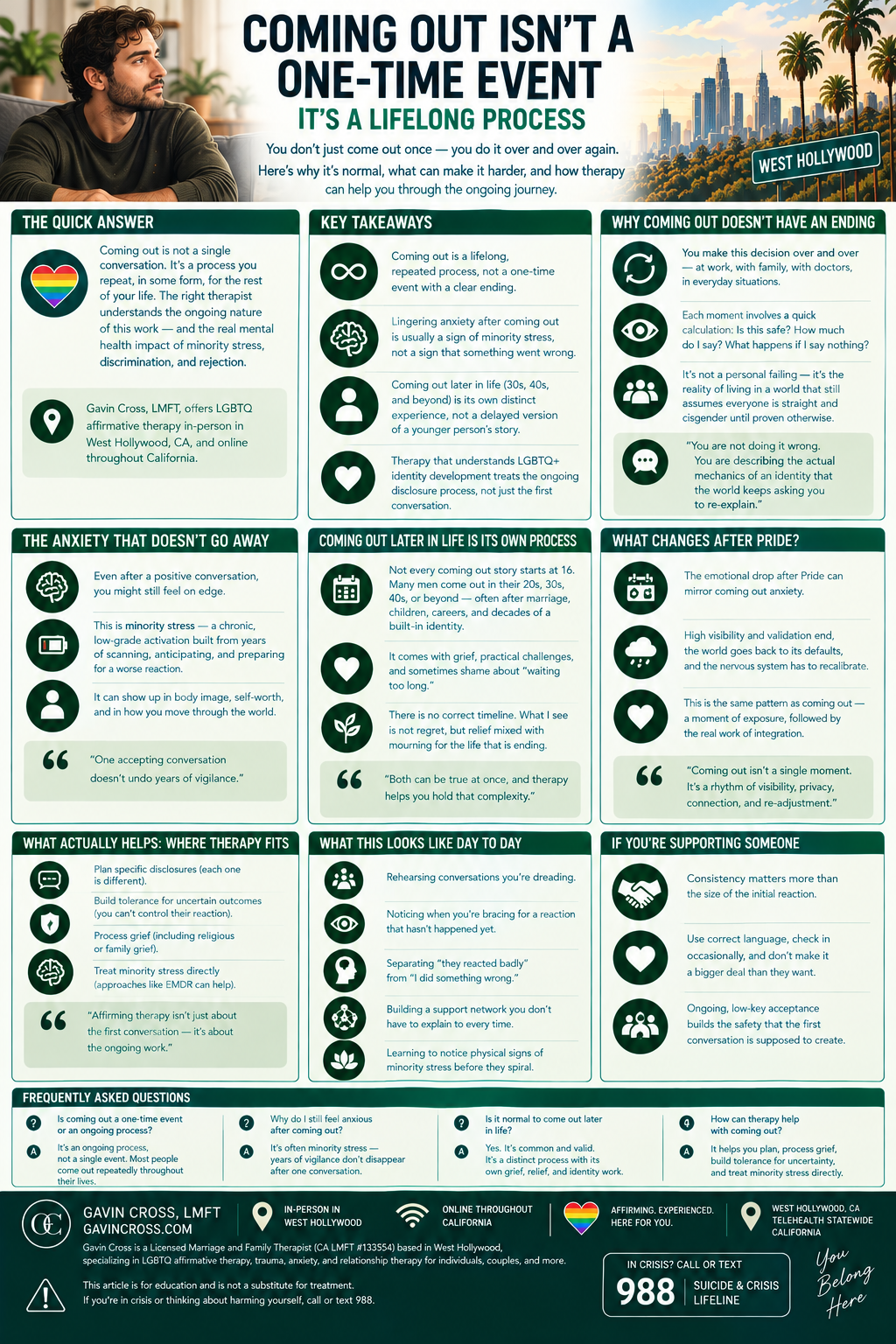
Coming out is not a single conversation. It is a process you repeat, in some form, for the rest of your life, and the mental health work behind it does not end when the first conversation does. Every October, National Coming Out Day gets treated like a finish line: you say the words, your family reacts, the story wraps up. In my West Hollywood practice, I rarely see it work that way. I see clients who came out a decade ago still doing quiet, exhausting work every time they start a new job, meet a new doctor, or sit across from extended family at a holiday table. This piece is about that ongoing work, why it is normal, and what actually helps.
Key takeaways
The cultural script for coming out is a single scene: you tell someone, there is a reaction, credits roll. That script is useful for movies and largely useless for real life. In practice, coming out is a decision you make over and over, often multiple times a week, in contexts as different as a new dentist's intake form, a work happy hour, a rideshare driver's small talk, or a family member you have not seen since a wedding. Each of those moments involves a quick, mostly unconscious calculation: Is this safe? How much do I say? What happens if I say nothing?
That repeated calculation is not a personal failing or a sign that you have not "fully" come out. It is the actual shape of LGBTQ+ life in a world that still defaults to assuming everyone is straight and cisgender until proven otherwise. Researchers who study minority stress describe this as an ongoing management task, not a one-time disclosure, and the American Psychological Association's guidelines for practice with sexual minority clients explicitly frame coming out as a lifelong developmental process rather than a discrete event (APA LGBTQ Resources and Guidelines).
If you have found yourself thinking "I already did this, why am I still tired," you are not doing it wrong. You are describing the actual mechanics of an identity that the world keeps asking you to re-explain.
One of the most common things I hear from clients, often men who first found their way to me through Minority Stress 101, is confusion about why they still feel on edge after a coming out conversation that went well. Parents who cried and hugged them. Friends who said "of course, we love you." A boss who barely blinked. And yet the vigilance did not switch off.
This makes sense once you understand what minority stress actually does to the nervous system. It is not a single event you recover from. It is chronic, low-grade activation built from years of reading rooms, scanning for safety cues, and preparing for a worse reaction than you usually get. One accepting conversation does not undo that pattern any more than one good night's sleep undoes months of insomnia. The body keeps the score longer than any single conversation can rewrite.
This is also where body image and self-worth work often intersects with coming out. Clients who have done work around body image struggles as a gay man in Los Angeles frequently find that the same hypervigilance shows up in both places: a chronic sense of being evaluated, whether it is about identity or appearance. The nervous system does not always distinguish neatly between the two.
Not every coming out story starts at 16. In my practice, I work with a meaningful number of men coming out in their 20s, 30s, 40s, and beyond, often after marriages, children, careers, and decades of a life built around an identity they are now unwinding. This group tends to get the least cultural support, because most coming out narratives are built around adolescence and young adulthood.
Coming out later in life carries its own specific weight: grief for years lived a certain way, practical complications around family and finances, and sometimes shame about "waiting too long," which is not a useful frame. There is no correct timeline for self-knowledge. What I typically see in this population is not regret about coming out, but relief mixed with a genuine mourning process for the version of life that is ending. Both can be true at once, and therapy that treats this as a binary, good news or bad news, tends to miss the actual experience.
If this describes where you are, the work in How to Make Confident Choices as a Queer Person is a useful starting point, particularly around separating what you actually want from what you have been taught to want.
There is a pattern I see every year that mirrors coming out anxiety almost exactly: the emotional drop after Pride month ends. I wrote about this in After the Parade: Navigating the Post-Pride Comedown as a Gay Man, and the mechanism is the same one at work after a coming out conversation. A period of high visibility and validation ends, the world goes back to its usual defaults, and the nervous system has to recalibrate. Coming out works the same way. The conversation happens, life continues, and the identity work that the conversation was supposed to "finish" is actually just getting started.
A lot of what makes ongoing disclosure exhausting is not the disclosure itself, it is the emotional aftermath of not knowing how a moment will land. Will this coworker be weird about it now? Will this extended family member bring it up at every gathering going forward? Learning to regulate the anticipatory anxiety and the after-the-fact replaying is a specific, learnable skill, and it is one I go into in more depth in Emotion Regulation: Challenging Negative Responses to Your Queerness.
The short version: the goal is not to stop feeling anxious before a disclosure. It is to build enough capacity that the anxiety does not run the decision, and that the aftermath does not hijack the rest of your week.
Affirming therapy for coming out is not a single conversation about "how to tell your parents." It typically involves several distinct threads, often running at the same time:
The Trevor Project's most recent national survey of LGBTQ+ young people found that LGBTQ+ youth who felt high social support reported significantly lower rates of attempting suicide than those with low support, and that access to affirming spaces, including therapy, was consistently protective (The Trevor Project, 2025 U.S. National Survey on the Mental Health of LGBTQ Young People). While that survey focuses on youth, the underlying finding tracks with what I see clinically across age groups: affirming support, whether from people or from a therapist, changes outcomes. It is not a nice-to-have.
Mental Health America's coming out resources also make a point I emphasize with clients often: you are allowed to come out on your own timeline, to different people at different times, and in different amounts of detail, and none of that makes your identity less valid or less "official" (Mental Health America, Coming Out Guides).
In sessions, this work rarely looks dramatic. It looks like:
None of this is about becoming fearless. It is about making the ongoing work sustainable, so it costs you less over time.
A quick note for partners, friends, and family reading this: the most useful thing you can do after someone comes out to you is not a single reaction, it is consistency over time. A great initial response followed by silence, discomfort, or repeatedly forgetting can undercut the safety that first conversation was supposed to create. Ongoing, low-key acceptance, checking in occasionally, using correct language, not making it a bigger deal than the person wants, tends to matter more than the size of the initial reaction.
Coming out is an ongoing process, not a single event. Most LGBTQ+ people come out repeatedly throughout their lives, to new coworkers, doctors, neighbors, and friends, and each disclosure carries its own small risk assessment and emotional weight. Affirming therapists generally treat coming out as a lifelong process rather than a milestone with a clear finish line.
Lingering anxiety after coming out is common and is often tied to minority stress, the chronic strain of anticipating rejection or managing how much of yourself to disclose in a given setting. Even a supportive coming out conversation does not erase years of vigilance, and that vigilance can take time and support to unwind.
Yes. Coming out later in life is increasingly common and often involves more complexity than a teenage coming out story, including existing marriages, children, careers, and long-held identities to unravel. It is its own distinct process with its own grief, relief, and identity work, not a delayed version of a younger person's experience.
An LGBTQ affirming therapist can help you plan disclosure conversations, build tolerance for uncertain reactions, process family or religious grief, and work through the identity integration that continues long after the first conversation. Therapy also treats minority stress directly, addressing the hypervigilance and self-monitoring that can persist even in accepting environments.
Minority stress is the chronic, cumulative stress that LGBTQ people experience from stigma, discrimination, and the need to conceal or manage their identity in different settings. It does not end when someone comes out. Coming out can reduce concealment stress while introducing new stressors, such as family conflict or workplace uncertainty, which is why ongoing support matters.
If National Coming Out Day has you thinking about a conversation you have been putting off, or you are tired from carrying the ongoing version of a story people assume is finished, that is exactly the work I do with clients in West Hollywood and across California. I offer LGBTQ affirming therapy both in person and through online therapy for California residents, so support is available whether a coming out conversation is next week or has been sitting on the calendar for years. Contact Gavin Cross, LMFT to talk about what ongoing support could look like for you.
There’s a big, beautiful world out there. You deserve to experience all it has to offer.
Let’s rediscover your strength.
