

You've built the career. You show up, you perform, you deliver. Your social calendar is full of dinners, events, the things you said yes to because that's what you do. You look great on Instagram. And underneath all of it, you are absolutely exhausted in a way that a weekend away does not fix.
Gay men burn out too. But we rarely talk about it in terms that actually fit, terms that account for the specific weight of doing all of that while also navigating the ongoing, low-grade labor of being queer in a world that still requires you to manage your identity in every room you walk into.
This isn't about victimhood. It's about accuracy. Burnout in gay men has specific features, specific causes, and specific recovery needs that standard burnout conversations miss entirely. This is at the core of my therapy for gay men services., because getting those features right is the difference between therapy that actually helps and therapy that leaves you explaining yourself when you're already too tired to explain anything.
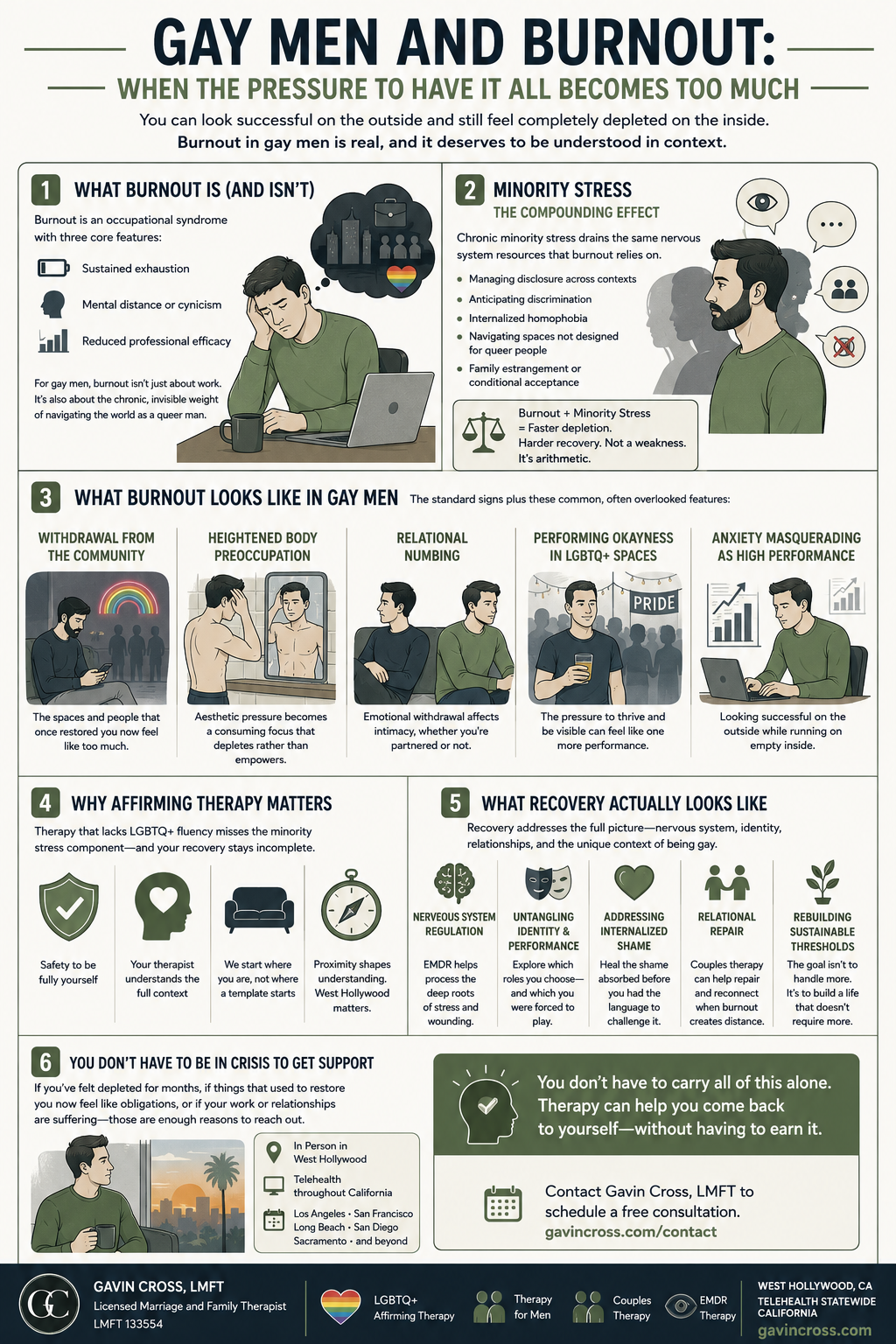
The World Health Organization classifies burnout as an occupational syndrome characterized by three dimensions: sustained exhaustion, increasing mental distance or cynicism toward work, and reduced professional efficacy. What that clinical definition leaves out is everything that feeds the exhaustion before you even get to work.
For straight men in demanding careers, burnout is primarily an occupational story. For gay men, it's almost never that simple. The occupational pressure is real, and in Los Angeles specifically, where professional identity and social performance are deeply entangled, it's often acute. The entertainment industry, finance, tech, creative fields: these environments reward performance and relentlessness in ways that grind anyone down over time.
Minority stress, as defined by researcher Ilan Meyer and extensively studied in LGBTQ+ health research, describes the chronic psychological burden that members of stigmatized groups carry as a direct result of their social position. For gay men, this includes:
The American Psychological Association's research on LGBTQ+ mental health consistently documents elevated rates of anxiety and depression among gay men compared to their heterosexual peers, not because of identity, but because of what it costs to carry that identity through systems and spaces still calibrated around heteronormativity. I regularly help gay men overcome struggles with body identity and other stresses that contribute to burnout.
Burnout draws on the same nervous system resources that minority stress depletes: cortisol regulation, prefrontal cortex function, emotional bandwidth, reward sensitivity. A gay man in a high-pressure professional environment is drawing on those resources from two directions simultaneously. He hits the wall faster, and the wall is harder. That's not a weakness. It's arithmetic.
The standard signs of burnout in men who experience exhaustion that sleep doesn't fix, emotional numbness, cynicism, loss of motivation, physical symptoms without clear medical cause. But burnout in gay men often has additional features worth naming:
Withdrawal from the community that used to replenish. The queer community, friends, spaces, events, and shared culture functions as a genuine restorative resource for many gay men. When burnout sets in, one of the first things to go is the energy to participate in that community. This creates a compounding problem: the resource that would help is the one you're too depleted to access.
Heightened body preoccupation. Gay male culture carries its own specific aesthetic pressures that layer on top of burnout in ways that often go unacknowledged in mainstream burnout conversations. When everything else feels out of control, the body becomes a domain of intense focus. This can manifest as overexercising, disordered eating patterns, or a particular kind of social comparison that makes existing in your own skin exhausting. These patterns are worth bringing to therapy directly, not just as burnout symptoms but as standalone concerns.
Relational numbing. Whether you're partnered or not, burnout tends to flatten the emotional range available for intimacy. Partners of burned-out gay men often describe a version of the emotional withdrawal explored in what it means when he pulls away, a person who is physically present but emotionally unavailable, and who doesn't seem to have the bandwidth to explain why. In some cases this overlaps with the avoidant attachment patterns that predate the burnout entirely.
Performing just alright in LGBTQ+ spaces. There's a particular exhaustion that comes from feeling like you're supposed to be thriving in the spaces designed for you. Gay bars, Pride events, queer social gatherings, these carry a cultural expectation of celebration and visibility that can feel like one more performance to manage when you're already running on empty. The gap between how you're supposed to feel and how you actually feel becomes its own source of shame.
Anxiety presenting as high performance. Many gay men navigate burnout through high-functioning anxiety, looking productive and on top of things externally while operating at a sustained deficit internally. The piece on high-functioning anxiety in men covers why this pattern is so common and why it's so costly over time.
Burnout recovery requires genuine rest for the nervous system, and genuine rest requires safety. For gay men, that safety includes the safety of not having to explain your life to the person who is supposed to be helping you with it.
A therapist who lacks genuine LGBTQ+ competency, not just policy affirmation but actual cultural fluency will miss the minority stress component of your burnout entirely. They'll treat the occupational piece and may leave the identity piece unaddressed, which means the recovery is incomplete before it begins. Sessions that should be spent on your actual experience get spent on context-setting. You leave more tired than when you came in.
LGBTQ+ affirming therapy at Gavin Cross starts from fluency. You won't spend session time educating your therapist on what your life actually looks like. The work starts where you are, and it addresses burnout in the full context of your experience, not the sanitized version that fits a generic template.
This practice is based in West Hollywood, which matters beyond geography. Proximity to the community you're part of shapes clinical orientation in ways that are genuinely different from a culturally neutral practice operating from elsewhere. Gay men who have previously felt like visitors in their own therapy tend to find that something fundamental shifts here.
Recovery from burnout for gay men addresses the same foundational pillars as burnout recovery generally including nervous system regulation, identity work, relational repair, boundary building, but with the LGBTQ+-specific context built in from the start.
Nervous system regulation. Burnout dysregulates the autonomic nervous system. EMDR therapy is particularly effective here, especially when burnout has roots in earlier identity-based wounding including the chronic stress of the closet, family rejection, or the sustained vigilance of navigating anti-LGBTQ+ environments. EMDR reaches what talk therapy often can't, because the pattern isn't just cognitive: as the research on what trauma does to the body explains, it's stored somatically.
Untangling identity and performance. Many gay men have spent years performing versions of themselves for professional competence for one audience, cultural legibility for another, family-safe presentations for a third. Part of burnout recovery is examining which performances are chosen and which are compelled, and building a self-concept that doesn't require continuous audience management to stay intact.
Addressing internalized shame. Shame absorbed before there was language to challenge it doesn't disappear when you come out. It goes underground and shapes everything from how you respond to criticism at work to how you tolerate intimacy in relationships. Working through internalized shame is some of the most important and most durable work burnout recovery can do.
Relational work. If burnout has affected a relationship, as it almost always does, couples therapy may be part of the recovery picture. Same-sex couples navigating one partner's burnout-related withdrawal face all the dynamics of the pursuer-distancer cycle with the added complexity of minority stress inside the relationship itself. That work benefits from a therapist who holds both.
Rebuilding sustainable thresholds. The goal isn't to become someone who can handle more. It's to build a life that doesn't require you to handle more than any person should. For gay men who have spent years overextending, whether professionally, socially, emotionally. That recalibration involves both practical boundary work and a deeper renegotiation of what you owe to which audiences.
One of the patterns that makes burnout particularly costly for gay men is the delay in seeking help. The instinct to manage it alone, to perform okayness until something actually breaks, is built into the same cultural conditioning that made managing your identity a private project from the start.
You don't have to wait until you're in a crisis. If you've felt depleted for months without improvement, if the community that used to restore you now feels like another obligation, if your relationship or your work is taking damage from a version of yourself you don't fully recognize, those are sufficient reasons to reach out.
Sessions are available in person in West Hollywood and via telehealth throughout California in Los Angeles, San Francisco, Long Beach, San Diego, Sacramento, and beyond. Contact Gavin Cross, LMFT to schedule a free consultation.
Gavin Cross is a Licensed Marriage and Family Therapist (LMFT 133554) based in West Hollywood, CA, with telehealth available statewide in California. He specializes in LGBTQ+ affirming therapy, therapy for men, couples therapy, and EMDR.
There’s a big, beautiful world out there. You deserve to experience all it has to offer.
Let’s rediscover your strength.
