


Most people who consider EMDR therapy have the same first question, even if they never say it out loud: what am I actually going to have to do in there? The eye movements are the part everyone has heard about, and they are also the part that generates the most confusion. Will I have to relive the worst moment of my life out loud? Will a light or a set of fingers just wave in front of my face until something happens? Neither of those pictures is accurate, and the uncertainty itself is often enough to keep people from booking a first session.
Here is the more useful answer. EMDR, Eye Movement Desensitization and Reprocessing, is a structured, research-backed protocol with eight distinct phases, developed by psychologist Francine Shapiro in the late 1980s and refined over three decades of clinical research since. It is not improvisational, and it is not something a therapist does to you. It is something you move through together, at a pace your nervous system can actually tolerate. Understanding the phases in advance tends to lower the anxiety around starting, which is exactly why I am laying them out here.
Talk therapy processes experience primarily through language: you describe what happened, examine it, reframe it. That works well for a lot of psychological pain. But some experiences, especially trauma, get stored in a way that language does not fully reach. The World Health Organization recognized EMDR as an effective treatment for trauma-related conditions in 2013, alongside trauma-focused cognitive behavioral therapy, specifically because it works through a different mechanism than talking alone.
The U.S. Department of Veterans Affairs' National Center for PTSD similarly identifies EMDR as a recommended treatment for PTSD, and it is one of the few trauma therapies where the client does not have to narrate the traumatic memory in detailed, sustained language for treatment to work. That distinction matters enormously for people who have avoided treatment specifically because they dread having to talk through the worst thing that ever happened to them, in detail, out loud, more than once.
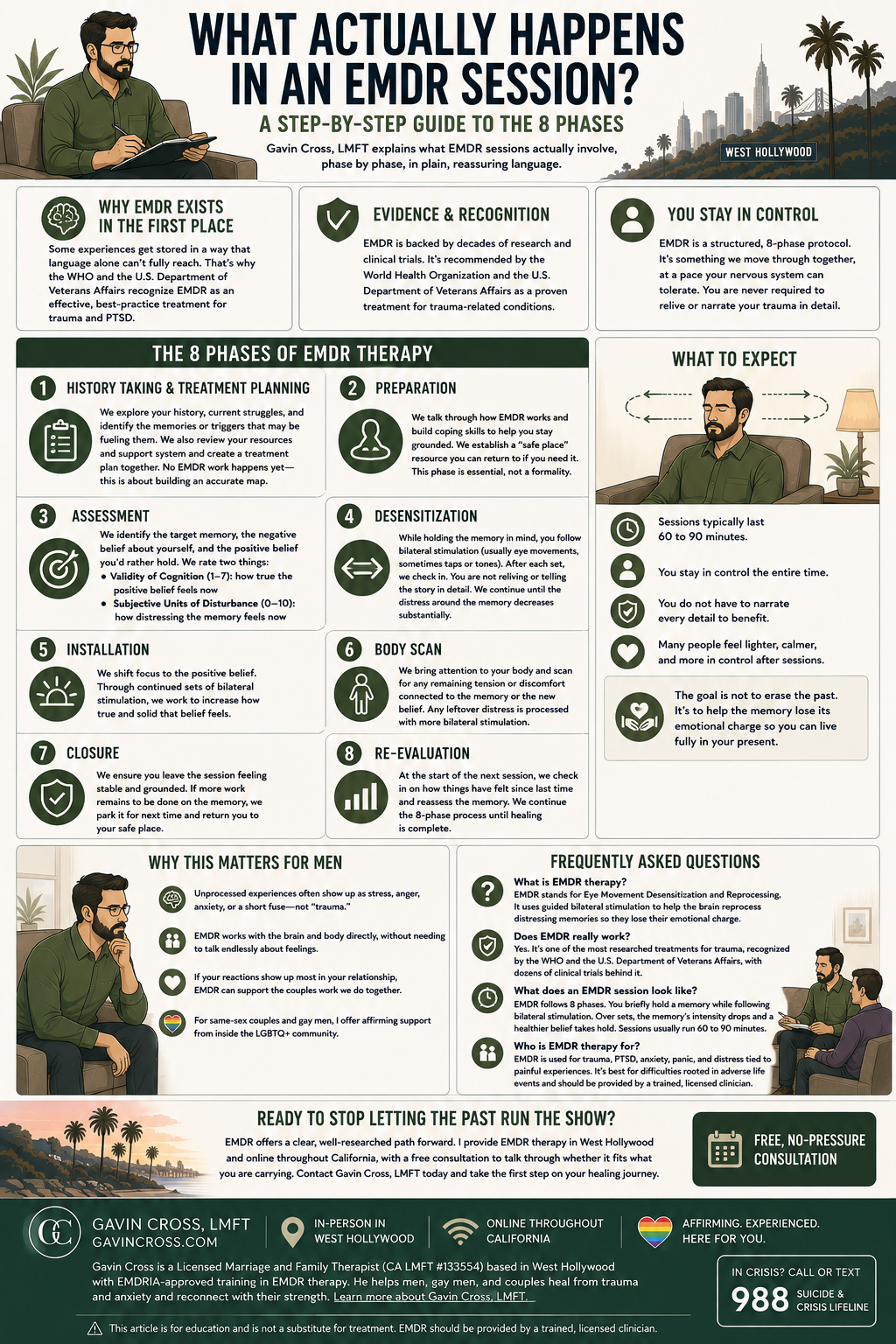
Before any reprocessing work begins, we spend time understanding your history: the presenting issue, relevant background, and what specific memories or present-day triggers seem to be feeding it. This phase also includes identifying your resources and support system, and beginning to build a treatment plan that targets the specific memories most connected to your current struggle. Nothing about the actual EMDR technique happens yet. This phase is entirely about building an accurate map before any work starts.
This is where I explain how EMDR works, what to expect physically and emotionally, and we build coping skills together for staying grounded between and during sessions. For clients who are anxious about the unknown, this phase does a lot of the heavy lifting, because it replaces uncertainty with a concrete understanding of the process. We also establish what is sometimes called a "safe place," a resource you can return to mentally if a session brings up more intensity than expected. Preparation is not a formality. It is a genuine part of the clinical process, and rushing it tends to produce worse outcomes.
Here we identify the specific target memory for the session: the image that represents the worst part of it, the negative belief you hold about yourself connected to it (something like "I am not safe" or "I am not enough"), and the positive belief you would rather hold instead ("I am safe now" or "I did the best I could"). We also measure two things using standardized scales: the Validity of Cognition (how true the positive belief feels right now, on a scale of 1 to 7) and the Subjective Units of Disturbance (how distressing the memory feels right now, on a scale of 0 to 10). These numbers give us a concrete way to track progress across the session and across treatment.
This is the phase most people picture when they think of EMDR. While holding the target memory in mind, you follow a form of bilateral stimulation, typically guided eye movements, though alternating taps or tones can also be used. Sets last roughly 20 to 30 seconds, after which I check in briefly and ask what came up. You are not narrating the trauma in detail during this phase. You are simply noticing what surfaces, whether that is an image, a body sensation, another memory, or a shift in feeling, and reporting it briefly before we continue. This continues across multiple sets until the disturbance connected to the memory decreases substantially.
Once the distress around the target memory has come down, we shift focus to strengthening the positive belief you identified back in Phase 3. Using continued sets of bilateral stimulation, we work to increase how true that positive belief feels, until it is fully and authentically connected to the memory, not just intellectually agreed with but felt as true.
Trauma and distress often live in the body even after the cognitive and emotional charge has decreased. In this phase, you scan your body for any residual tension, discomfort, or sensation connected to the memory, and we process anything that remains using additional sets of bilateral stimulation. This step reflects a core principle in trauma treatment: that healing has to include the body, not just the narrative, since the nervous system stores experience somatically as well as cognitively.
Every EMDR session ends with closure, regardless of whether the target memory has been fully processed. If we run out of time mid-processing, closure includes stabilization techniques to ensure you leave the session regulated and grounded, not activated. I will also give you a brief sense of what to expect between sessions, since some continued processing can happen naturally in the days after a session, similar to how dreams sometimes work through unresolved material.
At the start of the next session, we reevaluate: how is the previously targeted memory sitting with you now? Has the disturbance stayed down? Has the positive belief held? This phase ensures that progress is durable, not just a temporary shift that occurred in the room, and it informs whether we move to a new target memory or continue working on the current one.
A few misconceptions keep people from trying EMDR who might otherwise benefit from it. EMDR does not require you to describe the traumatic event in exhaustive verbal detail. It does not require hypnosis, and you remain fully aware and in control throughout every phase. It is also not a quick fix performed in a single session, despite how it is sometimes portrayed. A full course of EMDR treatment for a single well-defined trauma might take somewhere between 6 and 12 sessions, though this varies significantly depending on the complexity and number of memories being addressed. Complex or longstanding trauma, the kind many men carry from childhood or years of accumulated stress, often takes longer, which is discussed in more detail in what trauma does to your body.
EMDR was originally developed for single-incident trauma, but its clinical use has expanded substantially. The American Psychological Association lists it among treatments with strong research support for PTSD specifically, and clinicians now also use it for anxiety, panic, phobias, grief, and the kind of chronic, low-grade activation that comes from years of stress rather than one identifiable event.
In this practice, EMDR is often useful for men whose anger turns out to be covering something older, for men whose anxiety has become the default operating mode rather than a response to a specific stressor, and for LGBTQ+ clients whose trauma history includes chronic, identity-based experiences like family rejection or the accumulated toll of hiding for years, which do not always present as a single, clean traumatic memory the way clinical models sometimes assume.
You do not need a fully worked-out understanding of your trauma before beginning EMDR. You do not need to have already named the "root cause." What is genuinely useful going in is a willingness to notice what comes up without immediately needing to explain or justify it, and enough stability in daily life that processing distressing material will not be destabilizing. Phase 2, preparation, exists specifically to build that stability if it is not already there. If you are unsure whether you are ready, that uncertainty is a completely reasonable thing to bring into a free consultation rather than something you need to resolve on your own first.
Most clients describe EMDR as less distressing than traditional talk therapy about trauma, precisely because it does not require detailed verbal narration of the event. Some sessions bring up real emotional intensity, which is a normal part of processing, but the structured phases, especially preparation and closure, are specifically designed to keep that intensity manageable and to ensure you leave each session regulated.
It depends on the complexity of what is being treated. A single, well-defined traumatic memory might resolve in 6 to 12 sessions. Complex trauma involving multiple memories, or trauma that developed over years rather than a single incident, typically requires a longer course of treatment. Your therapist should be able to give you a working estimate after the history-taking phase.
The bilateral stimulation (eye movements, taps, or tones) is one component of a broader eight-phase protocol that also includes history-taking, resourcing, and structured cognitive work. Research bodies including the World Health Organization and the VA/DoD Clinical Practice Guidelines for PTSD recognize EMDR as an evidence-based treatment, not because of the eye movements alone, but because of the full structured process.
Yes. Many clients use EMDR alongside ongoing talk therapy, or move between the two depending on what a given session calls for. In this practice, EMDR is often integrated with therapy for men or therapy for LGBTQ+ individuals rather than used as a standalone, separate treatment track.
EMDR is one part of a broader approach to trauma, and it is often most effective combined with other support:
Understanding the process is often the first step toward actually starting it. If old experiences are still running the show in your present-day reactions, EMDR therapy may be able to reach what talk therapy alone has not. I offer a free 15-minute consultation to talk through what you are dealing with and whether EMDR is a fit. Contact Gavin Cross, LMFT to get started.
Gavin Cross is a Licensed Marriage and Family Therapist (CA LMFT #133554) based in West Hollywood, with EMDRIA-approved training in EMDR and Restoration Therapy Level II certification. He specializes in helping men, couples, and LGBTQ+ clients process trauma and reclaim a sense of safety in their own lives. Learn more about Gavin Cross, LMFT.
There’s a big, beautiful world out there. You deserve to experience all it has to offer.
Let’s rediscover your strength.
