


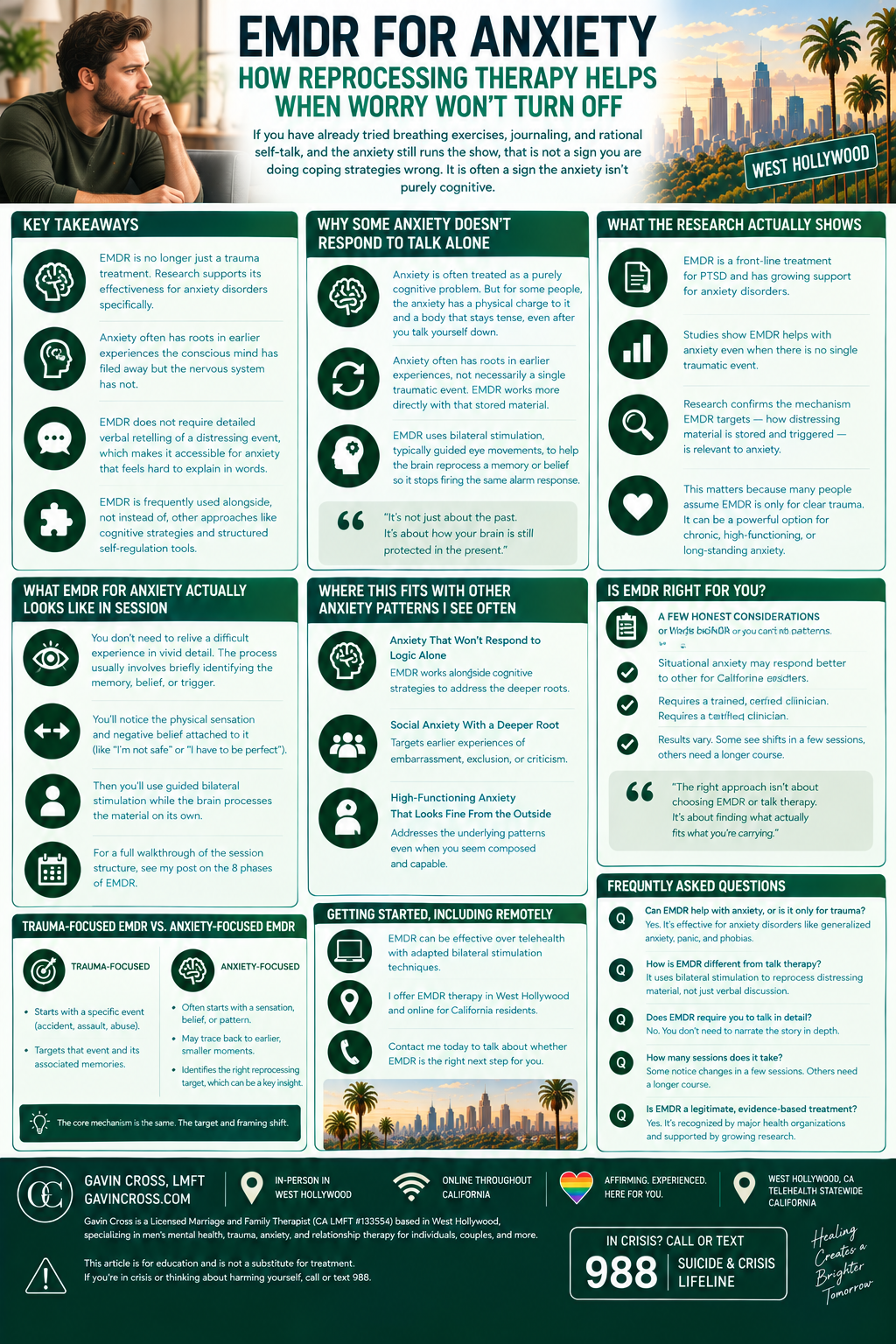
If you have already tried breathing exercises, journaling, and rational self-talk, and the anxiety still runs the show, that is not a sign you are doing coping strategies wrong. It is often a sign the anxiety isn't purely cognitive. EMDR, Eye Movement Desensitization and Reprocessing, was built to work with the parts of the nervous system that talk therapy alone sometimes cannot fully reach, the parts that keep bracing for a threat long after the logical, thinking part of your brain has already concluded there isn't one. It is best known for treating trauma, but a substantial and growing body of research also supports its use for anxiety, including the kind that never traces back to one clear traumatic event.
Anxiety is often treated as a purely cognitive problem: irrational thoughts that need correcting, worst-case scenarios that need reframing. That model helps a lot of people, and I use it regularly. But for a specific and common subset of anxiety, the kind that has a physical charge to it, a racing heart before a meeting that logically shouldn't be stressful, a body that stays tense even after you have talked yourself down, that purely cognitive approach hits a ceiling. You can know, intellectually, that the anxiety doesn't make sense, and still feel it exactly the same as before.
This is the gap EMDR is designed to close. Anxiety frequently has roots in earlier experiences, not necessarily a single dramatic trauma, but accumulated moments of feeling unsafe, criticized, or out of control, that the nervous system encoded as a threat pattern. Talking about the pattern logically does not always update how the body has stored it. EMDR works more directly with that stored material.
I go into the mechanics of this in more detail in what EMDR therapy actually does, but the short version relevant here: EMDR uses bilateral stimulation, typically guided eye movements, to help the brain reprocess a memory or belief so it stops firing the same alarm response it currently does.
EMDR's evidence base started with PTSD, where it is now recognized as a front-line treatment by major health bodies. Its application to anxiety disorders specifically is a newer but increasingly well-supported area of research. A review published in the Journal of EMDR Practice and Research examined the efficacy of EMDR therapy across anxiety disorders and found meaningful support for its use beyond trauma-specific presentations, reinforcing that the mechanism EMDR targets, how distressing material is stored and triggered, is relevant to anxiety even when no single traumatic event is the clear origin point (EMDR International Association, Efficacy of EMDR Therapy for Anxiety Disorders). The EMDR Institute's broader research overview similarly documents a growing evidence base across a range of conditions beyond PTSD, including anxiety-related presentations (EMDR Institute, Research Overview).
This matters clinically because a lot of clients come to EMDR assuming it is only appropriate if they have a clear, identifiable trauma. That assumption keeps people with "ordinary" chronic anxiety, the kind built from years of smaller stressors rather than one defining event, from considering an approach that could genuinely help them.
A common misconception is that EMDR requires reliving a difficult experience in vivid detail, the way some exposure-based therapies do. It does not. The process typically involves briefly identifying the memory, belief, or trigger connected to the anxiety, noting the physical sensation and negative belief attached to it (something like "I'm not safe" or "I have to be perfect or something bad will happen"), and then using guided bilateral stimulation while the brain processes the material on its own. You do not need to narrate the story in depth for the process to work, which is part of why many clients find it more tolerable than they expected.
For a full walkthrough of the session structure itself, I wrote about the actual phases in what actually happens in an EMDR Therapy session. Clients often find it useful to know the structure in advance, since not knowing what to expect can itself be a source of anxiety around starting EMDR in the first place.
Between sessions, or in moments when anxiety spikes and you don't have access to a therapist, simple self-soothing techniques that borrow from the same bilateral principle can help take the edge off. I cover one specific technique in the Butterfly Hug, which is a self-soothing technique you can do anywhere, which is not a replacement for full EMDR processing but is a genuinely useful tool for managing acute anxiety in the moment.
EMDR is rarely the only tool in the room. It tends to work well alongside cognitive and behavioral strategies rather than replacing them, and it is particularly useful for a few specific patterns:
Clients working through the four-question framework in mastering your anxiety with effective coping and self-sooting strategies and often find the cognitive piece helps manage anxiety in the moment, while EMDR Therapy from Gavin Cross, LMFT addresses why the anxiety keeps regenerating in the first place. The two approaches are complementary, not competing.
Similarly, the practical strategies in managing social anxiety work well for many clients on their own. For others, social anxiety traces back to specific earlier experiences of embarrassment, exclusion, or criticism that keep getting relived, consciously or not, in current social situations. EMDR can target those specific memories directly.
Men who present as composed and capable while privately struggling, the pattern described in the anxiety tht no one talks about, often respond well to EMDR precisely because the anxiety in that pattern is rarely irrational on the surface. It is deeply conditioned, which is exactly the kind of material EMDR is designed to reach.
EMDR is not a fit for every anxiety presentation, and part of good clinical practice is being straightforward about that rather than presenting one modality as a cure-all. A few honest notes:
If you are unsure whether EMDR or another approach is the better starting point, that is a completely reasonable thing to bring directly to a first session. A good assessment should guide the choice, not the other way around, and a therapist who is honest about fit will tell you early if a different approach makes more sense for what you're dealing with.
The core mechanism is the same, but the target and the framing shift. Trauma-focused EMDR usually starts from a specific, identifiable event: an accident, an assault, a period of abuse. The reprocessing work centers on that event and its associated memories directly.
Anxiety-focused EMDR often starts somewhere less obvious: a recurring physical sensation, a persistent negative belief like "I'm going to mess this up" or "something bad is about to happen," or a pattern of worry that does not point to one clear origin. Part of the early work is actually identifying what the reprocessing target should be, sometimes tracing a present-day anxiety response back to an earlier, smaller moment the client had not previously connected to it. This detective work, figuring out what the nervous system is actually reacting to, is often where clients get their first real insight into why the anxiety has been so persistent despite their best conscious efforts to manage it.
This is also why an accurate initial assessment matters so much. Jumping straight into reprocessing without first understanding the anxiety's actual shape and history tends to produce weaker, less durable results than taking the time to map the pattern first.
One question I get often: does EMDR work over telehealth? Yes, with adapted bilateral stimulation techniques designed for virtual sessions, EMDR can be delivered effectively online, which matters for anxiety specifically, since anxiety around scheduling, travel, or leaving the house is sometimes part of what brings someone to treatment in the first place. I cover the broader research on telehealth effectiveness regarding if online therapy works best for your situation.
EMDR was originally developed for trauma and PTSD, but research and clinical use have expanded to show it is effective for anxiety disorders as well, including generalized anxiety, panic, and phobias. EMDR targets the way the nervous system has encoded a distressing experience or belief, which is often relevant to anxiety even when no single traumatic event is the clear cause.
Talk therapy for anxiety typically works through cognitive patterns and coping strategies discussed verbally, while EMDR uses bilateral stimulation, such as guided eye movements, to help the brain reprocess distressing memories or beliefs at a more direct, less purely verbal level. Many clients use both approaches together rather than choosing one over the other.
No. Unlike some trauma therapies, EMDR does not require a client to describe a distressing event in detailed narrative form. The process focuses on brief identification of the memory or belief and then uses bilateral stimulation to help the brain process it, which many clients find less overwhelming than repeatedly retelling a difficult story.
The number of EMDR sessions needed varies by individual and by the complexity of what is being addressed. Some clients notice a shift in specific anxiety triggers within a handful of sessions, while more deeply rooted or long-standing anxiety patterns typically require a longer course of treatment, similar to other evidence-based therapies.
Yes. EMDR is recognized as an evidence-based treatment for PTSD by major health organizations, and a growing body of research supports its use for anxiety disorders specifically. It is practiced by licensed clinicians trained through structured EMDR certification programs rather than being an alternative or unregulated approach.
If you have done the cognitive work, tried the coping strategies, and the anxiety is still running underneath it all, that is worth a real conversation about whether EMDR could reach what talk therapy alone has not. I offer EMDR therapy in West Hollywood, in person and through online therapy for California residents. Contact Gavin Cross, LMFT today to talk through whether it's the right next step for what you're carrying.
There’s a big, beautiful world out there. You deserve to experience all it has to offer.
Let’s rediscover your strength.
