


Most people researching online therapy get stuck on one question: does it actually work? That question matters, but it isn't the one that trips people up once they've decided to try it. The questions that actually stall people out are more practical: Do I have to be in California the whole time? Is it really private? What does insurance cover? What does a session even look like on a screen? In my West Hollywood practice, these logistics questions come up in nearly every first call about telehealth, so this piece answers them directly, in the order they usually come up.
If you're still weighing whether telehealth is clinically effective compared to in-person therapy, I covered the research directly in my blog Does Online Therapy Actually Work? What the Research Says Before You Book a Telehealth Session. The short answer is yes, for most presentations, outcomes are comparable to in-person care. This piece assumes you're past that question and starting to think about logistics, which is where most people actually get stuck.
Telehealth adoption for mental health care has remained high well past its pandemic-era surge. KFF's analysis of outpatient claims data found that telehealth has continued to account for more than a third of outpatient visits for mental health and substance use services, long after most other medical specialties returned to primarily in-person care. Mental health care, more than most fields of medicine, has settled into telehealth as a durable, mainstream option rather than a temporary substitute. That staying power matters when you're deciding whether to try it: this isn't an emergency-era workaround that providers are quietly phasing out, it's become one of the two standard ways therapy is delivered, and increasingly the default for people juggling demanding jobs, caregiving, or long commutes across Los Angeles.
Here is the logistics detail that surprises the most people: California-licensed therapists are generally required to provide telehealth only to clients who are physically located in California at the time of the session. It does not matter that you live in California and normally see your therapist from your apartment in Los Angeles. If you are visiting family in Arizona for a week, or on a work trip to New York, that scheduled session typically cannot happen as usual, because the therapist's license does not extend across state lines the way many people assume.
This isn't a workaround-able administrative technicality. It is a licensing board requirement grounded in how mental health licensure works in the United States: a license is issued by, and tied to, a specific state, and the client's location, not the therapist's, generally determines which state's rules apply. The California Board of Behavioral Sciences publishes consumer-facing guidance on telehealth specifically because this confusion is common.
The practical takeaway: if travel is a regular part of your life, mention it during your first conversation with a prospective therapist. Most therapists, myself included, can work around occasional travel with advance notice, but it needs to be planned for rather than discovered mid-course.
This is the second most common hesitation I hear, and it is a fair one. Legitimate online therapy platforms are built to HIPAA standards, meaning they use end-to-end encryption and are legally required to protect your information the same way an in-person medical record is protected. The platform itself is rarely the weak link.
The more common privacy issue is on the client's end: a thin apartment wall, a partner or roommate within earshot, a laptop camera angled toward a shared living room. I encourage clients to think through their physical setup the same way they would think about choosing a private room for a phone call they didn't want overheard. A closed door, headphones, and a consistent, quiet location solve most of what actually undermines privacy in telehealth, far more often than any technical vulnerability does. The American Psychological Association's guidelines for the practice of telepsychology specifically address this shared responsibility between platform security and the client's physical environment as a core part of ethical telehealth care..
Stripped of the abstraction, here is the actual sequence for a first telehealth session in my practice, and it is fairly representative of how most legitimate practices handle it:
If you're unsure whether you're even at the point of needing a first session, How to Tell if You Need Therapy can help clarify that before you get to logistics at all.
Telehealth is not universally interchangeable with in-person care, and a good therapist should be honest about where the format has real limits.
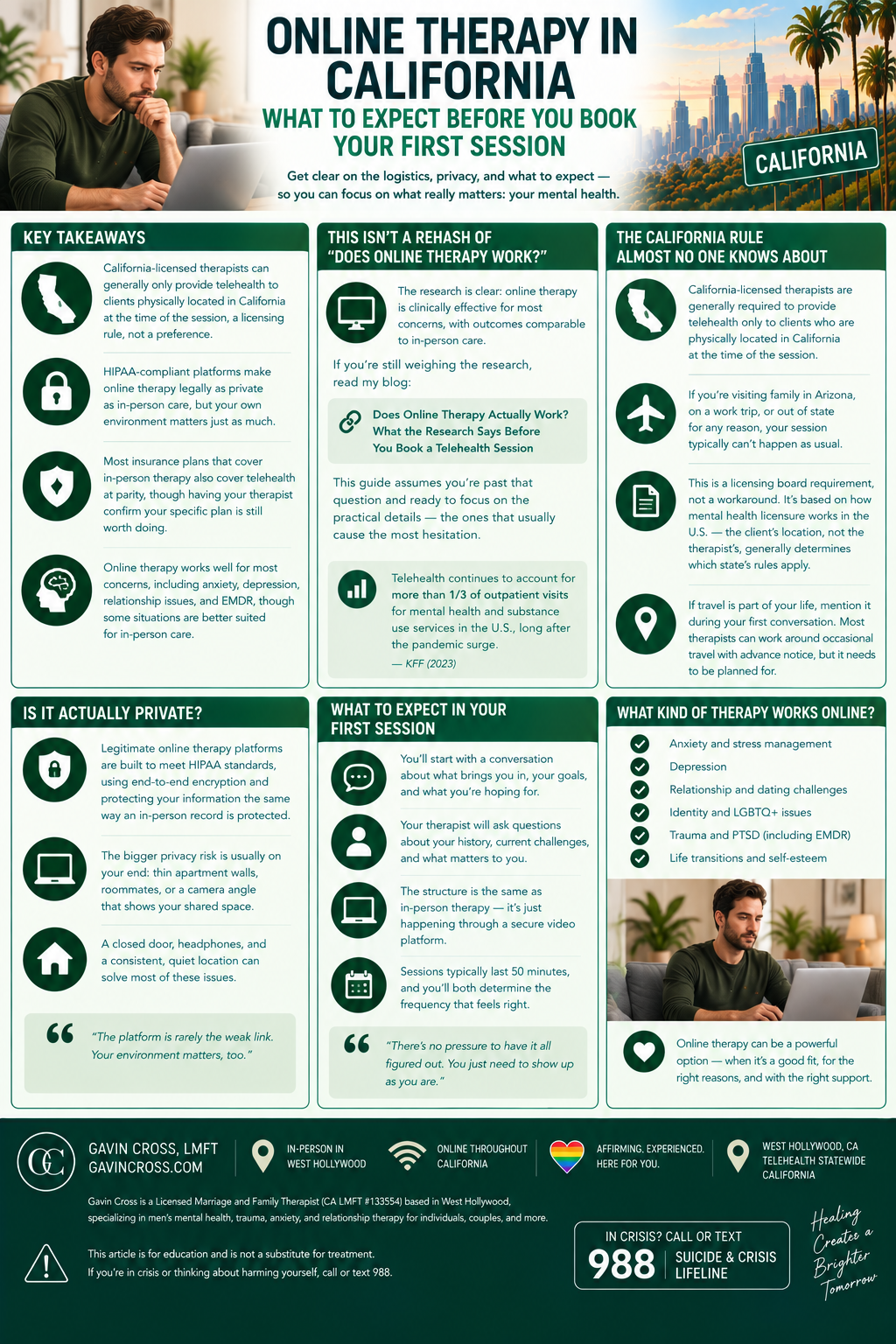
Anxiety, depression, stress management, relationship issues, and identity-related work all translate well to a screen. Even EMDR Therapy, which people often assume requires being in the same room, has adapted bilateral stimulation techniques built specifically for telehealth delivery; I walk through how that works in What Actually Happens in an EMDR Session. For men managing the kind of chronic isolation covered in The Male Loneliness Epidemic, removing the barrier of commuting to an office is sometimes the difference between actually starting therapy and putting it off another six months. Online therapy enables LGBTQ individuals to manage the ongoing vigilance described in Minority Stress 101, since being able to access affirming care privately, without navigating an unfamiliar waiting room, removes one more layer of exposure in an already effortful process.
Couples work can be done over telehealth or in-person. If you're evaluating whether couples counseling is the right step at all, that decision is covered in How to Tell if It's Time for Couples Counseling, independent of format. Acute safety concerns, active crises, or situations requiring immediate in-person intervention are also generally not appropriate for telehealth and need a higher level of care.
Most PPO Insurance health plans provide a partial reimbursement for services with any service provider. The best course of action is to check with your therapist’s accepted PPO plans to compare rates. If you're still in the process of finding the right fit, Finding the Right Therapist: How to Navigate the Therapy Search covers how to evaluate cost alongside fit rather than treating them as separate decisions.
A few practical habits make a noticeable difference in how useful telehealth sessions feel:
Yes. California-licensed therapists are generally required to provide telehealth only to clients who are physically located in California at the time of the session, regardless of where the client normally lives. This is a licensing requirement from the California Board of Behavioral Sciences, not a preference, so if you plan to travel out of state, that session may need to be rescheduled or handled differently.
Legitimate online therapy uses HIPAA-compliant video platforms with end-to-end encryption, which provide the same legal confidentiality protections as in-person sessions. The client's own environment is the bigger variable: using a private room, headphones, and a secure internet connection matters as much as the platform's security features.
A first online therapy session typically includes a link sent in advance, a brief tech check, informed consent and intake paperwork completed beforehand, and then a conversation focused on what brought you to therapy, your history, and what you're hoping to get out of treatment, very similar in structure to an in-person first session.
Many California insurance plans cover telehealth mental health visits at parity with in-person visits, meaning the same coverage and cost-sharing rules apply. Coverage still varies by plan and by whether a given therapist is in-network, so confirming telehealth mental health benefits directly with your insurer before booking is the reliable way to know your specific costs.
Is online therapy effective for anxiety, depression, and relationship issues?
Research supports online therapy as effective for a wide range of concerns, including anxiety, depression, and relationship issues, with outcomes comparable to in-person therapy for most presentations. It tends to work less well for certain acute crisis situations, which may be better served by in-person or higher levels of care.
If the research question was never really what was holding you back, and it was the practical unknowns instead, hopefully this closes most of those gaps. I offer online therapy for California residents alongside in-person sessions in West Hollywood, across the same areas of focus: men's therapy, LGBTQ therapy, couples therapy, and EMDR. Contact Gavin Cross, LMFT to get a session on the calendar, wherever in California you happen to be.
There’s a big, beautiful world out there. You deserve to experience all it has to offer.
Let’s rediscover your strength.
