


You have a full calendar. You might even have a full house, a full inbox, a full life by most external measures. And you still cannot remember the last time you called a friend just to talk, not to coordinate logistics, not to catch up on a milestone, just to talk. If a hard week hit you tomorrow, you would probably know who to call. What you might not know is who would actually pick up, and mean it.
That gap is not in your head. It is one of the most well-documented, least discussed trends in men's mental health, and it has a name: the male loneliness epidemic. It is not about being an introvert or preferring a small circle. It is about a structural collapse in how men build and keep friendships once school, sports teams, and shared dorms stop doing the work of connection for them.
If this is landing a little too close, you are not broken and you are not alone in feeling alone. You are experiencing something that shows up in the data across nearly every developed country, and there is a clear, workable path out of it.
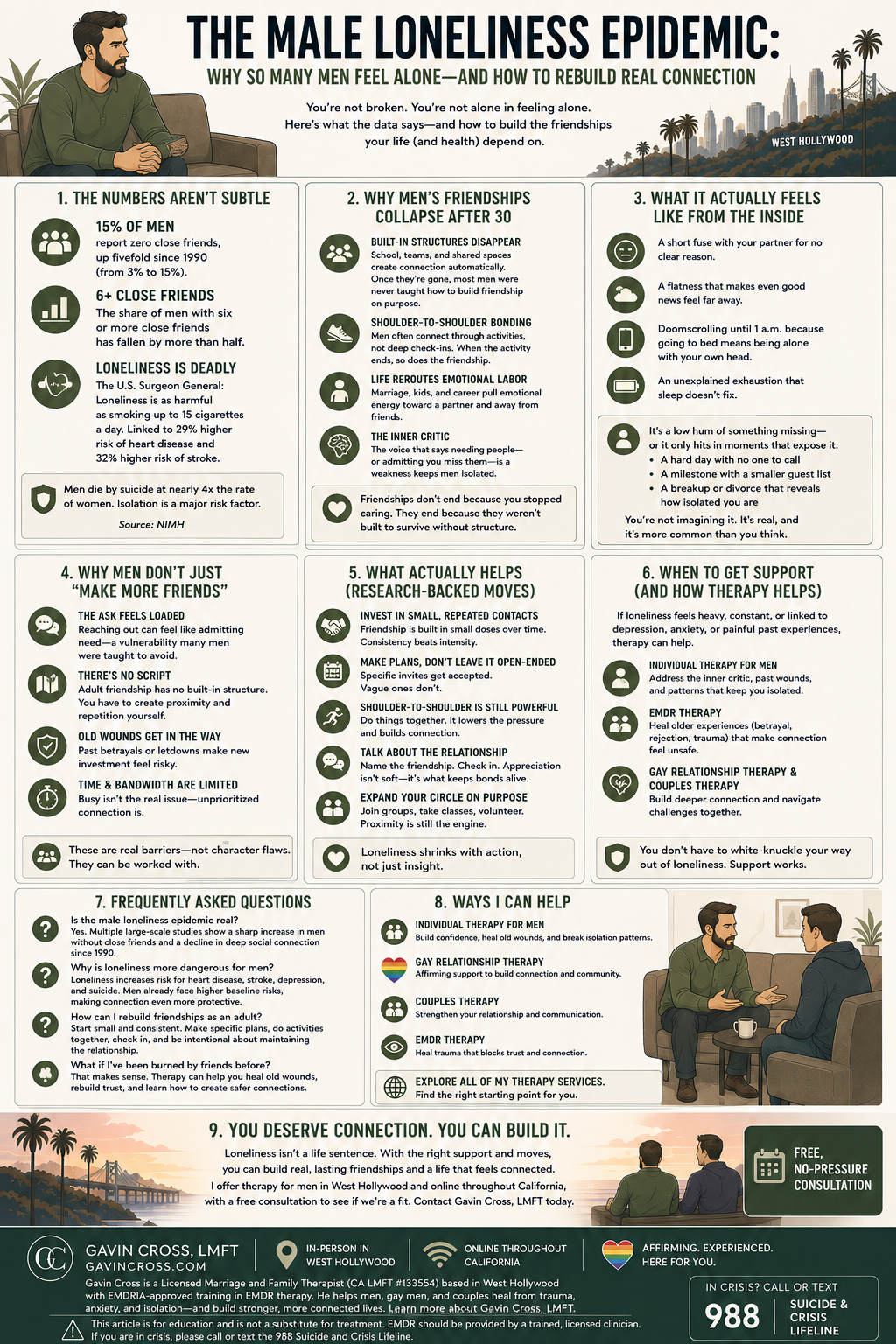
In 2021, the Survey Center on American Life found that the percentage of men reporting zero close friends had jumped fivefold since 1990, from 3 percent to 15 percent. Meanwhile, the share of men reporting six or more close friends fell by more than half. This is not a modest dip. It is a generational collapse in the infrastructure of male friendship, and it accelerated well before anyone had heard the term "social distancing."
The U.S. Surgeon General's 2023 advisory on loneliness and isolation went further, describing the health effects of chronic loneliness as comparable to smoking up to 15 cigarettes a day, and linking sustained isolation to a roughly 29 percent increased risk of heart disease and a 32 percent increased risk of stroke. You can read the full advisory directly from the U.S. Department of Health and Human Services. This is not a soft, feelings-only problem. It is a cardiovascular and mortality problem, and men are disproportionately carrying it.
Men also die by suicide at nearly four times the rate of women, according to the National Institute of Mental Health, and isolation is one of the most consistent risk factors researchers point to. None of this means every lonely man is in crisis. It means loneliness is not a minor inconvenience for men. It is a measurable health risk that most men have never been told to take seriously.
Friendship in your 20s often runs on what researchers call "proximity and repetition," meaning you see the same people constantly without having to try: college, an early job, a shared apartment, a rec league. Once those built-in structures disappear, most men discover that no one ever taught them how to build friendship on purpose. Women, on average, tend to maintain friendships through more frequent emotional check-ins and direct communication about the relationship itself. Men are more often socialized toward what researchers call "shoulder to shoulder" bonding: doing an activity together rather than talking about the relationship directly.
That is not a flaw. Shoulder-to-shoulder connection is real connection. The problem is that once the activity disappears (the team ends, the job changes, you move for a partner or a kid), a lot of men lose the connection along with it, because the friendship was never built to survive without a shared task attached to it.
Add marriage, kids, and career intensity, all of which quietly reroute the emotional labor men used to spend on friends toward a partner instead, and you get exactly the pattern researchers describe: a shrinking circle that keeps shrinking because nothing is actively rebuilding it. This is closely related to the inner critic many men carry into midlife, the quiet voice insisting that needing people, or admitting you miss them, is somehow a weakness rather than a basic human fact.
Male loneliness rarely announces itself as "I am lonely." It shows up sideways. A short fuse with your partner that has nothing to do with what she actually said. A flatness that makes even good news feel far away. Doomscrolling until 1 a.m. because going to bed means being alone with your own head. An unexplained exhaustion that a full night's sleep does not touch.
Some men describe it as a kind of low hum, a background sense that something is missing they cannot quite name, especially compared to the ease of friendship they remember from earlier in life. Others only notice it in the specific moments that expose it: a hard day at work with no one to call, a milestone with a smaller guest list than they expected, a divorce or breakup that reveals how much of their entire social world ran through their partner. If any of that sounds familiar, it is worth reading about why men pull away from intimacy, because the same avoidance pattern that isolates men from partners often isolates them from friends first.
If the fix were obvious, more men would have done it already. A few real barriers get in the way, and none of them are about laziness.
The ask feels loaded. Reaching out to a friend you have drifted from can feel disproportionately vulnerable, like you are admitting you need something. For men who were taught early that needing people is a liability, that ask can feel harder than it should.
There is no script. Making a friend as an adult has no built-in structure the way school or a team provided. You have to manufacture the repetition and proximity yourself, and most men were never taught how.
Old wounds get in the way. For some men, past friendships ended badly, through betrayal, competition, or just quietly fading without explanation, and that history makes new investment feel risky. This is often the same territory covered in what trauma does to your body, where old, unprocessed experiences quietly shape present-day avoidance.
It gets tangled with depression. Isolation and depression feed each other in both directions. The less connected you feel, the harder it is to reach out, and the harder it is to reach out, the more isolated you become. If that loop sounds familiar, it is worth reading about why men don't talk about depression, since low mood is one of the most common hidden drivers behind a man's shrinking social world.
The research on adult friendship formation is more encouraging than the loneliness statistics suggest. A widely cited study from the University of Kansas found it takes roughly 50 hours of shared time to move from acquaintance to casual friend, and around 200 hours to reach close friendship. That number matters, because it reframes the problem correctly: friendship is not about finding the right person through luck. It is about accumulating repeated, low-stakes contact on purpose.
A few things consistently help men rebuild this:
Sometimes the barrier really is practical: a move, a demanding job, a new baby, a season of life with less bandwidth. But sometimes the barrier is deeper, rooted in an old belief that closeness is dangerous, or that you are fundamentally more likable at a distance than up close. That belief usually did not start in adulthood. It often started somewhere in childhood or adolescence, in a family system, a friend group, or an experience that taught you connection was not safe to fully trust.
When that is the case, working on logistics alone (schedule more hangouts, download the friendship app) will only get you so far, because you are treating a symptom while the actual driver stays untouched. This is where deeper work, including EMDR therapy, can be useful, since it targets the older experiences that are still quietly running the show underneath your present-day avoidance.
The data supports what it feels like. The Survey Center on American Life documented a fivefold increase in men reporting zero close friends between 1990 and 2021, and the U.S. Surgeon General has formally classified loneliness as a public health concern with measurable physical health risks. This is a real, measurable trend, not just a subjective impression.
There is no universal number, but researchers generally point to quality and reliability over quantity. Having even one or two friends you could call in a genuine crisis, and who would call you, matters more than the size of your broader social circle.
Most adult friendships in your 20s form through proximity and repetition: school, early jobs, shared living situations. Once those structures disappear, and marriage, kids, and career responsibilities take up more emotional bandwidth, friendship stops happening automatically. It has to be built on purpose, which most men were never explicitly taught to do.
Yes. Therapy will not manufacture friends for you, but it can help you understand what is actually driving your isolation, whether that is old relational wounds, depression, anxiety, or simply never having learned how to build connection intentionally. Many men find that once the underlying pattern is named and understood, the practical steps become much easier to take.
Loneliness rarely shows up alone. It usually travels with a few other patterns worth addressing directly:
If you read this and recognized yourself in it, that recognition is worth taking seriously. Loneliness is not a personal failure, and it is not something you have to quietly manage forever. I offer therapy for men in West Hollywood and online across California, with a free 15-minute consultation to talk through what you are dealing with. Contact Gavin Cross, LMFT and let's start rebuilding the connection you have been missing.
Gavin Cross is a Licensed Marriage and Family Therapist (CA LMFT #133554) based in West Hollywood. He holds a Restoration Therapy Level II certification and EMDRIA-approved training in EMDR, and specializes in helping men move through isolation, anxiety, and old relational wounds toward genuine connection. Before private practice, he spent five years working on a crisis hotline. Learn more about Gavin Cross, LMFT.
There’s a big, beautiful world out there. You deserve to experience all it has to offer.
Let’s rediscover your strength.
