

If opening a dating app now feels like opening a second inbox of unpaid work, that reaction is not cynicism, it's burnout, and it has a real psychological shape. In my West Hollywood practice, this comes up constantly, almost always described the same way: men who genuinely want a relationship, who have been putting in real effort, and who are now numb to the whole process. They don't want to quit dating. They want to stop feeling exhausted by it. Those are different problems, and conflating them is usually what keeps people stuck.
Key Takeaways
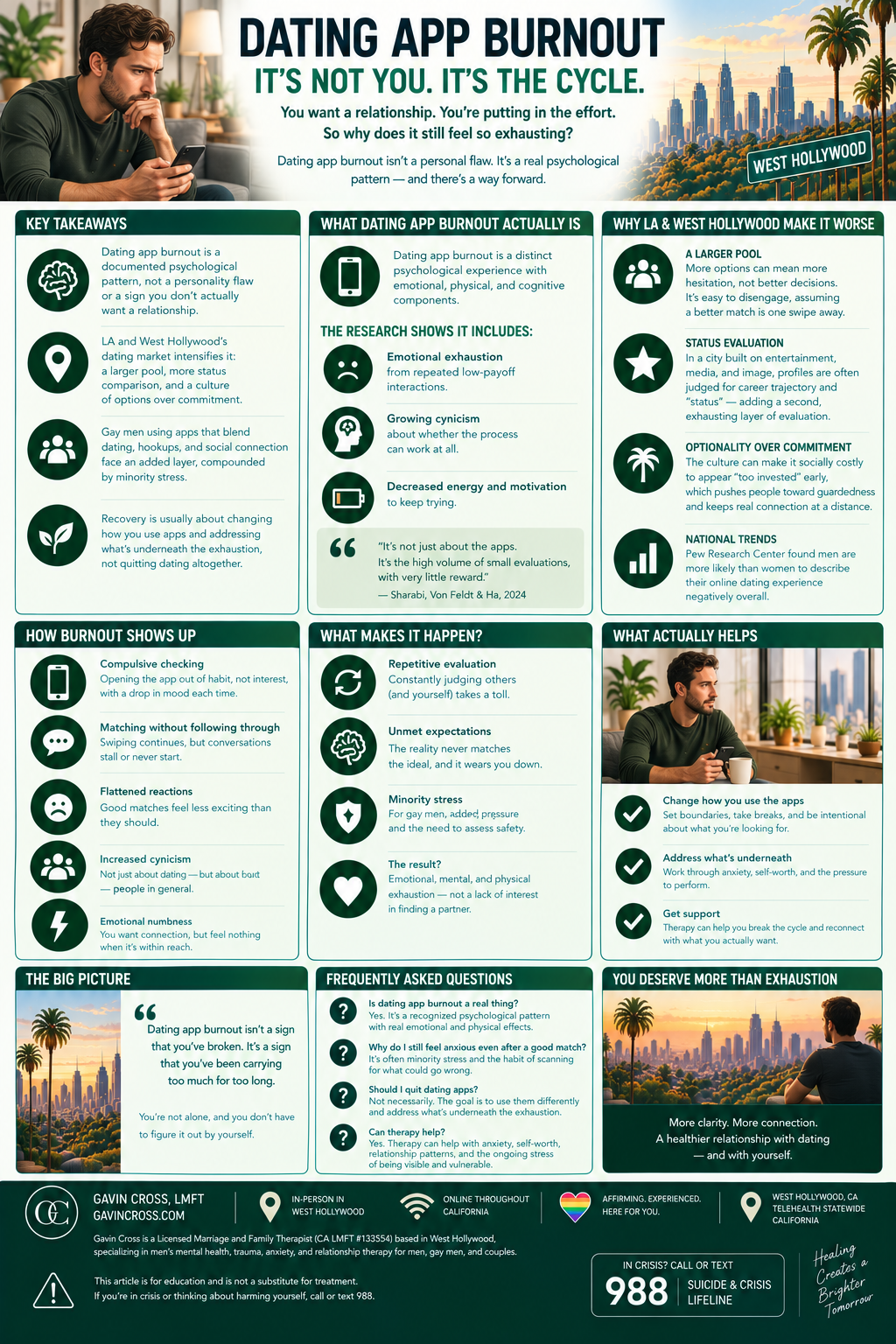
Dating app burnout is not the same as general frustration with being single, and treating it that way tends to lead to the wrong fix. A 2024 study published in the Journal of Social and Personal Relationships examined dating app burnout longitudinally and described it as a distinct experience with emotional, physical, and cognitive components: emotional exhaustion from repeated low-payoff interactions, a growing cynicism about whether the process can work at all, and a decline in the energy or motivation available to keep trying (Sharabi, Von Feldt & Ha, "Burnt Out and Still Single," Journal of Social and Personal Relationships). That structure will sound familiar to anyone who has studied workplace burnout, and the parallel is intentional. Dating apps ask users to perform a high volume of small, repetitive evaluations, of others and of themselves, with very little in the way of consistent reward. That is close to the textbook setup for burnout in any domain.
The distinction matters clinically. Someone who is simply tired of being single usually still feels hopeful and engaged when a good match appears. Someone in dating app burnout often feels flat even when a promising match appears, because the exhaustion has dulled the capacity to feel excited at all. That flatness is frequently the detail that finally gets someone into my office, not the singleness itself.
Dating app burnout is not unique to Los Angeles, but the local market has features that reliably intensify it. A few I see play out consistently with clients:
National survey data backs up how widespread the frustration has become even before layering in LA-specific pressures. Pew Research Center's most recent survey on the experiences of U.S. online daters found that substantial shares of users describe the experience as frustrating, and that men in particular are more likely than women to describe their online dating experience negatively overall (Pew Research Center, The Experiences of U.S. Online Daters). LA's specific market dynamics do not create this frustration from nothing. They amplify a pattern that was already common nationally.
Dating app burnout rarely announces itself directly. It tends to show up as a cluster of smaller behavioral and emotional shifts:
One of the more counterintuitive parts of dating app burnout is that it often coexists with, and can worsen, loneliness. Apps promise constant access to potential connection, yet heavy, prolonged use is increasingly associated with feeling more isolated, not less. The American Psychological Association's most recent national polling on loneliness found that a significant share of U.S. adults report chronic loneliness, with technology-mediated interaction identified as a factor that can substitute for, rather than build toward, the kind of sustained connection that actually reduces loneliness (American Psychological Association, National Polling on Loneliness and Division). If this pattern of increasing isolation despite constant digital contact sounds familiar, I go into the broader mechanics of it in The Male Loneliness Epidemic, which covers the friendship side of the same underlying pattern.
For gay men, dating app burnout often carries additional weight that a general framing misses. Many of the platforms used in gay dating culture, particularly in a hub like West Hollywood, blend dating, hookups, and social connection into a single app experience, which means the emotional stakes and the sheer interaction volume can run even higher than on apps built purely around long-term dating.
A peer-reviewed study on problematic online dating app use among men who have sex with men found associations between heavier, more compulsive app use and worse mental health and sexual health outcomes, underscoring that this isn't simply a matter of willpower or preference, there is a documented clinical pattern here worth taking seriously (National Institutes of Health, Problematic Online Dating App Use and Mental and Sexual Health Outcomes in Men-Having-Sex-with-Men). This layers directly on top of the minority stress many LGBTQ+ men already carry day to day, which I cover in more depth in Minority Stress 101. Dating app fatigue on top of chronic minority stress is not simply additive, the two tend to compound each other, since both draw on the same limited reserve of emotional bandwidth.
Body image pressure often enters here too. West Hollywood's dating and social culture places significant emphasis on physical appearance, and app profiles make that evaluation explicit and constant in a way in-person dating doesn't. If this dynamic resonates, it connects directly to what I wrote in Body Image Struggles as a Gay Man in Los Angeles, and to the broader exhaustion pattern in Gay Men and Burnout: When the Pressure to Have It All Becomes Too Much.
Dating app burnout responds well to specific, structural changes, more than to willpower or "just staying positive." What I typically work through with clients:
Most dating app burnout resolves with a real break and a shift in approach. But if the exhaustion has been present for months, has started affecting your mood or motivation outside of dating entirely, or feels tied to a longer pattern of avoiding closeness even when you want it, that's worth bringing to a therapist directly rather than assuming another app break will fix it. Burnout is often the visible symptom. What's underneath it, old relationship wounds, an avoidant attachment style, unresolved anxiety, is usually the more useful place to actually do the work.
Dating app burnout is a state of emotional exhaustion, cynicism, and reduced motivation that develops from prolonged, repetitive use of dating apps without meaningful results. Research published in the Journal of Social and Personal Relationships describes it as a distinct pattern with emotional, physical, and cognitive components, similar in structure to workplace burnout, rather than simply being tired of being single.
Los Angeles, and West Hollywood specifically, combines an unusually large, image-conscious dating pool with industry-driven status comparison and a culture that often prioritizes options over commitment. That combination increases the volume of interactions people manage while lowering the odds that any single one leads anywhere, which accelerates the exhaustion and cynicism at the core of dating app burnout.
No. Dating app burnout is a reactive state caused by the specific mechanics of app-based dating, constant evaluation, low follow-through, and repetitive low-stakes interactions, not a fixed personality trait or a lack of interest in relationships. Many people who experience it strongly want a relationship and are burned out specifically because they have been trying hard for a long time without proportional results.
Research on men who have sex with men and dating app use has found associations between heavy or compulsive use and worse mental health and sexual health outcomes, layered on top of the minority stress many LGBTQ+ men already carry. In gay dating culture specifically, apps often combine dating, hookups, and social connection in one platform, which can intensify both the volume of interactions and the emotional toll of app use.
Recovering from dating app burnout typically involves taking a defined break rather than an indefinite one, shifting from volume-based swiping to a smaller number of intentional conversations, examining whether underlying patterns like anxiety or avoidance are driving compulsive use, and in some cases working with a therapist to address the deeper relationship patterns the burnout is surfacing.
Wanting connection and being exhausted by the current way you're pursuing it are not contradictions, and you don't have to choose between giving up on dating and pushing through burned out. I work with men throughout Los Angeles and West Hollywood on exactly this pattern through men's therapy in West Hollywood and LGBTQ therapy, in person or through online therapy for California residents.
If you're not sure therapy is the right next step yet, Finding the Right Therapist is a good place to start. Contact Gavin Cross LMFT when you're ready to stop treating dating like a second job.
There’s a big, beautiful world out there. You deserve to experience all it has to offer.
Let’s rediscover your strength.
